
The One Big Beautiful Bill Act (OBBBA), signed into law on July 4, 2025, is the most significant tax legislation since the Tax Cuts and Jobs Act of 2017. Whether you run a sole proprietorship, an LLC, or a corporation, the new law contains provisions that could meaningfully reduce your tax burden. Here is a breakdown of the key changes every small business owner should understand.
100% Bonus Depreciation Is Back and Permanent
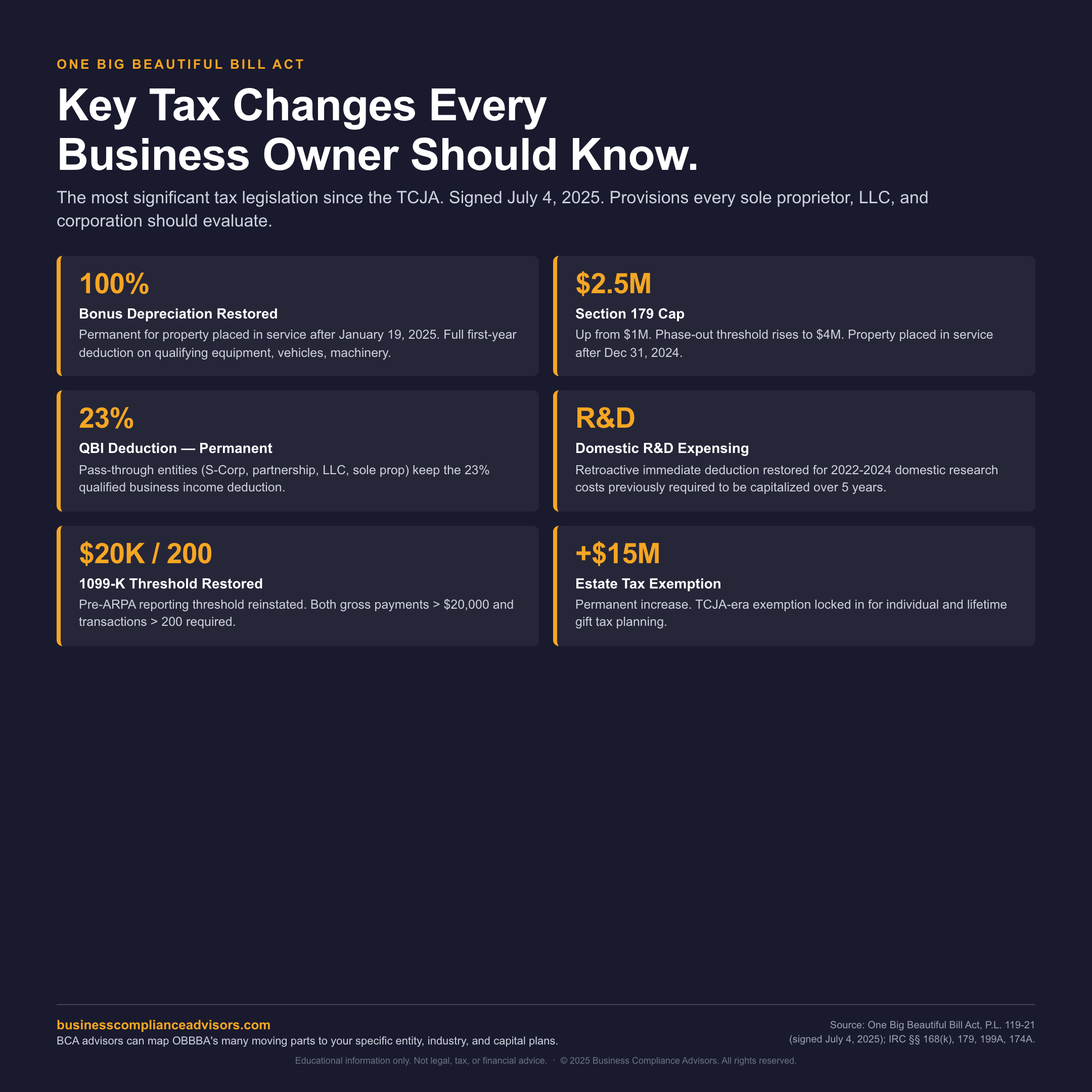
One of the most impactful provisions is the permanent restoration of 100% first-year bonus depreciation for qualified property acquired after January 19, 2025. Under the Tax Cuts and Jobs Act of 2017, bonus depreciation had been phasing down (80% in 2023, 60% in 2024). You can now deduct the entire cost of equipment, vehicles, and machinery in the year of purchase rather than depreciating over several years.
Section 179 Expensing Jumps to $2.5 Million
The Section 179 deduction cap has been increased from $1 million to $2.5 million, with the phase-out threshold rising to $4 million for property placed in service after December 31, 2024. This allows small businesses to immediately expense qualifying purchases rather than capitalizing and depreciating them. With 46 states conforming to Section 179, the state-level benefits are substantial as well. Business owners should evaluate whether Section 179 or bonus depreciation provides greater overall tax savings, particularly when considering state tax conformity.
R&D Expenses Are Immediately Deductible Again
The TCJA had imposed a requirement starting in 2022 that domestic research and development expenditures be capitalized and amortized over five years rather than deducted immediately. The OBBBA reverses this and permanently restores immediate expensing for domestic R&D costs incurred after December 31, 2024.
For small businesses with average gross receipts under $31 million over the prior three years, the law also provides retroactive relief. These businesses can file amended returns to claim immediate R&D deductions for tax years 2022 through 2024, recovering deductions that were previously lost to the capitalization requirement.
SALT Deduction Cap Raised to $40,000
The state and local tax (SALT) deduction cap increases from $10,000 to $40,000 for taxpayers earning under $500,000, with an additional 1% annual increase beginning in 2026. This temporary provision reverts to $10,000 in 2030. If you own a business in a high-tax state like California, New York, New Jersey, or Illinois, this increase could meaningfully reduce your state and local tax burden.
No Tax on Tips and No Tax on Overtime
The OBBBA introduces new deductions for tips (up to $25,000 per return) and overtime pay (up to $12,500 individual, $25,000 joint). These apply to tax years 2025 through 2028 and phase out for taxpayers with modified adjusted gross income above $150,000 ($300,000 for joint filers). While these primarily benefit employees, business owners in service industries should be aware of how these changes affect their workforce’s tax planning.
New Vehicle Loan Interest Deduction
A new deduction allows taxpayers to deduct up to $10,000 annually in interest paid on qualified passenger vehicle loans for vehicles with final assembly in the United States. This applies to loans incurred after December 31, 2024, and is available through 2028. Qualifying vehicles include cars, vans, SUVs, pickup trucks, and motorcycles with a gross vehicle weight under 14,000 pounds.
Enhanced Child Tax Credit and Senior Deduction
The Child Tax Credit has been permanently increased to $2,200 per child and will be adjusted annually for inflation. Taxpayers age 65 and older receive an additional $6,000 deduction for tax years 2025 through 2028, on top of the existing senior standard deduction.
What You Should Do Now
BCA recommends small business owners take the following steps: review your capital expenditure plans to take advantage of 100% bonus depreciation and the increased Section 179 limits; consult with your tax advisor about retroactive R&D deduction claims if applicable; reassess your estimated tax payments given the SALT cap increase; and plan for the vehicle loan interest deduction if you are financing a U.S.-assembled vehicle. These provisions represent real opportunities to reduce your tax liability, but many require proactive planning to maximize the benefit.
Disclaimer: This article is for informational purposes only and is not legal, tax, or financial advice. BCA is not a licensed professional services firm. We help clients assess their situations and work with licensed attorneys, tax advisors, and other qualified professionals on your behalf. Read our full Disclaimer and Terms of Use. Have questions? Contact BCA and let us put the right team together for you.
Sources and Further Reading
- IRS One Big Beautiful Bill Provisions: irs.gov
- IRS Tax Deductions for Working Americans and Seniors: irs.gov
- RSM US OBBBA R&D Tax Analysis: rsmus.com
- Baker Tilly OBBBA Deep Dive: bakertilly.com
- H&R Block OBBBA Tax Guide: hrblock.com