

IRS used the start of July to remind businesses that seasonal and part-time hiring still comes with payroll work. That point sounds basic until a busy restaurant, retailer, event company, lawn-care business, farm, or summer program starts putting people on the schedule before the tax setup is done.
The short version: temporary does not mean informal. If the person is an employee, the business still needs wage records, withholding, Social Security and Medicare tax handling, and the right employment tax return process.
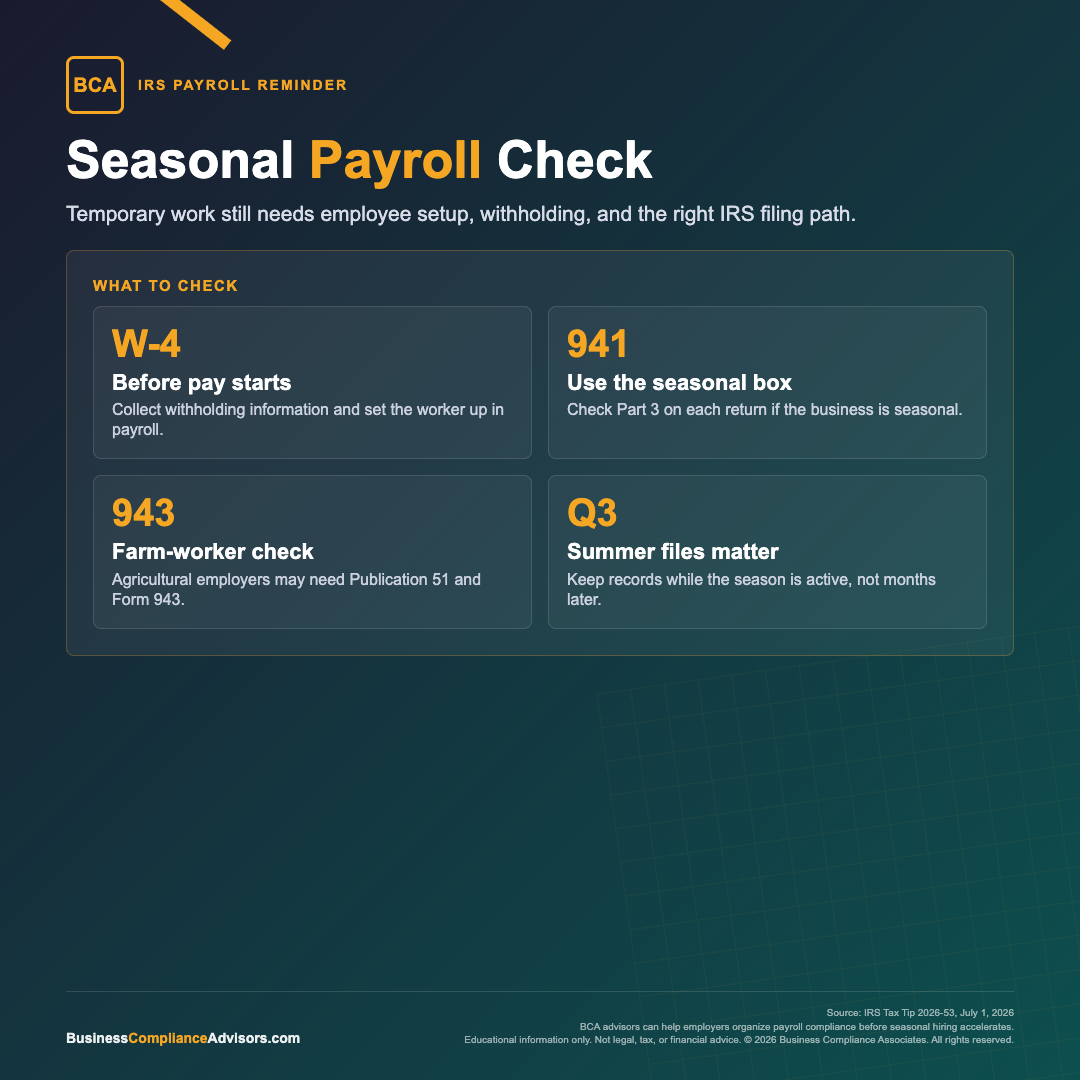
Start before the first shift
Get the worker classified correctly before hours are worked. If the worker is an employee, collect the onboarding documents, set up payroll, and make sure the payroll system knows whether the business operates seasonally.
IRS says seasonal and part-time employees are subject to the same federal income tax withholding, Social Security, and Medicare tax rules as other employees. The fact that the worker is only helping for summer, weekends, events, or a short production run does not remove those rules.
Form 941 has a seasonal employer box
Seasonal employers generally don’t have to file Form 941 for quarters when they had no tax liability because no wages were paid. The IRS reminder points to a simple control: check the seasonal employer box in Part 3 of every Form 941 the business does file.
That box matters because it tells the IRS not to expect a return for every quarter of the year when the employer has at least one taxable return on file. Skip that step, and a seasonal business can create avoidable IRS notices.
Farm work has its own path
Businesses that employ farm workers shouldn’t assume Form 941 is the answer. IRS points agricultural employers to Publication 51, Agricultural Employer’s Tax Guide. Farm payroll may involve Form 943 instead of the ordinary quarterly Form 941 path.
That is a workflow issue, not just a tax issue. The person running hiring needs to know which payroll form applies before the first filing deadline arrives.
What BCA readers should do
Before seasonal hiring ramps up, build a short checklist: worker classification, Form W-4, payroll tax setup, state payroll registration if needed, Form 941 seasonal box review, and a separate farm-worker check if agricultural labor is involved.
The goal isn’t to slow down hiring. The goal is to keep summer staffing from turning into fall payroll cleanup.
Sources
- Internal Revenue Service, “Tips for businesses hiring seasonal or part-time employees,” Tax Tip 2026-53, July 1, 2026. https://www.irs.gov/newsroom/tips-for-businesses-hiring-seasonal-or-part-time-employees
- Internal Revenue Service, “Part time or seasonal help.” https://www.irs.gov/businesses/small-businesses-self-employed/part-time-or-seasonal-help
- Internal Revenue Service, “Publication 15 (2026), Employer’s Tax Guide.” https://www.irs.gov/publications/p15
Disclaimer
This article is for general educational purposes. It is not legal, tax, payroll, financial, or regulatory advice. Rules can change, and the right answer depends on the facts. BCA can help readers organize the issue and coordinate with the appropriate licensed advisor when needed.