If you negotiated a debt settlement, walked away from a credit card balance, or had a loan written off, you may receive a Form 1099-C the following January. It looks like a routine tax document. It is not. The amount on that form is generally taxable income to you.
Most consumers learn this the year after they thought they had resolved a debt problem, when they file their tax return and the unexpected income arrives. The amount can be substantial. A $20,000 credit card balance settled for $8,000 generates a $12,000 1099-C, which can push you into a higher tax bracket and increase what you owe by several thousand dollars.
The good news: there are legitimate ways to reduce or eliminate the tax impact, but they require active filing on your part. Doing nothing is the worst option, because the IRS already has a copy of the 1099-C from the creditor.
This post covers what the form means, the exclusions available to most consumers, the most common mistakes, and when to bring an advisor in.
What a 1099-C is
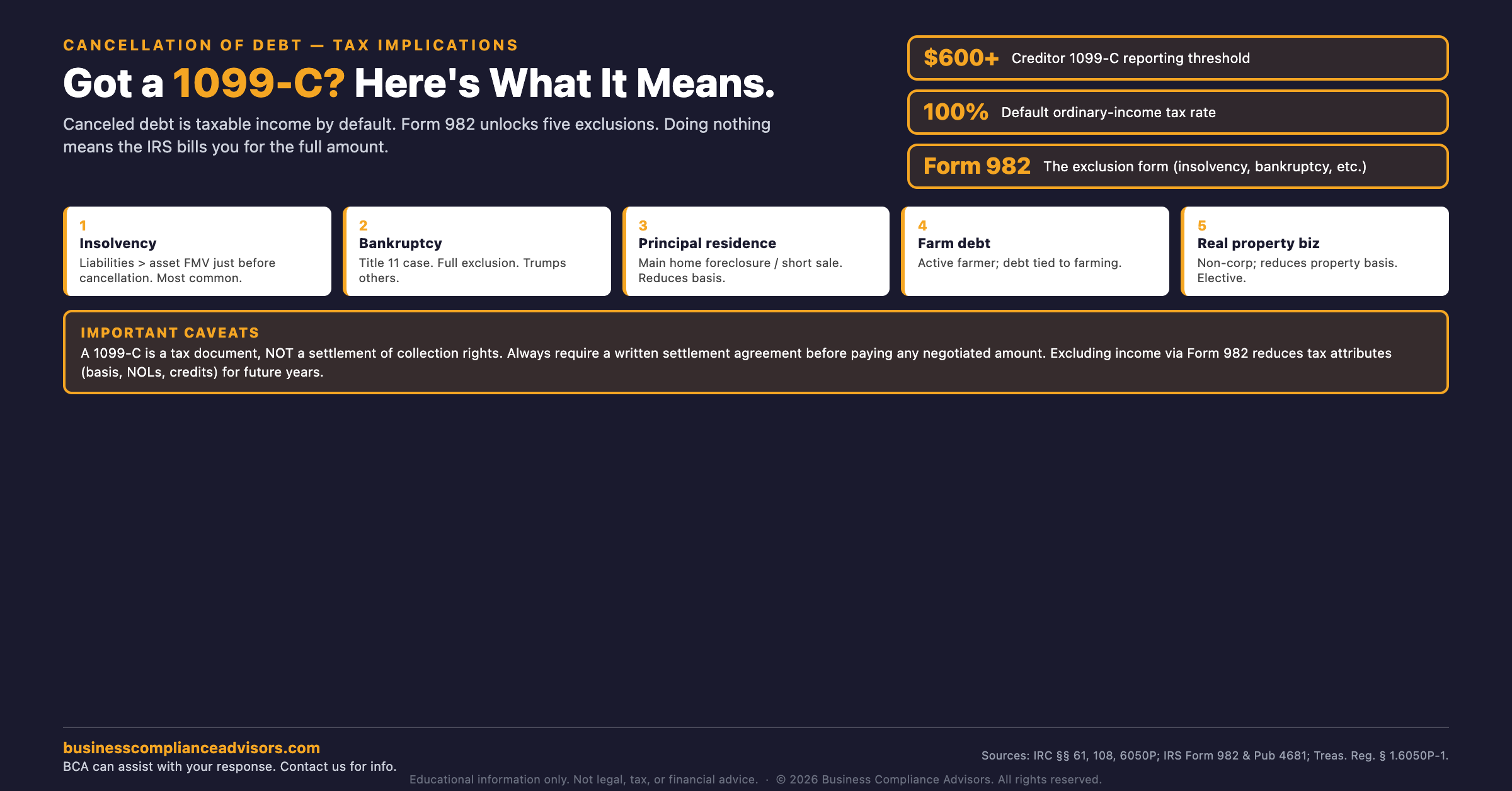
Form 1099-C, “Cancellation of Debt,” is filed by a creditor with the IRS when they cancel $600 or more of a debt. Common triggers:
- A credit card issuer accepts a settlement for less than the full balance.
- A lender writes off a defaulted loan after the statute-required testing period.
- A medical provider forgives a hospital bill.
- A mortgage servicer forecloses on a property and the sale doesn’t cover the loan.
- A creditor gives up trying to collect after a long period of nonpayment.
The amount in Box 2 is what the IRS treats as canceled debt. Under Internal Revenue Code section 61, canceled debt is gross income unless an exclusion applies. The default rule is taxation; the exclusions are the relief.
What does NOT count as cancellation
A 1099-C is sometimes issued in error or for amounts that are not actually taxable to you:
- Gifts. A truly forgiven debt from a family member that is structured and documented as a gift is not taxable to you (it may have gift-tax consequences for the giver, but that is their issue, not yours).
- Disputed debts. If you never actually owed the underlying amount, the cancellation is not taxable. You must be prepared to prove the debt was disputed.
- Refunds and price adjustments. A retailer adjusting a billing error is not canceling debt.
- Already-discharged-in-bankruptcy debts. A 1099-C arriving for a debt that was discharged in your prior bankruptcy is generally not additional taxable income, but you do still need to handle the form correctly on your return.
The five most common exclusions
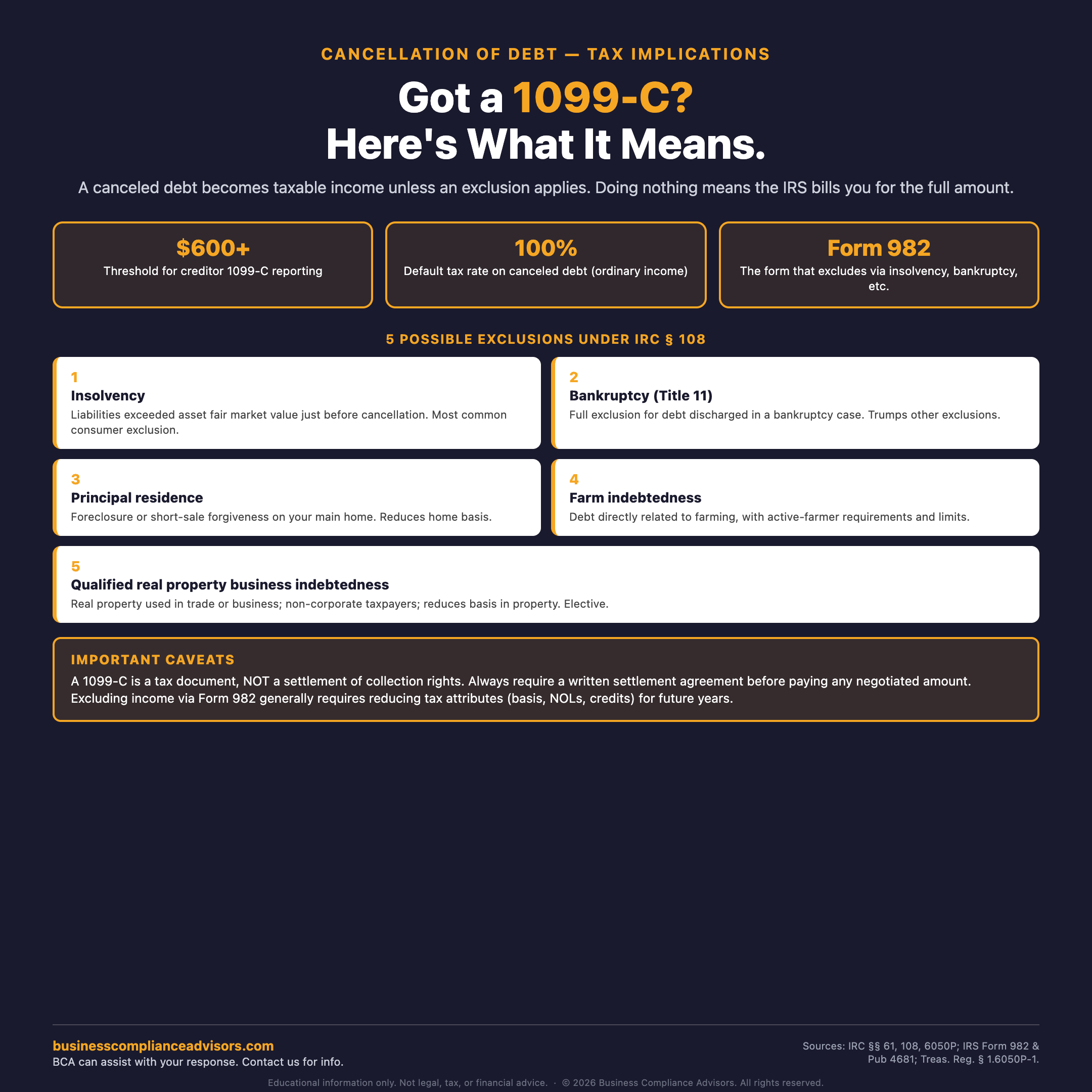
Under IRC § 108, several exclusions can reduce or eliminate the tax on canceled debt. The most common for individuals:
1. Insolvency exclusion (the one most people need)
If you were “insolvent” immediately before the debt was canceled, you can exclude the canceled amount up to the amount of your insolvency.
Insolvency means your total liabilities exceeded the fair market value of your total assets just before the cancellation. This is computed dollar-for-dollar:
- Total all your debts the moment before cancellation (the canceled debt itself counts in the total, and so do all other debts: credit cards, mortgages, student loans, medical bills, taxes owed, etc.).
- Total the fair market value of all your assets immediately before cancellation (cash, retirement accounts, vehicles, real estate, investments, business interests, retirement plan vesting, even pension cash-out value).
- If liabilities exceed assets, you are insolvent by the difference.
Example: $35,000 of canceled credit card debt, but at the moment of cancellation you had $80,000 in total liabilities and $50,000 in total assets. You are insolvent by $30,000. You can exclude $30,000 of the $35,000 1099-C; the remaining $5,000 is taxable.
The insolvency exclusion is claimed by filing Form 982 with your tax return, checking box 1b, and entering the excluded amount on line 2. You also have to attach an insolvency worksheet (or be prepared to produce one if asked) showing the math.
2. Bankruptcy exclusion
Debt discharged in a Title 11 bankruptcy proceeding is fully excluded under IRC § 108(a)(1)(A). This trumps any other exclusion. If the cancellation happened as part of your bankruptcy case, file Form 982, check box 1a, and the entire amount is excluded.
3. Qualified principal residence indebtedness
If the canceled debt was secured by your principal residence and was used to buy, build, or substantially improve that residence, a special exclusion may apply. The provision has been extended several times by Congress and the rules vary by year. If you had a foreclosure, short sale, or principal-residence loan modification with debt forgiveness, this exclusion is the one to check first. The amount excluded reduces your basis in the home (a future tax consequence to plan for).
4. Qualified farm indebtedness
If the debt was directly related to a farming business and you are an active farmer, IRC § 108(a)(1)(C) provides an exclusion subject to certain limits. Specialized; if it applies, get advisor help.
5. Qualified real property business indebtedness
For taxpayers other than C corporations who had debt cancellation on real property used in a trade or business, IRC § 108(a)(1)(D) provides an elective exclusion that reduces basis in the underlying property.
How to actually file
Receiving a 1099-C and excluding the income from tax requires both pieces. Reporting alone, without filing Form 982, results in tax on the full amount. Filing Form 982 without the underlying income reporting can trigger an IRS notice.
The standard sequence:
- Report the canceled debt as income on Schedule 1 (Form 1040), line 8c “Cancellation of debt” (the line number can shift year to year; the 2025 Form 1040 instructions are authoritative for 2025 returns being filed now).
- File Form 982 with the relevant box checked (1a bankruptcy, 1b insolvency, 1d qualified principal residence indebtedness, etc.) and the excluded amount on line 2.
- Reduce tax attributes as required on Form 982 lines 4-13. The exclusion is not free: in exchange for not paying tax now, you may have to reduce things like net operating losses, tax credit carryovers, or basis in property.
- Keep your insolvency worksheet if claiming insolvency. The IRS does not require it to be attached, but they can request it during a review.
Common mistakes BCA expects to see
- Ignoring the 1099-C. The IRS already has a copy. Skipping it produces a CP2000 notice the following year with the full amount added to taxable income plus penalties and interest. Filing correctly even if late is much better than not filing.
- Claiming insolvency without doing the math. “I was broke” is not a substitute for the insolvency worksheet. The IRS routinely requests the worksheet on examination.
- Forgetting retirement assets in the insolvency calculation. 401(k) and IRA balances count as assets even though you cannot easily access them. This catches a lot of people who think they were insolvent when they weren’t.
- Confusing 1099-C with debt extinguishment. Receiving a 1099-C does not always mean the creditor cannot still try to collect on the underlying debt. The form is a tax document; collection rights are separate. Always demand a written settlement agreement before paying any negotiated amount, and confirm in writing that the creditor will not attempt further collection.
- Filing without addressing the basis or attribute reduction. The Form 982 attribute-reduction step is not optional when you exclude debt. Skipping it can have consequences in future tax years (e.g., when you sell a property whose basis should have been reduced).
When to bring BCA in
Three scenarios where the right move is a call before you file:
- You received a 1099-C and the dollar amount is more than $5,000-$10,000. The math on insolvency, attribute reduction, and which exclusion to elect benefits from a second look.
- You received a 1099-C for a debt that was part of a divorce, a co-signed loan, or a business obligation. The default treatment is rarely the right answer.
- You received a 1099-C for a debt you genuinely do not believe you owed, or for an amount that does not match what was actually forgiven. The dispute path matters and has timing implications.
BCA advisors bring business and compliance experience to evaluating debt cancellation. We help you organize the records, advise on which exclusion fits your situation, walk through the insolvency math, and weigh the attribute-reduction tradeoffs. The forms you file go out under your name; our role is to advise and assist, not to substitute our voice for yours.
Sources
- Internal Revenue Code §§ 61(a), 108(a)-(d), 6050P.
- Treasury Regulations § 1.6050P-1.
- IRS Form 982, “Reduction of Tax Attributes Due to Discharge of Indebtedness,” and instructions.
- IRS Form 1099-C, “Cancellation of Debt,” and instructions.
- IRS Publication 4681, “Canceled Debts, Foreclosures, Repossessions, and Abandonments.”
- IRS Tax Topic 431, “Canceled Debt — Is It Taxable or Not?”
This information is provided for general educational purposes and reflects opinions based on experience. Individual circumstances vary considerably in cancellation-of-debt situations. The interaction between the insolvency exclusion, attribute reduction, basis adjustments, and other Code provisions can be complex. BCA advisors bring business and compliance experience to help you evaluate documentation, advise on which exclusion fits, and weigh the planning options before filing.