If you carry credit card debt across multiple cards, the question is rarely whether to pay it down. It is which dollar to put where, in what order, and what the consequences look like if your situation forces a different path than you planned.
This guide is for two readers. The first is the owner-operator who bootstrapped a business on personal cards or covered cash-flow gaps with personal credit and is now sitting on balances that need a real paydown plan. The second is the household carrying multiple cards and trying to choose between approaches without falling for the personal-finance industry’s louder voices.
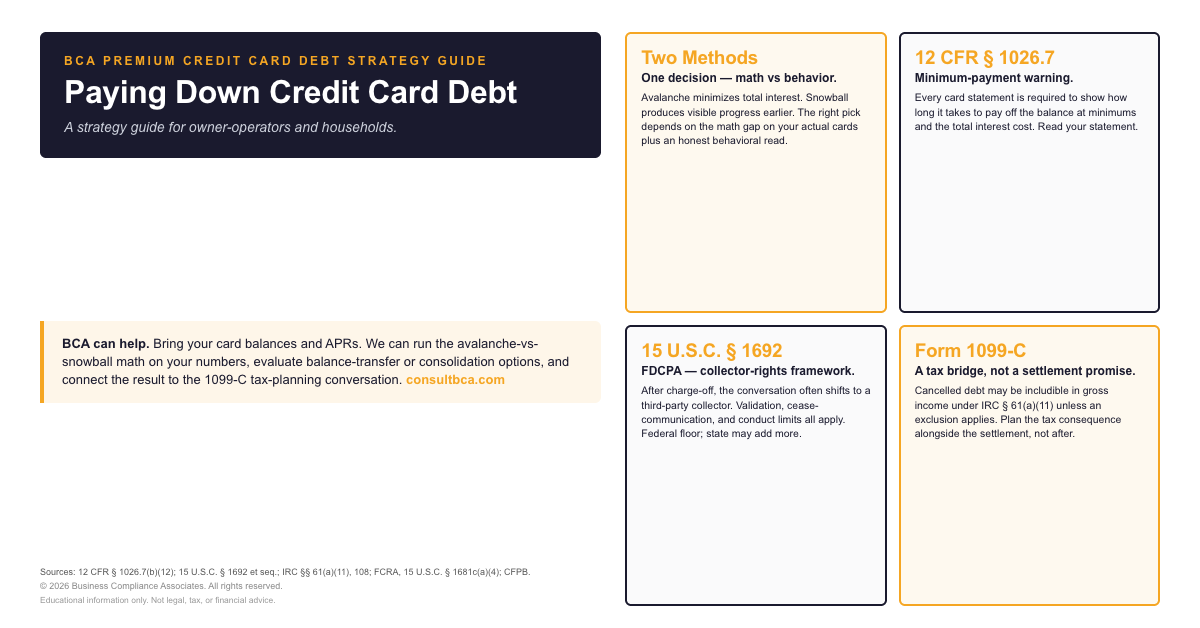
Below: a public-side framework covering the two named methods (avalanche and snowball), the minimum-payment math that traps balances at status quo, and the basic shape of balance-transfer offers. The full operational decision logic, the harder sections on what happens when a card reaches charge-off, the FDCPA collector-rights framework, three worked minimum-payment examples, and the bridge to the 1099-C tax exposure that catches people the year after a settlement are gated for BCA Premium and beta members.
Out of scope: bankruptcy planning (consult a bankruptcy attorney if you are considering that path), credit-score gaming or repair tactics, IRS resolution work (covered separately in BCA’s IRS Enforcement Field Manual), specific lender or product recommendations, real-time APR shopping, and any state-specific legal advice. The piece names categories where each of those exists; it does not become any of them.
1. Avalanche vs. Snowball, at Consumer-Finance Baseline
Two named methods dominate the conversation. Both rely on the same prerequisite: enough monthly cash flow to make at least the minimum on every card, every month. Neither method works if minimums are not getting paid; that situation is a different problem with different math, covered later in the guide.
The avalanche method sends every dollar of extra payment beyond the minimums to the card with the highest interest rate, regardless of balance size. Once that card is paid off, the avalanche rolls onto the card with the next-highest rate. Mathematically, avalanche minimizes total interest paid, all else equal. There is no contested math here; the highest-APR balance accrues interest fastest, so paying it down first reduces lifetime interest cost.
The snowball method sends every dollar of extra payment beyond the minimums to the card with the smallest balance, regardless of interest rate. Once that card is paid off, the snowball rolls onto the next-smallest balance. Mathematically, snowball costs more in total interest than avalanche, often noticeably more on long horizons. The case for snowball is not mathematical. It is behavioral: paying a card to zero produces a visible milestone that some borrowers find easier to follow through on than a long-horizon plan with no visible progress for the first year. For borrowers who execute long-horizon plans without that signal, avalanche is dominant. For borrowers who have started multi-month plans before and stopped, the snowball’s early payoff may be worth the extra interest cost.
Either method requires the same operational discipline. List every card with its current balance and its current APR. Confirm the minimum on each. Identify the total monthly amount you can commit to debt paydown — minimums plus extra. Direct the extra to the targeted card under whichever method you pick. Recompute the picture every two or three months as balances move and APRs occasionally reset.
The full guide’s Section 4 covers how to actually choose between these two given your specific numbers and behavioral profile. Section 5 covers the related “one card vs spread across all” question that the two-method framing doesn’t answer.
2. The Minimum-Payment Trap
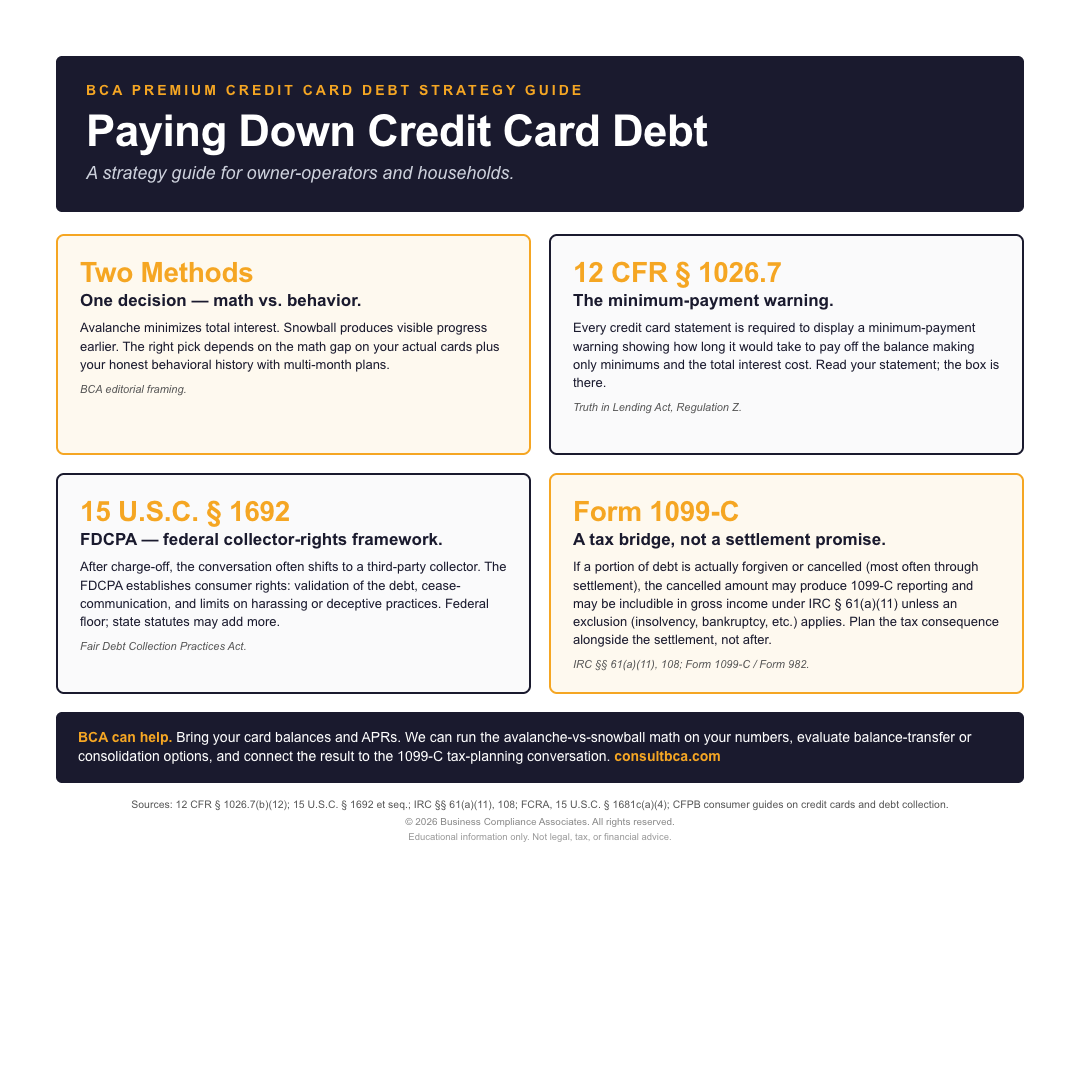
Every credit card statement in the United States is required to display a minimum-payment warning showing how long it would take to pay off the current balance making only the minimum payment, and how much total interest that would cost. The disclosure is required under federal Regulation Z (12 CFR § 1026.7(b)(12)), part of the Truth in Lending Act framework. Read your most recent statement; the box is there.
The math behind that warning is the trap. Minimum payments are typically structured as a small percentage of the balance plus accrued interest, with a floor (often around $25-$35). On a balance of any meaningful size, paying the minimum covers the interest plus a small slice of principal — and the next month’s interest is computed against the remaining principal, which barely moved. Years of payment, mostly to interest. Decades on a large balance.
Below is an illustration computed under stated assumptions: a $5,000 balance at 22% APR, minimum payment formula of 1% of balance plus accrued interest with a $25 floor. Under those assumptions, paying only the minimum takes roughly 17 years and costs roughly $5,800 in total interest — more than the original balance. Different APR, different formula, different numbers — your statement will reflect different math.
3. Balance Transfer, the Basic Shape
Balance transfer offers move debt from a high-APR card to a different card with a low-or-zero introductory APR. The structural pieces to understand:
The transfer fee, commonly 3-5% of the transferred balance, is paid up front. On a $10,000 transfer at a 4% fee, that is $400 added to the new balance.
The introductory APR window, commonly 12-21 months at 0% or a low rate, is when interest is suppressed. After the window closes, the rate jumps to the post-promotional APR, which may be higher than the original card.
The post-promotional APR applies to whatever balance remains when the window ends. Anything not paid off by then accrues interest at the new rate.
Balance transfer math works when the borrower can pay off (or substantially pay down) the transferred balance during the introductory window. The savings are the suppressed interest during the window, minus the transfer fee. Over a full payoff inside the window, the savings on a high-APR balance can be meaningful.
Balance transfer math fails when the borrower cannot pay down the transferred balance during the window, or when the new card sits unused while the borrower keeps spending on the old card. The transfer fee becomes a sunk cost; the post-promotional APR catches the remaining balance; and the borrower now has two cards with debt instead of one.
The full guide’s Section 8 covers the analytical framework — breakeven, sensitivity to actual paydown speed, and when consolidation by personal loan beats balance transfer.
Closing
The math behind credit card debt is unforgiving when minimum payments are the only payments. It rewards extra payment heavily, especially in the early months when balances are highest and interest is accruing fastest. The two named methods (avalanche and snowball) frame the question of which card to target first, but the operational decision turns on the math gap between methods on your actual cards plus an honest read of your behavioral history with multi-month plans.
What’s inside the full guide for BCA Premium and beta members:
- The operational decision logic for choosing avalanche, snowball, or a hybrid based on your numbers and behavioral profile (§4)
- One-card-vs-spread concentration discipline, including the two situations where it gets tested (§5)
- What happens when a card reaches charge-off — the consequences, the FFIEC framework, the credit-report impact, and the triage decision when it surfaces (§6)
- The federal FDCPA collector-rights framework and how state statutes of limitations interact with collection lawsuits (§7)
- The analytical balance-transfer and consolidation framework, with the math sensitivities that determine whether each works (§8)
- Three worked minimum-payment-trap examples at $5K, $15K, $30K, with stated assumptions (§9)
- Rebuilding credit during paydown without re-leveraging (§10)
- The 1099-C tax bridge to BCA’s Phase 1 post on cancellation-of-debt income (§11)
Companion artifact (printable, Premium download): the Credit Card Paydown Decision Aid — one-page decision flow that takes you from cash-flow reality to recommended method, with the minimum-payment trap mini-table for quick reference.
For the tax side of debt forgiveness specifically, see BCA’s 1099-C Cancellation of Debt guide. For ongoing IRS exposure and tax compliance after the debt situation is resolved, see BCA’s IRS Enforcement 2026 Field Manual.
Beta access to BCA Premium is currently open at no cost while we continue to expand the library. Join here →
BCA can advise and assist with the actual paydown plan — running the avalanche-vs-snowball math on your cards, evaluating balance transfer or consolidation options, and connecting the result to the 1099-C tax-planning conversation if any debts are likely to be settled. Contact us for info.