
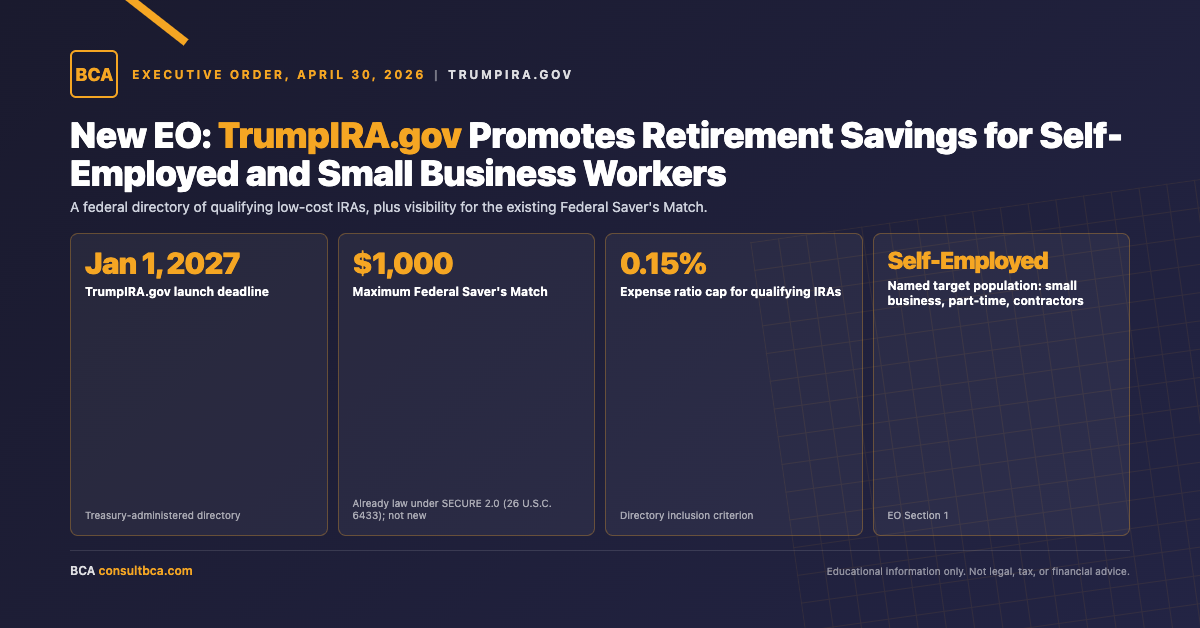
President Trump signed an Executive Order on April 30, 2026 establishing TrumpIRA.gov, a federally administered website that will direct American workers to qualifying private-sector individual retirement accounts and to the Federal Saver’s Match. The Order is targeted at workers without access to employer-sponsored retirement plans, including small business employees, part-time workers, independent contractors, and the self-employed.
The full text of the Order is published at whitehouse.gov/presidential-actions/. Implementation is directed by Treasury, with a January 1, 2027 deadline for the website launch.
What the Executive Order does
The Order has six operational sections beyond the policy statement.
Establishes TrumpIRA.gov. Treasury must build the site by January 1, 2027. The site will list IRAs offered under 26 U.S.C. 408 by private-sector financial institutions that meet specified criteria, allow individuals to filter and select among them, and explain the Federal Saver’s Match.
Sets qualifying-IRA criteria for inclusion. To appear on TrumpIRA.gov, an IRA product must:
- Offer investment options that include life-cycle or target-date funds, balanced funds, or principal-protection funds (per existing DOL standards at 29 C.F.R. 2550.404c-5(e)(4));
- Have net expense ratios at or below 0.15%, inclusive of operating, management, and administrative costs; and
- Have no minimum contribution or balance requirements.
Promotes the Federal Saver’s Match. This is a federal contribution of up to $1,000 to qualifying retirement accounts for low- and moderate-income savers. The Saver’s Match was enacted by SECURE 2.0 (Public Law 117-328, Division T) and is codified at 26 U.S.C. 6433. The Order does not create or change the Saver’s Match. It directs Treasury to take steps to ensure qualifying contributors receive the match and to encourage financial institutions to accept it.
Directs guidance on tax-exempt contributions. Treasury and the IRS are directed to provide guidance on the tax treatment of contributions made by tax-exempt organizations to IRAs maintained by workers in a charitable class, without jeopardizing the organizations’ tax-exempt status.
Directs worker protection regulations. Treasury and the Department of Labor are directed to issue regulations, exemptions, or guidance to ensure that IRAs maintained by financial institutions, including those listed on TrumpIRA.gov, protect workers, maintain transparency, and prevent prohibited transactions under 26 U.S.C. 4975.
Directs legislative recommendations. Treasury, in consultation with the Assistant to the President for Economic Policy, is directed to prepare legislative recommendations to codify the policy.
What the Executive Order does NOT do
The Order does not change the Federal Saver’s Match itself, the contribution limits for IRAs, or the income thresholds for the Match. It does not create a new tax shelter or a new account type. It does not require any private-sector financial institution to participate in the directory. It does not grant individuals or businesses any rights enforceable in court. The Order is reversible by future executive action unless Section 6’s legislative recommendation is enacted.
Why this matters for BCA’s audience
The Order’s named target population is the same population BCA serves: small business owners, self-employed workers, independent contractors, and part-time workers. The Federal Saver’s Match (up to $1,000) has been law since 2022 but is rarely surfaced by tax preparers or financial advisors at the time of filing. The EO’s website launch in January 2027 is the visibility play; the underlying federal contribution is already accessible for qualifying savers.
BCA will publish a deeper analysis of what the Order means for self-employed and small business workers, including which IRA products meet the 0.15% expense ratio criterion, how the Saver’s Match works under existing law, and the new compliance question opened by Section 4 for tax-exempt organizations contributing to worker IRAs. That post is scheduled for May 13, 2026.
When to bring BCA in
Three scenarios where the conversation matters now:
- You are self-employed or run a small business with no employer retirement plan and have not opened an IRA. The EO does not change your eligibility for the existing Saver’s Match; you can act now without waiting for TrumpIRA.gov.
- You operate a tax-exempt organization that already supports a charitable class through worker benefits, and you are evaluating whether to contribute to worker IRAs. Treasury and IRS guidance under Section 4 is pending; document any contemplated contribution structure now and revisit when guidance issues.
- You hold an IRA at a brokerage and want to evaluate whether your current product would meet TrumpIRA.gov’s 0.15% expense ratio criterion. BCA can advise on the comparison; the gating criterion is itself a useful lens for evaluating retail IRA products regardless of whether you ever use the federal directory.
BCA’s role is to advise and assist with business and compliance experience. The investment selection, the IRA application, and the federal-tax filings stay yours.
Sources
- The White House. “Promoting Retirement-Savings Access for American Workers by Establishing TrumpIRA.gov.” Executive Order, April 30, 2026. https://www.whitehouse.gov/presidential-actions/
- SECURE 2.0 Act of 2022, Public Law 117-328, Division T.
- 26 U.S.C. 6433 (Federal Saver’s Match).
- 26 U.S.C. 408 (Individual Retirement Accounts).
- 26 U.S.C. 4975 (Prohibited Transactions).
- 29 C.F.R. 2550.404c-5 (Qualified Default Investment Alternatives under ERISA).
This information is provided for general educational purposes and reflects opinions based on experience. Individual circumstances may vary. The Executive Order has been signed but its implementation regulations and the TrumpIRA.gov website are not yet in place; the descriptions in this post are based on the text of the Order itself. The Federal Saver’s Match has additional eligibility requirements (income limits, account types, and contribution rules) under 26 U.S.C. 6433 that depend on the specific facts of the saver. BCA advisors bring business and compliance experience to help you evaluate retirement-savings options against your specific situation; we are not a CPA or licensed financial advisor.