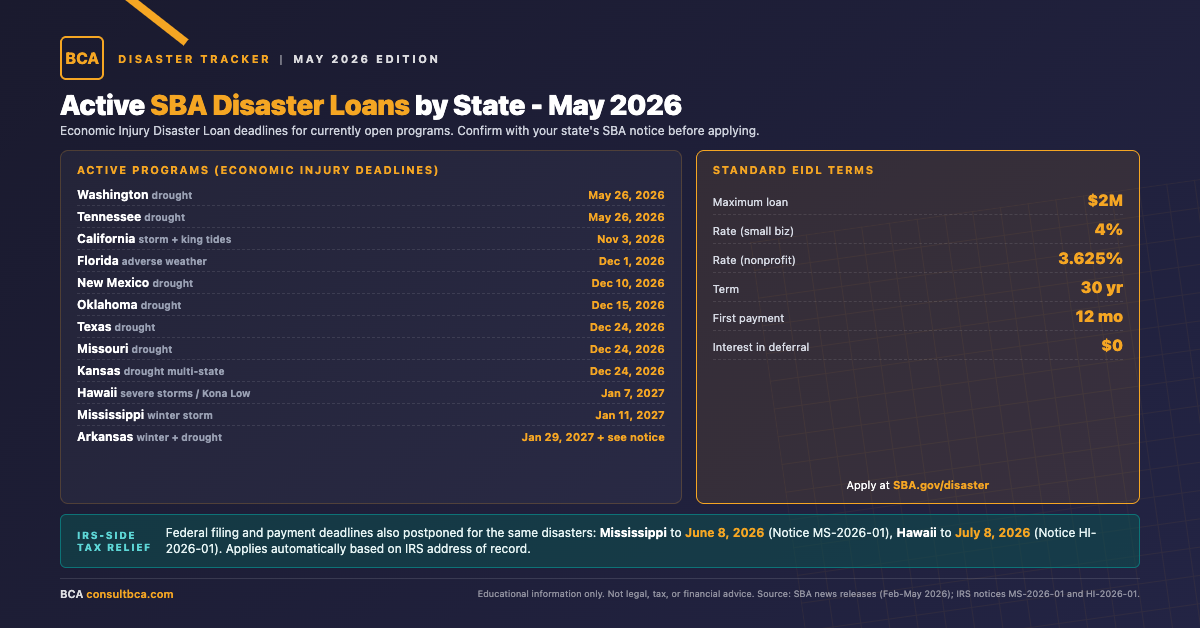
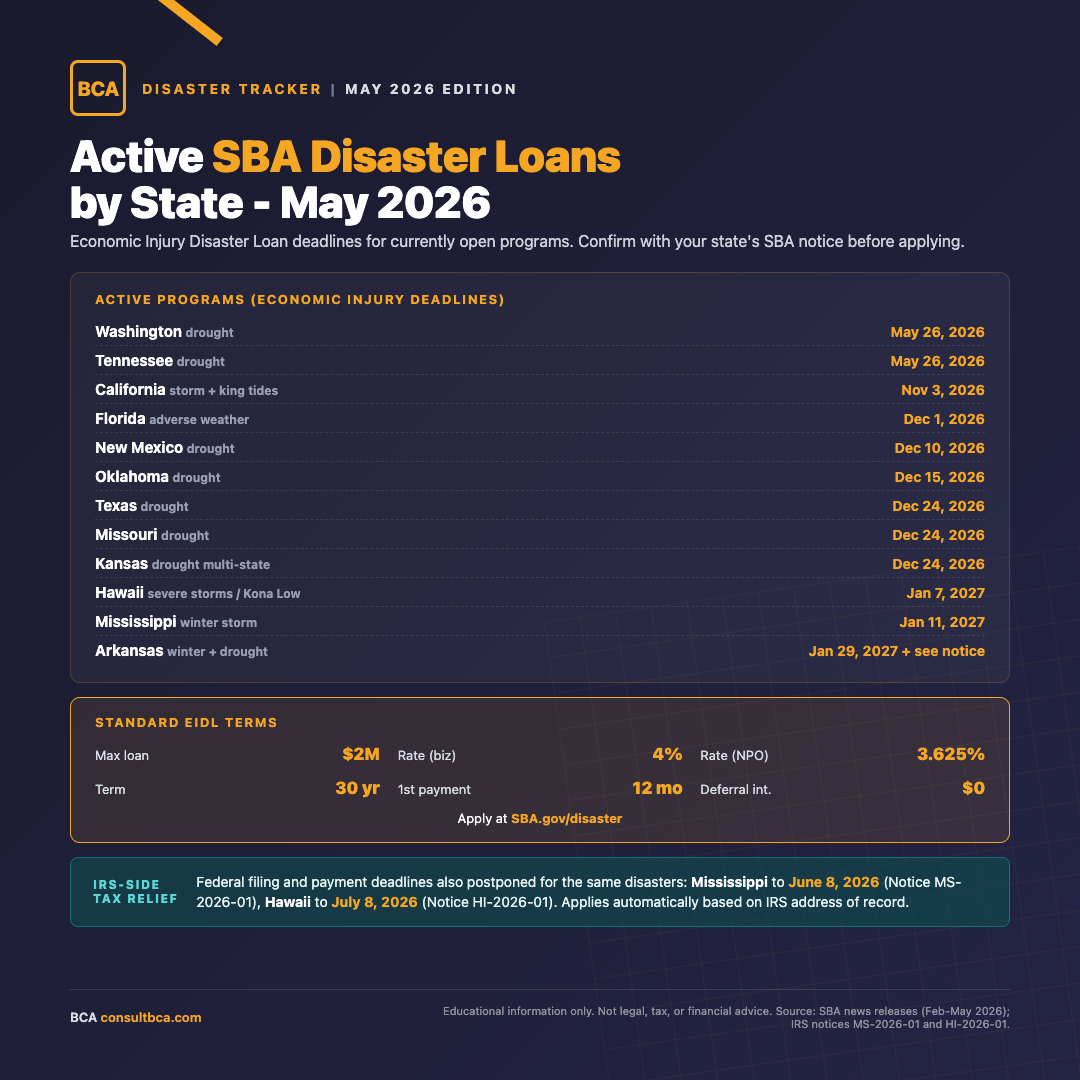
This is the first in what BCA expects to make a recurring monthly format: a snapshot of which states have active SBA disaster loan programs, what the deadlines are, and what the standard terms look like. SBA Economic Injury Disaster Loans, when active for your state, can be one of the most attractive forms of financing available to a small business, because the terms beat almost any commercial product. The announcement for each disaster runs on a single day and then drops off the news cycle. This tracker is the catch-up version.
Currently active SBA disaster loan programs
Two deadline columns matter: the physical-damage deadline (the earlier one, typically two months from declaration) and the economic-injury deadline (typically nine months out). Apply for whichever fits your loss. Where a state’s program is economic-injury only, the physical-damage column is left blank.
| State | Disaster | Onset | Physical Damage Deadline | Economic Injury Deadline |
|---|---|---|---|---|
| Washington | Drought | July 29, 2025 | N/A, EIDL only | May 26, 2026 |
| Tennessee | Drought | Sept. 16, 2025 | N/A, EIDL only | May 26, 2026 |
| Florida | Adverse weather (multiple declarations) | Various 2025-2026 | N/A, EIDL only | December 1, 2026 |
| Mississippi | Severe winter storm | Jan. 23, 2026 | June 10, 2026 | January 11, 2027 |
| Arkansas | Severe winter weather + drought (multi-state) | Jan. 23-26, 2026 + drought additions | N/A, EIDL only | January 29, 2027 (winter); confirm with SBA notice for drought declaration |
| Oklahoma | Drought | Feb. 2026 | N/A, EIDL only | December 15, 2026 |
| New Mexico | Drought | Nov. 2025 | N/A, EIDL only | December 10, 2026 |
| California | Early-January 2026 storm and king tides | Jan. 2026 | April 6, 2026 | November 3, 2026 |
| Texas | Drought (and separate adverse-weather declaration) | Feb. 3, 2026 onset | N/A, EIDL only (drought); see SBA notice (adverse weather) | December 24, 2026 (drought) |
| Missouri | Drought | Per May 1, 2026 SBA notice | N/A, EIDL only | December 24, 2026 |
| Kansas | Drought multi-state (Cherokee County) | Per declaration tied to the May 1 multi-state action | N/A, EIDL only | December 24, 2026 (within the multi-state declaration) |
| Hawaii | Severe storms (Kona Low) | March 10-24, 2026 | June 14, 2026 | January 7, 2027 |
This list is current as of the publish date and may not be exhaustive. New SBA disaster declarations are issued throughout the year. For any state, confirm the current scope and deadlines via the corresponding SBA news release at sba.gov/disaster or the SBA disaster customer service line (800-659-2955). EIDL economic-injury deadlines typically run nine months from the initial declaration; physical-damage deadlines typically run about two months.
A note on the Washington and Tennessee May 26, 2026 deadlines: per the SBA news releases for both states, SBA will accept applications during a 60-day grace period after the May 26 deadline. The grace window does not change the original deadline. Always confirm the current SBA position for your specific declaration before relying on the grace period.
IRS-Side Tax Relief: Filing Deadlines Postponed for Mississippi and Hawaii
The SBA loans above are one form of disaster relief. The IRS provides a separate form: postponement of federal filing and payment deadlines for taxpayers in the same declared disaster areas. The two programs run on different timelines and serve different purposes. Easy to confuse, important to keep separate.
Two IRS postponements are currently active for the same disasters:
| State | IRS Filing/Payment Deadline | IRS Notice | SBA Physical-Damage Loan Deadline | SBA EIDL Deadline |
|---|---|---|---|---|
| Mississippi | June 8, 2026 | MS-2026-01 | June 10, 2026 | January 11, 2027 |
| Hawaii | July 8, 2026 | HI-2026-01 | June 14, 2026 | January 7, 2027 |
The IRS postponement applies automatically to taxpayers whose IRS address of record is inside the declared disaster area. Affected taxpayers do not need to call or file anything to get the relief; it is built in.
Two situations where a phone call is required:
- A business or individual whose IRS address of record is outside the declared area but whose records are inside (for example, a multi-state operator whose bookkeeping is at a Mississippi or Hawaii office). Call IRS Special Services at 866-562-5227 to request the relief.
- A taxpayer who received an IRS late-filing or late-payment notice for the postponement period and needs the penalty abated. Call the number on the notice or the Special Services line above.
The covered returns and payments typically include federal income tax returns and quarterly estimated payments due during the postponement window, payroll tax returns and deposits (with some exclusions for deposits more than the disaster window), and certain excise tax returns. The exact scope is set by the IRS notice for each disaster; consult the notice for specifics.
The IRS relief does not extend SBA loan application deadlines, and an SBA application does not change an IRS deadline. They are separate.
Standard SBA EIDL terms
These terms apply across the program (subject to small program-specific variations):
| Element | Standard Terms |
|---|---|
| Maximum loan amount | $2,000,000 |
| Interest rate, small business | As low as 4% |
| Interest rate, private nonprofit | As low as 3.625% |
| Maximum term | 30 years |
| First payment due | 12 months from initial disbursement |
| Interest accrual during deferral | None (no interest accrues during the 12-month deferral) |
For comparison: a 4% small-business loan with a 12-month deferral and 30-year amortization is materially cheaper financing than the typical SBA 7(a) loan, line of credit, or commercial bank product. The deferral and zero-interest-during-deferral structure make this particularly useful for small businesses that need bridge financing while a disaster’s economic impact resolves.
Who qualifies
Three categories typically qualify for an SBA EIDL after a disaster declaration:
- Small businesses located in the declared county (or in a contiguous county for some declarations).
- Private nonprofit organizations of any size in the declared area.
- Small agricultural cooperatives, small aquaculture enterprises, and most private nonprofit organizations, depending on the specific declaration.
The “small business” determination uses SBA’s industry-specific size standards, which vary by NAICS code. Many independent operators may qualify, but the size test depends on the NAICS code and the terms of the specific declaration. Agricultural producers (separate program) typically apply through USDA rather than SBA.
What “economic injury” actually covers
EIDLs cover working capital and normal operating expenses (payroll, accounts payable, fixed expenses) that the business cannot meet because of the disaster. They do not cover:
- Loss in revenue or anticipated future profit (a different category).
- Refinancing of existing debt.
- Capital expansion or upgrades unrelated to the disaster.
- Repayment of stockholder or principal loans.
Physical-damage loans (a separate SBA product) cover repair or replacement of damaged property, business assets, or inventory.
How to apply
The application is online at SBA.gov/disaster. Applicants need:
- Business and personal financial statements.
- Federal tax returns for the prior year (or a signed Form 4506-C authorizing SBA to obtain them).
- Schedule of liabilities (debts, monthly payments, balances).
- A short narrative describing the economic injury and its causal connection to the disaster.
For applicants outside the declared area whose records are inside the area (a not-uncommon situation for a business with multi-state operations or a remote-records arrangement), call the SBA Special Services line at 866-562-5227 to confirm eligibility before applying online.
What this is not
SBA EIDLs are not grants. They are loans, with personal guarantees typically required, and with the same default-and-collection consequences as any other federally-backed obligation. Small businesses that took COVID-era EIDLs and saw them referred to Treasury for collection know this firsthand (BCA’s April 27 post on the SBA’s $22B referral covered that story).
The current disaster EIDL program is a separate program, but the borrowing-discipline lesson from the COVID experience applies. A 4% loan that you cannot service is still a default waiting to happen.
When to bring BCA in
Two scenarios where the planning conversation matters:
- You qualify for an EIDL but are uncertain whether the loan amount you’d request matches your actual recovery need. Modeling the cash flow with and without the loan, and stress-testing for the post-deferral payment phase, is the conversation worth having before applying.
- You operate in a state that has not yet been declared but where conditions look similar to states that have. BCA can help you watch for a future declaration and have application paperwork ready.
BCA’s role is to advise and assist with business and compliance experience. The application paperwork is yours; we help you decide whether and how much to apply for, and how to integrate the EIDL into the broader financing picture.
Key Takeaways
- As of the May 11, 2026 publish date, this tracker lists active SBA Economic Injury Disaster Loan programs in 12 states (WA, TN, FL, MS, AR, OK, NM, CA, TX, MO, KS, HI), with deadlines spanning May 2026 through January 2027. The list is current as of publish; new declarations may issue throughout the year.
- Two IRS-side filing/payment postponements are running on the same disasters: Mississippi (MS-2026-01, June 8, 2026) and Hawaii (HI-2026-01, July 8, 2026). These are separate from the SBA loan deadlines and apply automatically based on IRS address of record.
- Standard EIDL terms: up to $2 million, rates as low as 4% (3.625% nonprofit), 30-year max term, 12-month payment deferral, no interest accrual during the deferral.
- These are loans, not grants. Personal guarantees typically required. The discipline that applied to COVID-era EIDLs applies here.
- Confirm the deadline and eligibility for your specific state from the SBA news release; deadlines vary by disaster declaration type.
- Apply at SBA.gov/disaster. For records inside a declared area when business is outside, call 866-562-5227.
- BCA can advise on whether and how much to apply for, and how to integrate the EIDL into your broader financing picture.
Sources
- U.S. Small Business Administration. Washington drought relief news release, April 27, 2026.
- U.S. Small Business Administration. Tennessee drought relief news release, April 24, 2026.
- U.S. Small Business Administration. Florida adverse weather news release, April 27, 2026.
- U.S. Small Business Administration. Arkansas severe winter weather news release, April 29, 2026.
- U.S. Small Business Administration. Mississippi severe winter storm news release, April 14, 2026.
- U.S. Small Business Administration. Oklahoma drought news release, April 24, 2026.
- U.S. Small Business Administration. New Mexico drought news release, April 22, 2026.
- U.S. Small Business Administration. California early-January 2026 storm and tidal flooding news release, February 5, 2026.
- U.S. Small Business Administration. SBA disaster loan program standard terms. sba.gov/disaster
- U.S. Small Business Administration. Texas drought relief news release, May 1, 2026.
- U.S. Small Business Administration. Missouri drought relief news release, May 1, 2026.
- U.S. Small Business Administration. Hawaii severe storms relief news release, April 16, 2026.
- Federal Register. Presidential Declaration of a Major Disaster for the State of Hawaii. April 21, 2026.
- U.S. Internal Revenue Service. Tax relief in disaster situations. irs.gov/newsroom/tax-relief-in-disaster-situations
- U.S. Internal Revenue Service. IRS Notice MS-2026-01, Mississippi severe winter storm tax relief.
- U.S. Internal Revenue Service. IRS Notice HI-2026-01, Hawaii severe storms tax relief.
- IRS e-News for Small Business, Issue 2026-10 (May 7, 2026), “IRS issues disaster tax relief for Mississippi and Hawaii.”
- BCA News, April 27, 2026 (SBA Just Sent 562,000 COVID Loans to Treasury for Collection).
Disclaimer
This information is provided for general educational purposes and reflects opinions based on experience. Individual circumstances may vary. SBA EIDL eligibility and terms depend on the specific disaster declaration, the applicant’s industry and size, and the documentation submitted. IRS disaster postponements depend on the taxpayer’s IRS address of record and the specific scope of the IRS notice. The state-by-state table above is current as of the publish date; deadlines and active declarations change. Always confirm with the authoritative SBA notice and the IRS notice for your state. BCA advisors bring business and compliance experience to help you evaluate the loan against your recovery need and weigh the planning options before applying.