
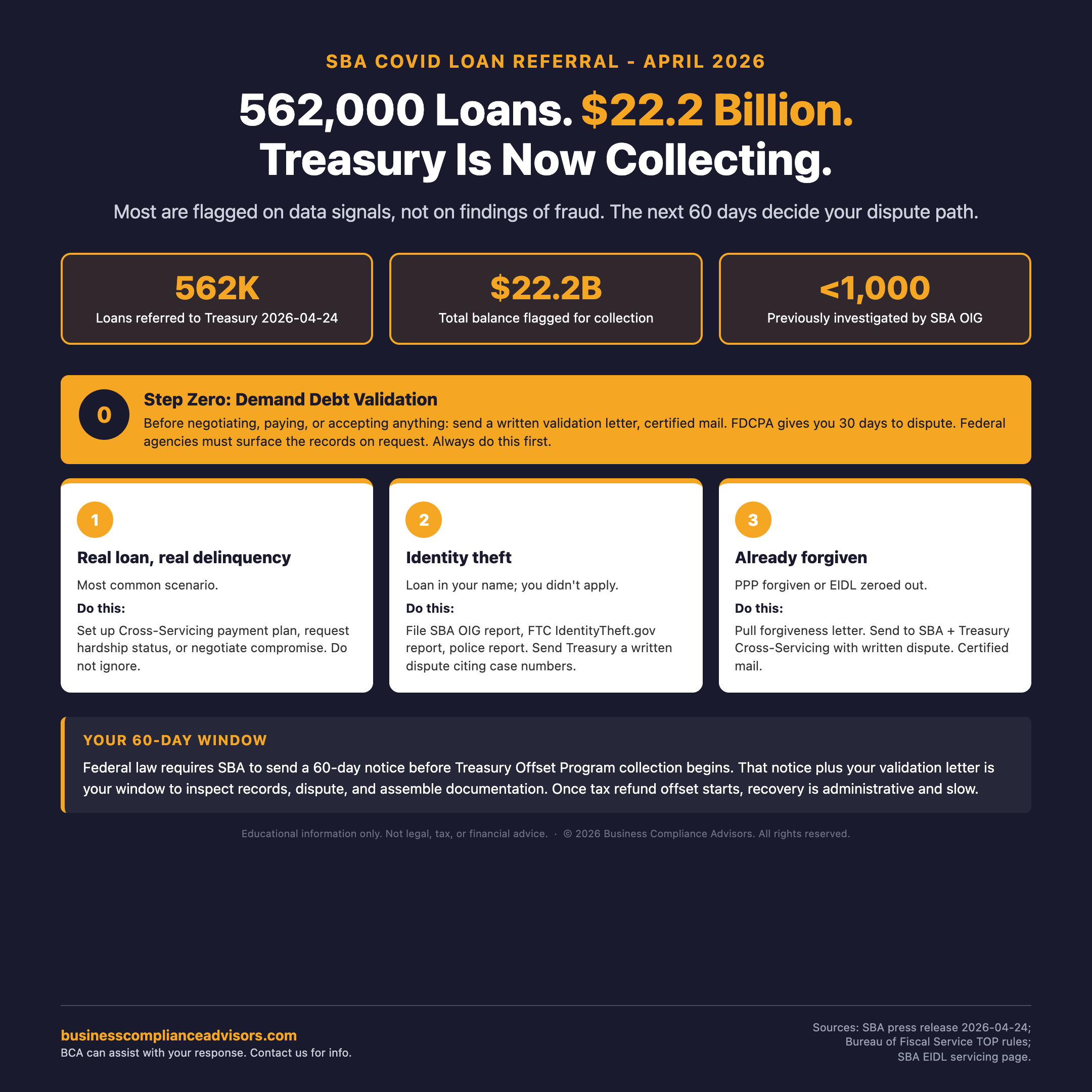
The Small Business Administration just sent the largest single batch of COVID-era loan referrals in agency history to the Treasury Department for collection. On April 24, 2026, SBA confirmed it referred 562,000 borrowers tied to $22.2 billion in delinquent Paycheck Protection Program and COVID Economic Injury Disaster Loan balances. The agency says these accounts were flagged for suspected fraud during the prior administration but had never been sent to Treasury or referred to the Department of Justice.
If you took a PPP or EIDL loan during 2020 or 2021, the next 90 days matter. Treasury Bureau of the Fiscal Service collection notices are about to start landing in mailboxes nationwide. The category your loan falls into determines whether you owe the money, owe nothing, or need to dispute right away.
What “Referred to Treasury” Actually Means
When SBA refers a loan to Treasury, two things happen in sequence.
First, the Treasury Offset Program (TOP). TOP is the federal government’s offset clearinghouse. Once a debt is in TOP, the Treasury can recover it by intercepting your federal payments. That includes federal income tax refunds, up to 15 percent of Social Security benefits, federal salary if you work for the government, and federal vendor payments if your business contracts with the government.
Second, Cross-Servicing. SBA also transfers many delinquent loans to the Bureau of the Fiscal Service’s Cross-Servicing program. Once a loan is in Cross-Servicing, the SBA no longer services it. You cannot call SBA to negotiate a payment plan, dispute the balance, or set up forbearance. You must work directly with Treasury.
Federal law requires the originating agency, in this case SBA, to send a written notice at least 60 days before referring a debt to TOP. That notice must:
- Identify the debt by type and amount
- State that the agency intends to refer the debt for offset
- Give you the opportunity to pay, enter a payment agreement, or dispute the debt
- Explain your right to inspect and copy agency records
- Explain your right to request administrative review
If you have not received that 60-day notice yet, your loan is not yet eligible for offset. If you received the notice and ignored it, the offset window may already be open.
Step Zero: Always Demand Debt Validation First
Before you do anything else, send a written debt verification letter to whoever is contacting you. Even if you know you owe the money. Even if it is the federal government. The debt collector or agency has to prove it.
This applies in two parallel tracks:
If a private collection agency contacts you under Treasury Cross-Servicing. Private Collection Agencies that Treasury hires must comply with the Fair Debt Collection Practices Act. Under 15 USC 1692g, a debt collector must send a written validation notice within five days of the first contact. The notice must state the amount owed, the name of the creditor, and your right to dispute the debt within 30 days and demand verification. If you send a written dispute within that 30-day window, the collector must stop collection activity until it provides written verification, including the original creditor’s records, the amount, and the basis for the debt.
If SBA or Treasury Bureau of the Fiscal Service contacts you directly. Federal agencies are not bound by FDCPA the same way private collectors are, but federal debt collection standards (31 CFR Part 901 and the agency’s own 60-day TOP notice rules) require the agency to give you the opportunity to inspect and request copies of agency records, request administrative review of the determination of indebtedness, and dispute the debt before offset begins.
In either case, send a written request. Keep it short and certified-mail it. The template below is a starting point that covers the basics every validation letter should include. Every situation is different. The specific language, the records to demand, and the legal authorities to cite will vary depending on your loan type, the entity contacting you, and your individual circumstances. BCA can help you tailor the letter to your situation.
Starting template (basics only):
I am writing to request validation of the debt referenced in your notice dated [date], account number [number]. Please provide:
- The original loan documents bearing my signature.
- The complete payment history.
- An accounting of any forgiveness, charge-off, or write-down decisions.
- The chain of assignment from SBA to Bureau of the Fiscal Service to your office, if applicable.
- The legal basis for the amount currently claimed.
I dispute this debt pending receipt of full verification. Under 15 USC 1692g, please cease collection activity until verification is provided.
[signature, date, certified mail tracking number]
Why a validation request is non-negotiable, even if you think you owe the money:
- It forces the collector or agency to surface the underlying records. Errors in transferred data are common when a loan crosses from SBA to Treasury to a private collector.
- It pauses collection activity while the verification is being assembled, which buys time to build your full response.
- It establishes a written record of dispute that protects you if the matter escalates to garnishment or further offset.
- It is the first thing any consumer protection lawyer or BCA advisor will want to see in your file.
Do this before you negotiate, before you pay, and before you set up any payment plan.
Three Categories of Borrower
Most of the 562,000 referred loans fall into one of three buckets. The category dictates the strategy.
Category 1: Legitimate Borrower, Loan Genuinely Delinquent
You took a real PPP or EIDL loan for a real business. The business survived or did not. You stopped making payments. The loan is past 120 days delinquent.
This is the most common scenario for the 561,000+ referred borrowers who had not previously been investigated by SBA OIG. SBA itself acknowledges that fewer than 1,000 of the 562,000 referred loans had been through prior OIG investigation. The “suspected fraud” flag on the rest is a data signal, not a finding of fact.
If you are in this category, your options are:
- Bring the loan current. Treasury Cross-Servicing will accept a lump sum or set up a payment agreement.
- Negotiate a compromise. The Bureau of the Fiscal Service has authority to settle for less than the full balance under specific hardship conditions.
- Request a hardship hold. Currently Not Collectible status is available for borrowers in temporary financial hardship.
What you cannot do: ignore it. TOP offset of your federal tax refund will start at the next refund cycle if no agreement is in place.
Category 2: Identity-Theft Victim
A loan was approved in your name or your business name without your knowledge. The funds went to a third party. Identity theft was the largest documented fraud channel in PPP and EIDL during 2020 and 2021.
If a Treasury collection notice arrives for a loan you did not apply for, this is the path:
- Do not pay anything.
- File an SBA identity theft report through the SBA Office of Inspector General hotline.
- File an FTC identity theft report at IdentityTheft.gov.
- File a police report locally.
- Send Treasury a written dispute citing the SBA OIG case number and the FTC report.
The Treasury fact sheet on TOP rules requires the originating agency to provide records, allow inspection, and give the debtor the opportunity to dispute the debt before offset. An identity theft determination by SBA OIG, when accepted, removes the debt from the offset list.
Category 3: Loan Forgiven But Still Showing as Delinquent
You applied for and received PPP forgiveness, or your EIDL balance was zeroed out under a small-loan administrative forgiveness window. The loan should not be in collection at all.
This happens when the SBA forgiveness decision did not flow through to the loan servicing record before referral. The fix is a paper trail:
- Pull your PPP forgiveness decision letter, EIDL forgiveness confirmation, or final servicing statement showing zero balance.
- Send it to SBA via CovidEIDLServicing@sba.gov for EIDL or to the lender’s PPP forgiveness portal for PPP.
- Send a copy to Treasury Cross-Servicing along with a written dispute.
- Keep the certified mail receipt. The 60-day TOP notice clock should pause once a documented dispute is on file.
If You Received a Notice: What To Do This Week
The checklist below applies once you have actually received a written notice from SBA, the Bureau of the Fiscal Service, or a private collection agency working under Treasury Cross-Servicing. If no notice has arrived, the most useful thing you can do right now is pull your loan records so they are ready when one does (Step 1 below).
If a notice has arrived:
- Pull your loan records. PPP forgiveness letter, EIDL final balance statement, any prior SBA correspondence, and the original promissory note if you have it.
- Send a written debt validation letter. See “Step Zero” above. Certified mail. Do this before negotiating, paying, or setting up any plan.
- Check your mail and your IRS account regularly. Confirm what you received from SBA or Treasury. The IRS Online Account at IRS.gov/account also flags federal payment offset alerts.
- Confirm the loan is yours. If the loan number, business name, or origination date does not match your records or the validation response, treat as identity theft (Category 2 above).
- Confirm the balance. If you believe the loan was forgiven or paid off, treat as Category 3 and document.
- If the balance is correct and the loan is yours, set up an arrangement. Cross-Servicing payment portal: 833-853-5638 for SBA-sourced debts. The TOP automated information line is 1-800-304-3107.
- Address the tax refund offset risk. If you are owed a 2025 refund, file your 2025 return and resolve the SBA debt before the IRS releases your refund. Once the offset is taken, recovery is administrative and slow.
- Talk to BCA before signing anything. Compromise offers, hardship status applications, and identity theft disputes all have deadlines and paperwork requirements that are easy to get wrong.
Why This Matters For Legitimate Small Business Owners
The SBA Inspector General has flagged the underlying data quality problem on these referrals. The agency itself confirmed that fewer than 1,000 of the 562,000 referred loans had been through OIG investigation. The remaining 561,000 are flagged on signals that include things like address mismatches, IP address overlap, and rapid sequential applications. None of those signals, on their own, prove fraud.
That means a meaningful share of the 562,000 are legitimate small business owners whose loans are about to be aggressively collected on with no individualized review. If you are one of them, the burden is on you to surface the documentation that gets you out of the offset queue.
The 60-day TOP notice is your window. Use it.
When to bring BCA in
Three scenarios where the right move is a call before any letter goes out:
- You received a TOP notice and the loan amount or balance does not match your records.
- You received a TOP notice and you have a PPP forgiveness decision or EIDL administrative forgiveness on file.
- You received no notice but expect one based on a delinquent loan.
In all three cases, the dispute paper trail is what protects you. BCA advisors bring business and compliance experience to your response. We help you organize the records, advise on what your validation letter and dispute should say, and walk through the compromise, hardship, and payment-plan options so you understand the tradeoffs before Treasury Cross-Servicing locks in terms. The letters you send go out under your name; our role is to advise and assist, not to substitute our voice for yours.
Sources
- U.S. Small Business Administration. “SBA Sends 562,000 Suspected Fraudulent Loans to Treasury for Collections Totaling $22 Billion.” Press release, April 24, 2026.
- Bureau of the Fiscal Service. “Treasury Offset Program: How TOP Works” and “FAQs for Debtors in the Treasury Offset Program.” Fiscal.treasury.gov.
- Bureau of the Fiscal Service. “Cross-Servicing: Private Collection Agencies.” Fiscal.treasury.gov.
- U.S. Small Business Administration. “Manage Your EIDL.” SBA.gov COVID-19 Relief Options.
- SBA Office of Inspector General. “COVID-19 Pandemic EIDL and PPP Loan Fraud Landscape Recommendations Update,” Report 25-10.
- Fair Debt Collection Practices Act, 15 USC 1692g (debt validation rights).
- Federal Claims Collection Standards, 31 CFR Part 901.
This information is provided for general educational purposes and reflects opinions based on experience. Individual circumstances may vary. BCA advisors bring business and compliance experience to help you evaluate documentation, advise on written disputes, and weigh the paths available with Treasury or SBA before any agreement is signed.