
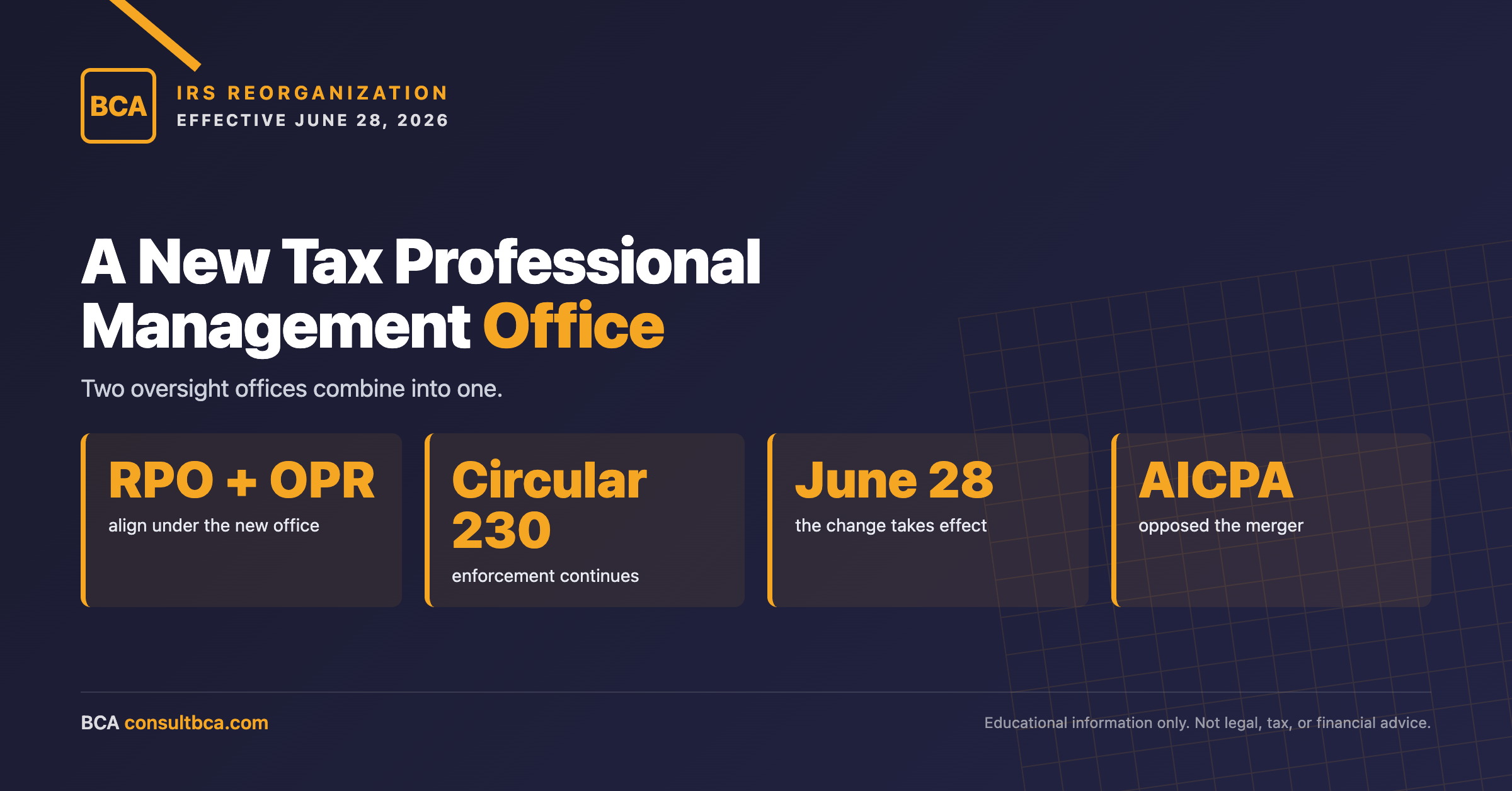
On June 28, the IRS is consolidating two of its tax-practitioner oversight offices into a single new unit called the Tax Professional Management Office. The Return Preparer Office and the Office of Professional Responsibility will both align under it. The agency says the change is about efficiency. Not everyone agrees it is a good idea.
What is changing
The Return Preparer Office, or RPO, runs the PTIN and enrolled-agent programs and processes certain complaints against return preparers. The Office of Professional Responsibility, or OPR, investigates alleged misconduct and enforces Circular 230, the rules that govern how tax professionals deal with the IRS. Both will now sit under the Tax Professional Management Office, which the IRS says will be led by Chris Pleffner. The agency frames the move as support for federal workforce-management goals set out in Executive Order 14210.
The IRS has stressed what is not changing. The reorganization does not erase the distinction between credentialed tax professionals and uncredentialed preparers. The agency says the missions of RPO and OPR stay intact and continue to operate independently within their own roles and authorities.
Why some professionals pushed back
The American Institute of CPAs opposed the merger before it was finalized, arguing that folding credentialed and uncredentialed preparers under the same structure could create conflicts of interest, confuse taxpayers, and pull resources away from OPR’s core disciplinary role. The change also lands during a period of thin staffing: according to the National Taxpayer Advocate, the Return Preparer Office lost close to 40% of its workforce and the Office of Professional Responsibility roughly 30% amid broader federal cuts. That backdrop is part of why the reorganization drew attention rather than passing quietly.
What it means for taxpayers
For most taxpayers the day-to-day picture does not change on June 28. PTINs, enrolled-agent status, and Circular 230 enforcement all continue. The reorganization is worth knowing about for a different reason: the offices that police preparer conduct are being restructured at the same time enforcement against dishonest preparers remains active. The practical takeaway for clients is unchanged. Work with a preparer or advisor whose duty runs to you, keep copies of what gets filed, and confirm the preparer signs the return and uses their own identifying number.
BCA tracks structural changes like this so owners do not have to. We bring business and compliance experience to help you understand how the rules around your filings are administered and to coordinate with a trusted tax advisor when a question needs a licensed professional.
Sources
- IRS, “Statement on new Tax Professional Management Office (TPMO).” https://www.irs.gov/newsroom/statement-on-new-tax-professional-management-office-tpmo
- Journal of Accountancy, “IRS to merge tax practitioner offices despite AICPA opposition.” https://www.journalofaccountancy.com/news/2026/jun/irs-to-merge-tax-practitioner-offices-despite-aicpa-opposition/
- Accounting Today, “IRS creates Tax Professional Management Office.” https://www.accountingtoday.com/news/irs-creates-tax-professional-management-office
- The Tax Adviser, “AICPA warns that merger of IRS offices would ‘confuse’ taxpayers.” https://www.thetaxadviser.com/news/2025/nov/aicpa-warns-that-merger-of-irs-offices-would-confuse-taxpayers/
- Bloomberg Tax, “IRS to Create New Office for Tax Professionals Starting June 28” (RPO and OPR staffing reductions attributed to the National Taxpayer Advocate). https://news.bloombergtax.com/employee-benefits/irs-to-create-new-office-for-tax-professionals-starting-june-28
This information is provided for general educational purposes and reflects opinions based on experience. It is not licensed legal, tax, or financial advice. Agency reorganizations and staffing figures are based on IRS announcements and trade-press reporting and may change. We refer to and partner with licensed professionals when personalized advice is needed. Laws change, and we make no warranty of accuracy or timeliness.