
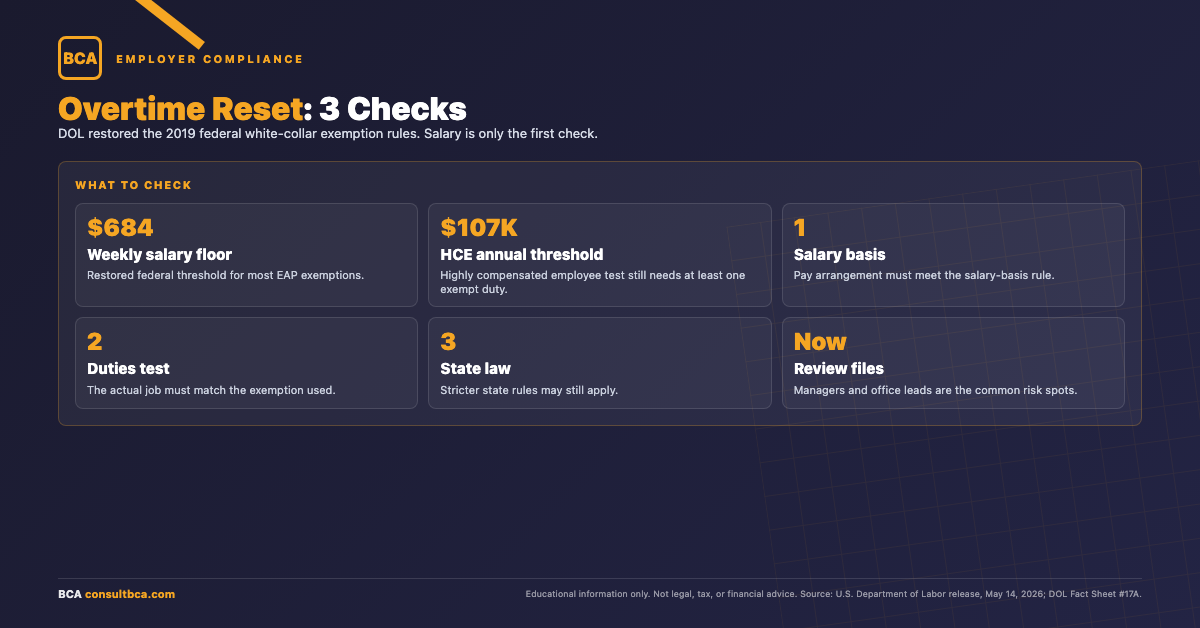
The Department of Labor has restored the federal white-collar overtime exemption rules that were in place under the 2019 regulations. For small employers, the practical takeaway is not complicated: the federal salary number is back to $684 per week, but salary is only one part of the exemption test.
This matters most for businesses that changed payroll or employee classifications during the 2024 overtime rule cycle. If a manager, office lead, assistant manager, dispatcher, bookkeeper, or administrative employee was moved between exempt and nonexempt status, now is the time to review the file before another payroll cycle passes.
What changed
DOL’s May 14, 2026 technical amendment removes the vacated 2024 rule text from the Code of Federal Regulations and republishes the operative 2019 regulations.
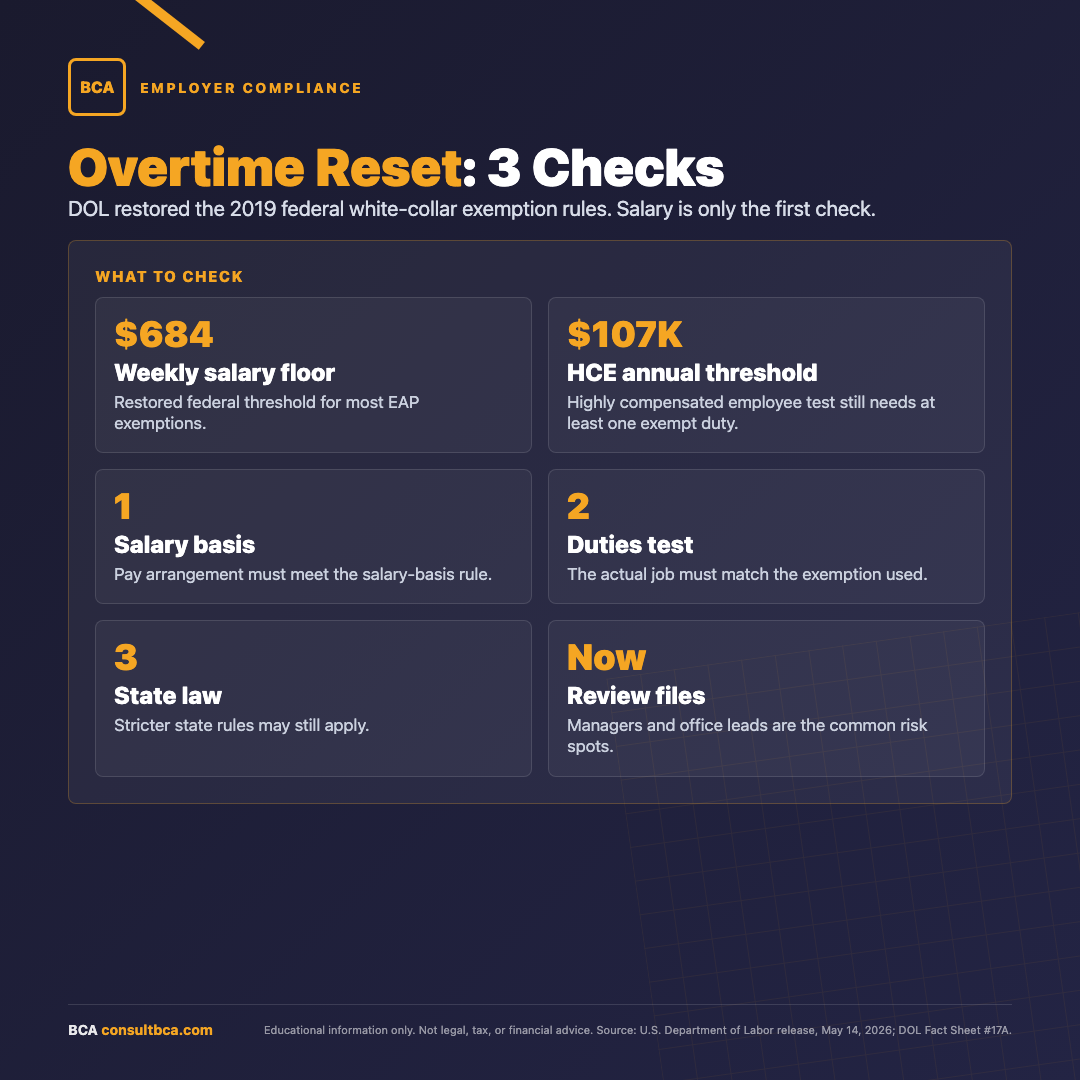
The restored federal salary threshold for most executive, administrative, and professional exemptions is $684 per week. The restored threshold for the highly compensated employee test is $107,432 per year, with at least $684 per week paid on a salary or fee basis.
That does not mean every employee paid above $684 per week is exempt. DOL’s own guidance is blunt on this point: job titles do not determine exempt status. The employee’s actual duties and pay arrangement have to satisfy the applicable test.
Three checks for small employers
First, check the pay level. If the employee is classified as exempt under the executive, administrative, or professional exemption, confirm the weekly salary is at least $684.
Second, check salary basis. A worker can be paid enough but still fail the exemption if the pay arrangement does not meet the salary-basis rules.
Third, check duties. This is where small employers often get into trouble. A title like manager, coordinator, lead, or administrator is not enough. The actual job has to match the exemption being used.
Who should review this now
Restaurants, retailers, clinics, agencies, contractors, and professional-services firms should pay special attention to front-line managers and office staff. These are the roles where the title may sound exempt but the day-to-day work may still look nonexempt.
If you use a payroll provider, do not assume the provider has validated the legal classification. Payroll systems process the status you give them. They usually do not decide whether the exemption is right.
What BCA readers should do
Pull a list of every salaried exempt employee. For each one, write down the exemption being used, the weekly salary, and the duties that support the classification. If you cannot explain the classification in two or three sentences, that file needs attention.
The goal is not to panic-change everyone to hourly. The goal is to make sure the classification still has support under the restored federal rule and any stricter state law that may apply.
Sources
- U.S. Department of Labor, “Department restores 2019 executive, administrative, professional exemption regulations,” May 14, 2026. https://www.dol.gov/newsroom/releases/whd/whd20260514
- U.S. Department of Labor, Wages topic page. https://www.dol.gov/topic/wages
- U.S. Department of Labor, Fact Sheet #17A, Exemption for Executive, Administrative, Professional, Computer and Outside Sales Employees Under the FLSA. https://www.dol.gov/agencies/whd/fact-sheets/17a-overtime
- HR Morning, “DOL Restores Overtime Salary Threshold to $684 in Final Rule Update,” May 2026. https://www.hrmorning.com/news/overtime-salary-threshold/
Disclaimer
This article is for general educational purposes. It is not legal, tax, payroll, or human-resources advice. Federal overtime rules interact with state wage laws, industry-specific rules, and facts about each employee’s actual duties. Employers should review classifications with a qualified employment-law or payroll-compliance advisor before making classification decisions.