
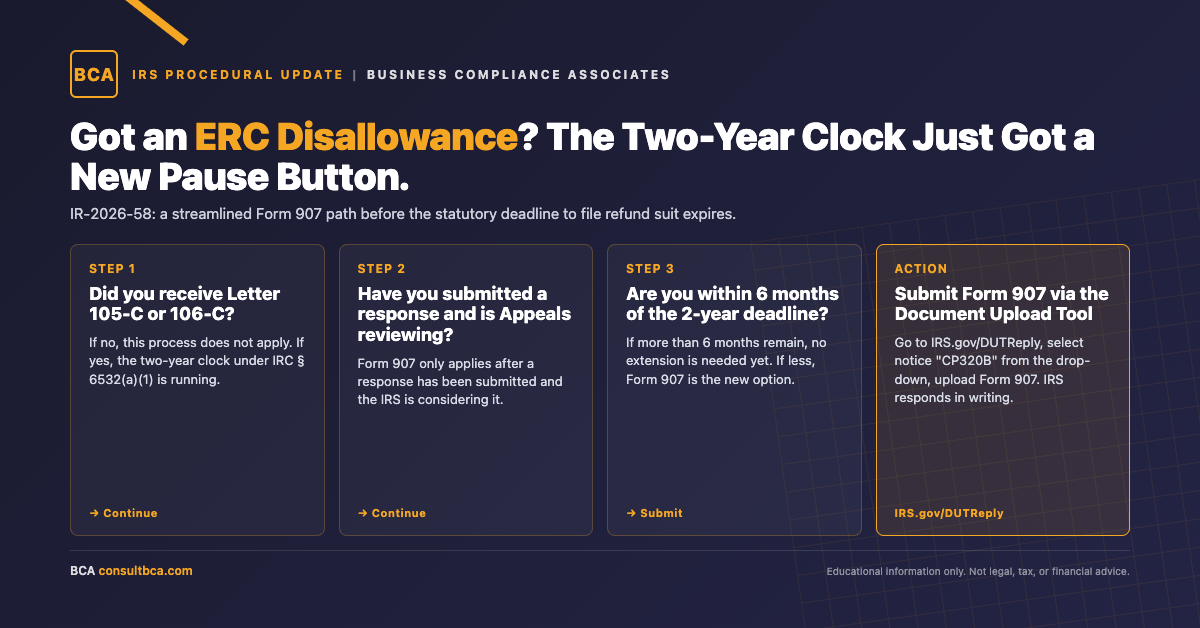
Small business owners with disallowed Employee Retention Credit claims have a new procedural path before the two-year clock runs out. On April 27, 2026, the IRS announced a streamlined option for taxpayers whose ERC claims have been disallowed and who are running out of time to file refund litigation.
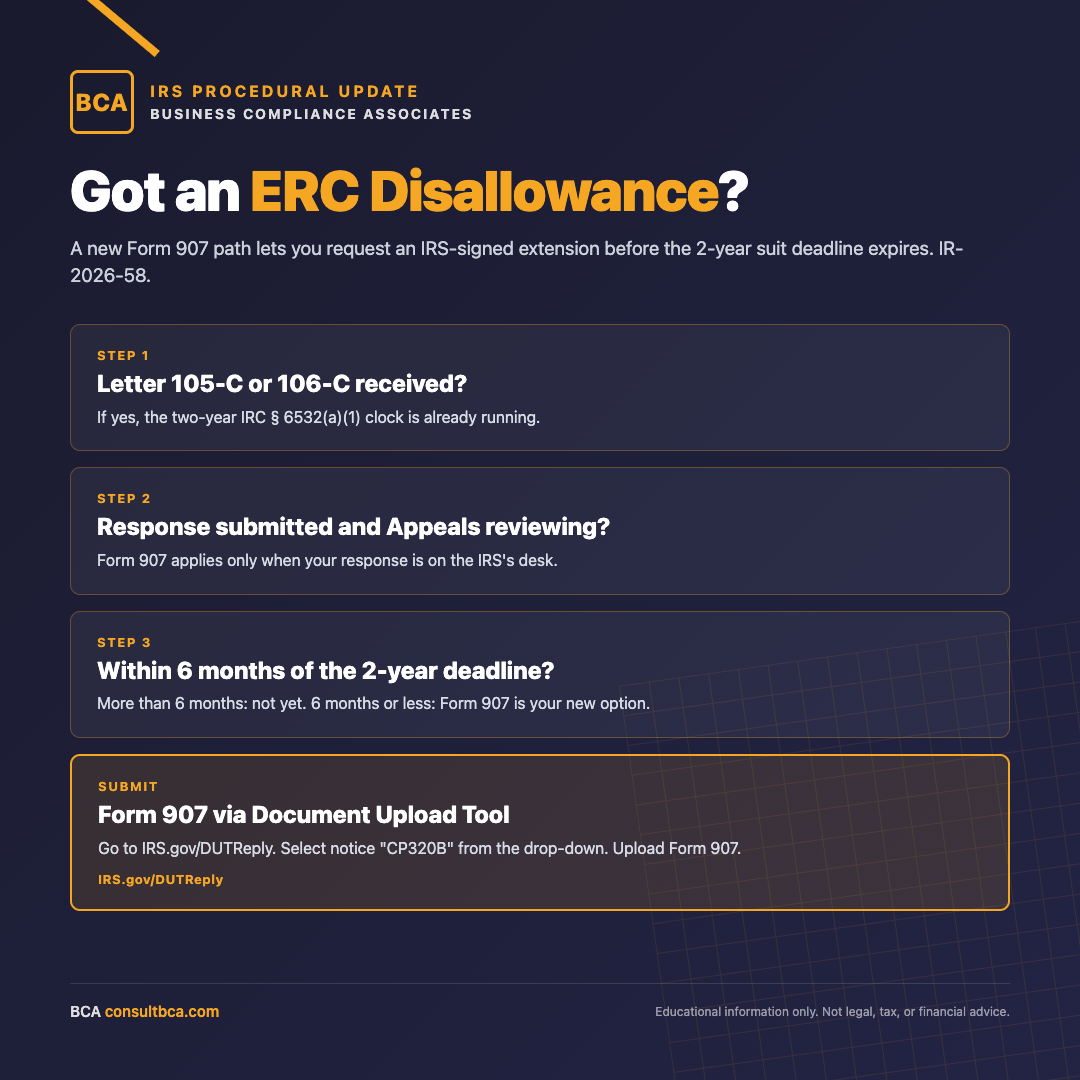
The new process matters because of a deadline most ERC claimants do not realize is ticking. When the IRS disallows an ERC claim through Letter 105-C or 106-C, federal law gives the taxpayer two years to file suit in federal court to recover the refund. That two-year clock under Internal Revenue Code § 6532(a)(1) does not stop while the IRS Independent Office of Appeals reviews a disallowance response. After two years, the IRS cannot issue the refund even if Appeals later decides in the taxpayer’s favor.
Before this streamlined route, many taxpayers faced a practical choice between filing suit to preserve rights or waiting for Appeals and risking the deadline.
What changed on April 27, 2026
The IRS opened a third path. Taxpayers with six months or less remaining on the two-year deadline, who are still waiting for the IRS to review their disallowance response, can now submit Form 907, “Agreement to Extend the Time to Bring Suit,” through the IRS Document Upload Tool.
The submission steps are specific:
- Go to IRS.gov/DUTReply.
- Select the notice “CP320B” from the drop-down menu.
- Upload Form 907.
Properly executed Forms 907 will be given due consideration by the IRS, which will respond in writing whether the agreement is accepted. If accepted, the IRS countersigns and returns the form to the taxpayer or authorized representative.
Who this helps
Three groups of ERC claimants:
- Taxpayers whose Letter 105-C or 106-C disallowance was sent in 2024 and whose two-year suit deadline is approaching in 2026, but whose Appeals response is still pending.
- Taxpayers who would otherwise have to file suit early to preserve rights, even though Appeals review has not finished.
- Tax professionals representing clients whose ERC files have been moving slowly through the system.
Who this does not help
- Taxpayers who have not yet responded to Letter 105-C or 106-C. Form 907 only applies after a response has been submitted and is under consideration.
- Taxpayers more than six months from the two-year deadline. They do not yet need an extension.
- Taxpayers whose claims were not disallowed (different process applies for unprocessed claims).
What this does not change
The two-year statutory deadline itself is still the law. Form 907 is a tool to extend it by mutual agreement, not a unilateral right. The IRS retains discretion to decline. The form is not effective unless both the taxpayer and an authorized IRS official sign it before the original two-year period expires. The underlying claim still has to be evaluated on the merits.
Pair this with the Tax Debt Help Tool
The IRS released a separate self-service Tax Debt Help tool earlier in April 2026 (covered in BCA’s April 29 post). For ERC claimants who not only had a disallowance but also have an outstanding balance from a partial claw-back, both tools may be relevant.
When to bring BCA in
Form 907 looks simple, but the consequences of getting it wrong are real. Two scenarios where business owners and their representatives should pause before submitting:
- Form 907 is a request for the IRS to agree to an extension. It is also evidence of the taxpayer’s understanding of the deadline. A defective submission, a missing authorization, or an extension request submitted outside the six-month window can complicate later litigation.
- The decision to extend versus file suit is strategic, not procedural. If Appeals review has gone cold, legal counsel may need to evaluate whether filing is required to preserve refund-suit rights. BCA advisors can help evaluate which path fits a specific case before the form goes in.
Our role is to advise and assist. The form, the agreement, and any litigation decision stay yours.
Key Takeaways
- The IRS released a streamlined Form 907 process on April 27, 2026 for taxpayers whose ERC claims have been disallowed and who are within six months of the two-year statutory deadline to file refund suit.
- Submission is via the IRS Document Upload Tool at IRS.gov/DUTReply, selecting notice “CP320B” from the drop-down.
- The two-year deadline under IRC § 6532(a)(1) does not stop while Appeals reviews; this new process extends it by mutual agreement.
- Eligibility requires that the taxpayer has already submitted a response to Letter 105-C or 106-C and is awaiting IRS consideration.
- Form 907 is discretionary; the IRS may decline to extend.
- The decision to extend versus file suit immediately is strategic. BCA can advise and assist on which path fits a specific case.
Sources
- U.S. Internal Revenue Service. “IRS announces new option for certain taxpayers to request more time after ERC claim disallowance.” IR-2026-58, April 27, 2026. irs.gov
- U.S. Internal Revenue Service. “Understanding your CP320B notice.” irs.gov/individuals/understanding-your-cp320b-notice
- U.S. Internal Revenue Service Form 907, “Agreement to Extend the Time to Bring Suit.” irs.gov/pub/irs-pdf/f907.pdf
- National Taxpayer Advocate. “Protect Your Employee Retention Credit Claim: Use IRS’s New Streamlined Process to Request an Extension.” NTA Blog, April 2026. taxpayeradvocate.irs.gov
- Internal Revenue Code § 6532(a)(1) (two-year statutory deadline for refund suits). uscode.house.gov
- IRS e-News for Small Business, Issue 2026-10 (May 7, 2026), “New option for requesting more time after ERC claim disallowance.”
Disclaimer
This information is provided for general educational purposes and reflects opinions based on experience. Individual circumstances may vary. The interaction between Form 907, the two-year statutory deadline, Appeals procedure, and refund litigation strategy can be complex. BCA advisors bring business and compliance experience to help you evaluate documentation, advise on the path forward, and weigh the strategic options before any agreement is signed or suit is filed.