
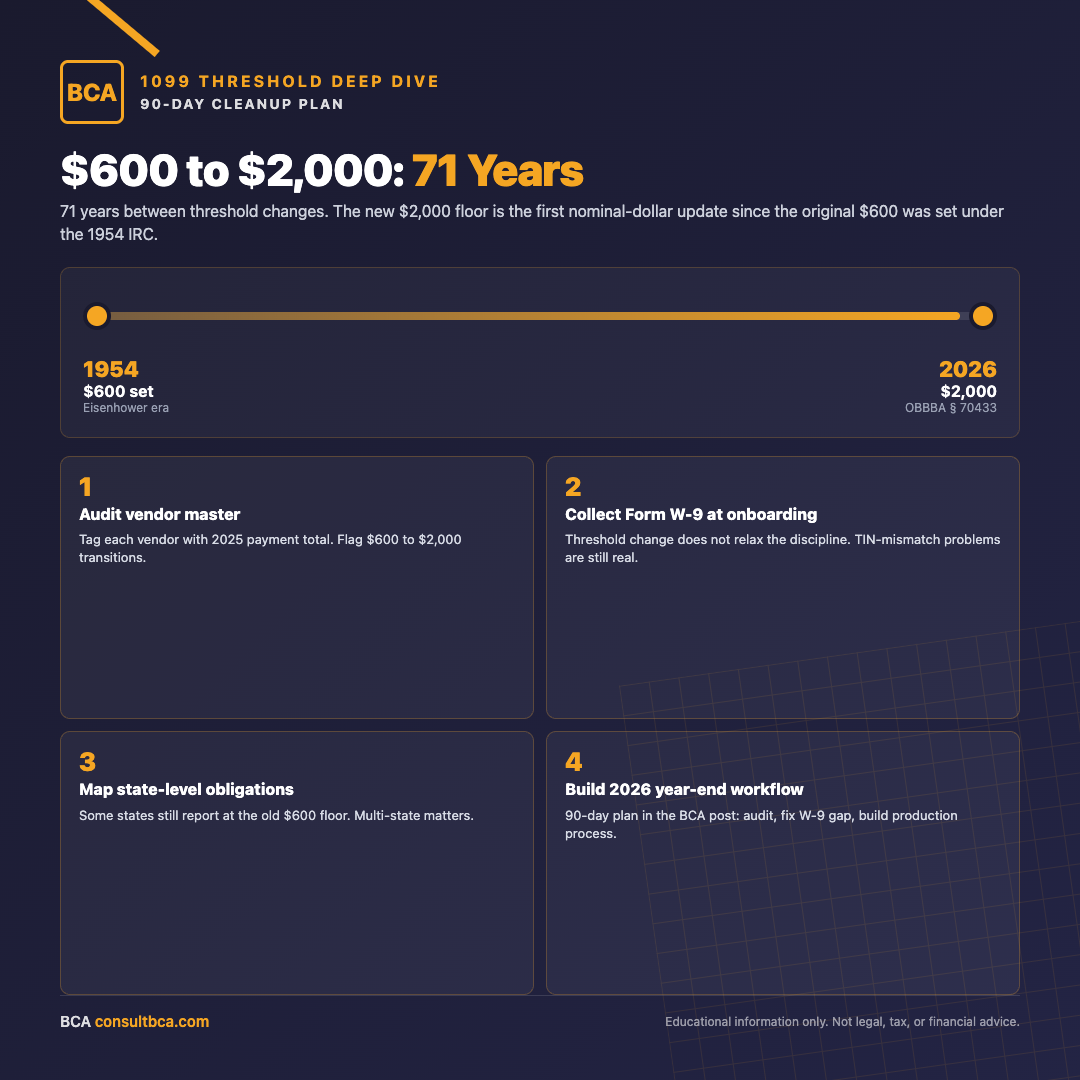
The 1099 reporting threshold just changed for the first time in 71 years. From 1954 until December 31, 2025, the Form 1099-NEC and Form 1099-MISC reporting threshold was $600 per payee per year. Starting January 1, 2026, it is $2,000.
The mechanical change is small: a single number in the tax code moved. The operational implications are not. For most small businesses, the change is an opportunity to clean up three things at once: the vendor master file, the W-9 collection process, and the year-end 1099 production workflow. That cleanup, done well, lowers compliance risk in a meaningful way. Done poorly, it creates new risk.
This post is about doing it well.
The number, in context
A $600 threshold in 1954 was not the same threshold as a $600 threshold in 2025. Inflation alone made the rule progressively more aggressive over seven decades. Run $600 in 1954 dollars through the BLS CPI calculator and the modern equivalent is roughly $7,000+ in current purchasing power. The $2,000 threshold OBBBA put in place is still substantially below the inflation-adjusted equivalent. It is a partial catch-up, not a full one.
What this means in practice: the $2,000 threshold is closer to capturing payments that look like meaningful business engagements (a contracted project, a multi-day service engagement, a recurring vendor relationship) and farther from capturing one-off transactions (a single repair, a one-meeting consult, a small reimbursement-style payment).
Three places this changes your operations
The threshold change touches three workflows. They each have their own discipline.
1. Vendor master file: the cleanup that should have happened anyway
Most small business AP systems carry a long tail of one-time payees who got set up because someone needed to pay them once. Plumber for a single emergency. Cleaner who covered while the regular cleaner was sick. A friend’s design contractor who did one logo refresh.
Under the old $600 rule, many of these never crossed the line, so the vendor record never got formalized. Under the new $2,000 rule, even fewer will. That is the easy good news.
The harder discipline question is: which of these vendor records actually represent active business relationships, and which are stale? The threshold change is a natural prompt to audit. Specifically:
- Tag every vendor in the master with the current 12-month payment total.
- Identify any vendor that crossed the old $600 line but not the new $2,000 line. Ask: still active, or wind down?
- For active vendors that will continue under the new $2,000 line, decide whether to keep collecting Form W-9 anyway. Recommendation: yes, always. (See § 3 below.)
- For vendors that are clearly stale, mark inactive in the master rather than delete. Audit-trail integrity matters more than master-file tidiness.
2. Year-end 1099 production: the actual paperwork savings
As an illustrative BCA modeling scenario, a 25-employee small business with an active contractor base might typically issue mid-to-high-teens Forms 1099-NEC under the old $600 rule and roughly half that under the new $2,000 rule. The exact magnitude depends on the actual vendor distribution; BCA can model it from a vendor master before year-end. The point is the order of magnitude: a meaningful production-volume reduction, not a marginal one.
Where the savings actually land:
- Fewer W-9 chases in November and December (the perennial year-end paperwork crunch).
- Fewer correction-and-reissue cycles because of mismatched names, addresses, or TINs.
- Fewer Forms 1099 mailed in late January, fewer electronic filings to the IRS.
- Lower exposure to IRC §§ 6721 and 6722 penalties for late, missing, or incorrect filings.
The trap to avoid: do not let the smaller volume make the remaining filings sloppier. The penalties scale per form, and the IRS audits 1099 production with at least the same rigor under the higher threshold as under the lower one. Fewer filings means each filing matters more.
3. Backup withholding: the dollar floor moved, the operational discipline did not
Under prior law, IRC § 3406 backup withholding was triggered independently of the § 6041 reporting threshold. OBBBA § 70433 amended IRC § 3406(b)(6) so the backup-withholding threshold cross-references the § 6041 reporting threshold. In practice: backup withholding generally applies once the new $2,000 floor is reached and the other backup-withholding conditions (missing TIN, IRS B-notice, etc.) are met. The dollar floor moved up; the substantive triggers (TIN failures, B-notices) did not.
That alignment is a real change, but it does not relax the operational discipline around W-9 collection. Three reasons collecting Form W-9 at onboarding is still the right BCA practice:
- Threshold-crossing surprise. A vendor relationship that looks small in March can grow past $2,000 by November. Collecting at onboarding avoids the November scramble and the backup-withholding mistake that often follows.
- TIN-mismatch problems. A bad TIN on a Form 1099-NEC produces an IRS B-notice and downstream filing corrections regardless of dollar amount. Catching that at onboarding is far cheaper than catching it after a B-notice arrives.
- Year-end paperwork cleanup. A vendor master with verified W-9s on every active vendor produces clean 2026 year-end reporting. A vendor master with gaps produces missed filings, late filings, and § 6721 / § 6722 penalty exposure.
The right operational rule, before and after OBBBA: collect Form W-9 from every contractor or service vendor at onboarding, before the first payment. The threshold change does not narrow that rule; it makes ignoring it more expensive on a per-error basis because each remaining filing carries higher production-quality stakes.
What about Form 1099-K?
Form 1099-K (third-party payment networks like PayPal, Stripe, Square, and most marketplace platforms) is governed by IRC § 6050W. OBBBA § 70432 addressed 1099-K separately and restored the prior $20,000-and-200-transaction reporting framework. The new $2,000 1099-NEC/MISC threshold does not apply to 1099-K. The two changes are different statutory provisions in OBBBA and produce different reporting mechanics.
For small businesses that pay contractors through payment networks, this matters: the contractor may receive a 1099-K from the platform under the § 6050W rule, and the small business may also need to issue a 1099-NEC if the contractor crosses the $2,000 threshold and the payment is not subject to a § 6050W exception. The framework around overlap (and the duplicate-reporting concern) is something the final IRS guidance is expected to address.
State-level 1099 thresholds
The federal threshold change does not preempt state reporting obligations. A number of states administer their own 1099 reporting at thresholds tied to state income-tax administration. Some states match the federal floor; others have independent thresholds, sometimes lower than the federal $600 (yes, lower). The federal-state interaction matters more for multi-state operators than for single-state ones, but it matters.
Specifics vary widely. Confirm with your state’s revenue department for the current state-level threshold and any state-specific 1099-NEC, 1099-MISC, or combined federal-state filing program participation.
A 90-day cleanup checklist
For a small business that wants to take the threshold change as the prompt to clean up its vendor and 1099 process, here is a sequenced 90-day plan.
Days 1-30: audit the current state.
- Pull the vendor master and tag each row with 2025 calendar-year payment total.
- Flag any vendor whose 2025 total was between $600 and $2,000. These are the relationships most affected by the change.
- Flag any vendor without a Form W-9 on file. These are the highest immediate risk.
- Cross-check W-9 TIN data against IRS Publication 1281 backup-withholding rules. Vendors with missing or unverifiable TINs are flagged for backup-withholding consideration once aggregate payments reach the $2,000 threshold (and earlier if a B-notice has been received).
- Document state-level 1099 obligations for each state where the business has nexus.
Days 31-60: fix the W-9 gap.
- Send Form W-9 to every active vendor without one on file. Use a written deadline (recommend 30 days).
- For vendors who do not respond by the deadline, apply backup withholding under § 3406 procedures once the aggregate-payment threshold is reached (or immediately if the vendor has an outstanding B-notice). This is not optional.
- Update the vendor master to record W-9 receipt date and the verified TIN.
- For new vendor onboarding going forward, require W-9 before the first payment is processed. Bake this into the AP workflow.
Days 61-90: build the 2026 production process.
- Map the new $2,000 threshold against the 2026 vendor population (projected based on 2025 actuals + known 2026 contracts).
- Identify which vendors will likely require Form 1099-NEC for 2026 and which will not.
- Build a single year-end calendar with the 2026 production workflow: data freeze date, W-9 reconciliation date, 1099 generation date, recipient mailing date (1099-NEC recipient deadline is January 31), IRS filing date (1099-NEC filing deadline is January 31 for both paper and electronic; other 1099 series forms have a February 28 paper deadline and March 31 electronic-filing deadline).
- Decide on filing method: paper, third-party platform, or direct via IRS FIRE / IRIS. The rules around mandatory electronic filing tightened in recent years; verify whether your filing volume crosses the e-file threshold.
This cleanup is not unique to the threshold change. It is good vendor-management discipline at any threshold. The change makes it timely.
Why this is BCA’s lane
A 1099 process audit is not glamorous work, but it is the kind of discipline that quietly reduces risk across multiple compliance surfaces at once. The operational pieces (vendor records, W-9 collection, year-end production, state-level mapping) are straightforward when done in sequence and become messy when left to the last week of January.
BCA advisors bring business and compliance experience to:
- Mapping the change against your specific vendor population.
- Designing the W-9 collection-and-onboarding workflow that fits your AP system.
- Identifying the state-level reporting obligations that still apply at the old $600 floor (or below) for businesses with multi-state operations.
- Spotting the backup-withholding compliance gaps that the threshold change does not solve.
Our role is to advise and assist. The vendor records, the W-9s, the year-end filings, and the state coordination stay yours.
When to bring BCA in
Three scenarios where the planning conversation matters:
- You have a contractor-heavy business (construction, creative agency, professional services, hospitality with seasonal labor) and a vendor master that has grown organically over multiple years. A clean-room audit before the 2026 year-end crunch saves time and reduces filing errors.
- You operate in multiple states and are not confident about which state-level 1099 obligations still apply at the old $600 floor. State variance is the single biggest source of avoidable filing errors after a federal threshold change.
- You have ever had a Form 1099 correction cycle, a missing TIN issue, or an IRS B-notice in the last three years. The threshold change is the right occasion to fix the underlying data-quality issue, not to defer it again.
Download the 1099 Threshold Cleanup Plan (PDF)
A printable checklist for auditing your 1099 vendor records before the new $2,000 threshold takes effect, with step-by-step instructions and a documentation reference.
Sources
- One, Big, Beautiful Bill Act, Public Law 119-21 (July 4, 2025), § 70433. https://www.congress.gov/119/plaws/publ21/PLAW-119publ21.pdf
- U.S. Internal Revenue Service. Internal Revenue Bulletin 2026-19, REG-113229-25 — Notice of Proposed Rulemaking on the increase of the information-reporting threshold to $2,000 (May 4, 2026 IRB). https://www.irs.gov/irb/2026-19_IRB
- 26 U.S.C. § 3406 (backup withholding). https://uscode.house.gov/view.xhtml?req=granuleid:USC-prelim-title26-section3406
- 26 U.S.C. § 6041 (information at source). https://uscode.house.gov/view.xhtml?req=granuleid:USC-prelim-title26-section6041
- 26 U.S.C. § 6041A (returns regarding payments of remuneration for services and direct sales). https://uscode.house.gov/view.xhtml?req=granuleid:USC-prelim-title26-section6041A
- 26 U.S.C. § 6050W (returns relating to payments made in settlement of payment card and third-party network transactions). https://uscode.house.gov/view.xhtml?req=granuleid:USC-prelim-title26-section6050W
- 26 U.S.C. §§ 6721, 6722 (failure-to-file and failure-to-furnish penalties). https://uscode.house.gov/view.xhtml?req=granuleid:USC-prelim-title26-section6721
- U.S. Internal Revenue Service. Publication 1281, “Backup Withholding for Missing and Incorrect Name/TIN(s).” https://www.irs.gov/pub/irs-pdf/p1281.pdf
- U.S. Bureau of Labor Statistics. CPI Inflation Calculator. https://www.bls.gov/data/inflation_calculator.htm
- BCA, “OBBBA Raises 1099 Reporting Threshold to $2,000. First Update Since 1954.” (companion news piece, May 7, 2026).
Disclaimer
This information is provided for general educational purposes and reflects opinions based on experience. Individual circumstances may vary. The proposed regulation REG-113229-25 is not yet final; the final rule may modify implementation details that affect 2026 reporting. State 1099 obligations are independent of the federal threshold and require separate analysis. The 90-day cleanup checklist in this post is illustrative; actual scope depends on the vendor population, the AP system, and the state footprint. BCA advisors bring business and compliance experience to help you evaluate the change against your specific operations, advise on documentation, and weigh the workflow options.