
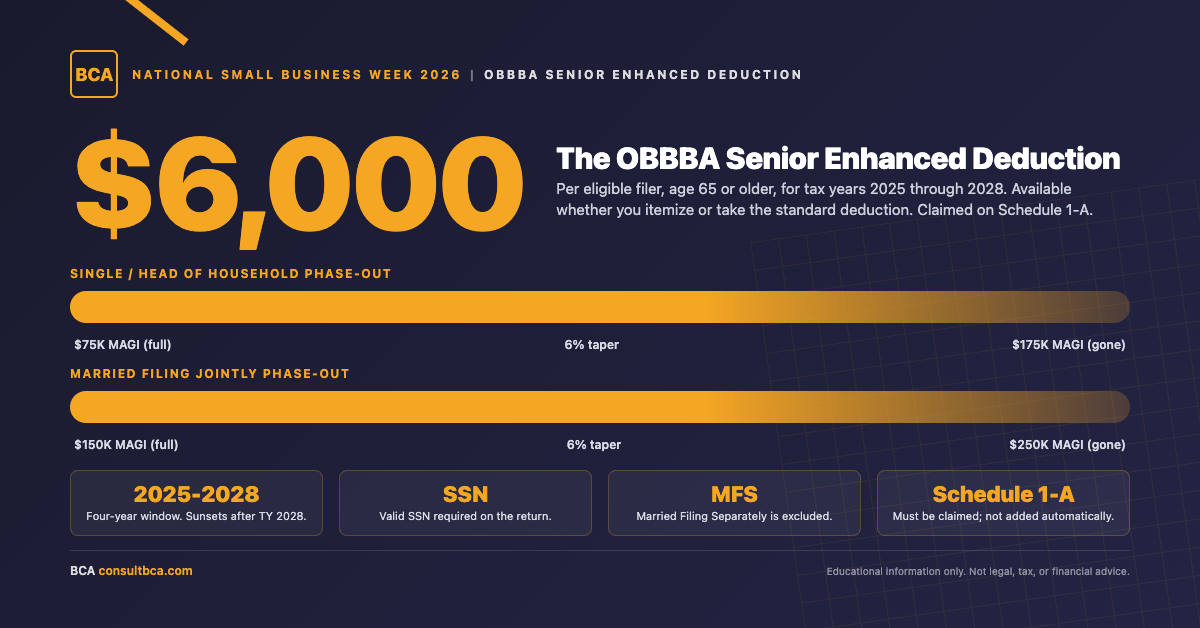
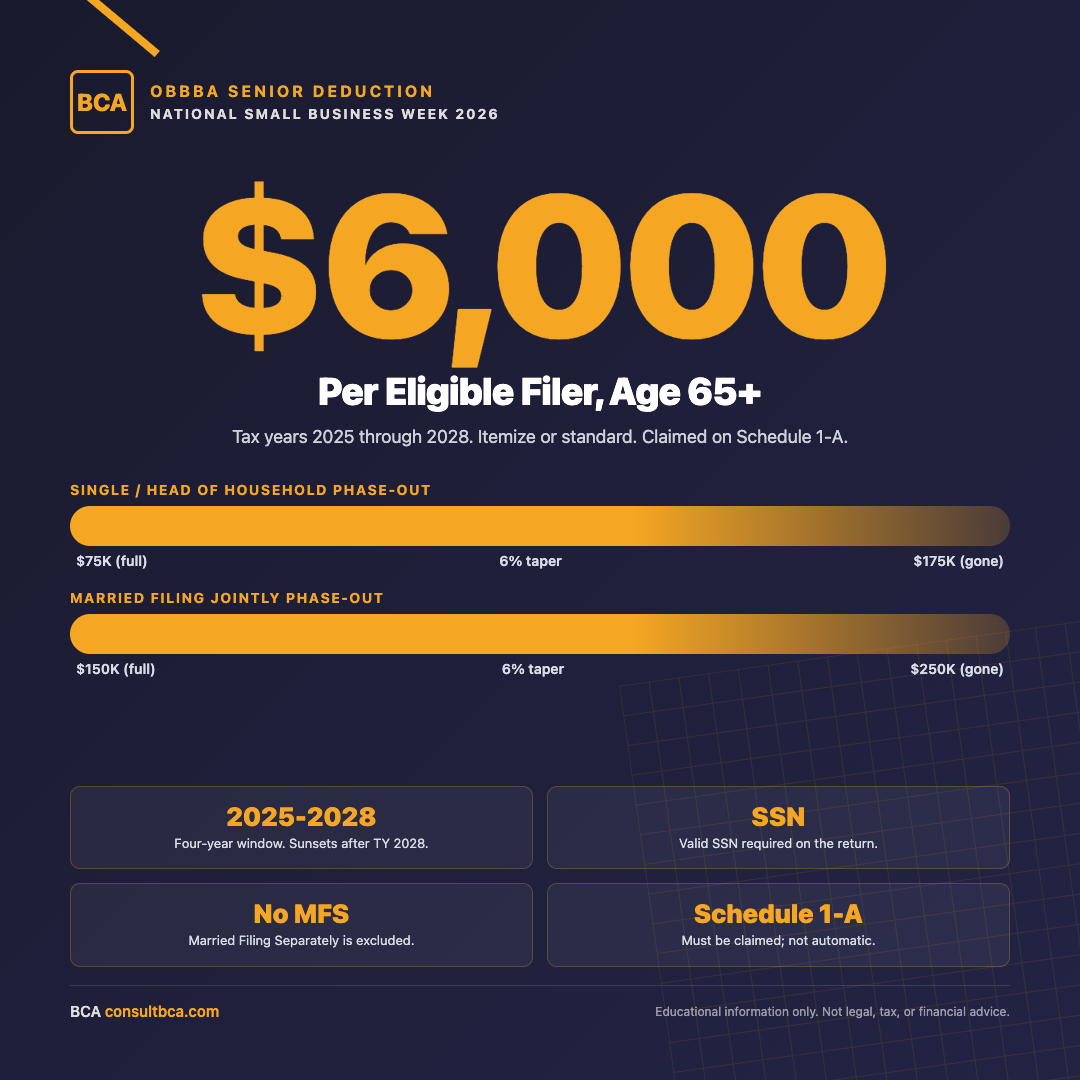
The 2026 filing season was the first one in which seniors could claim the One, Big, Beautiful Bill Act’s enhanced deduction for filers age 65 and over. The provision is worth up to $6,000 per eligible individual, applies for tax years 2025 through 2028, and is available whether the filer itemizes or takes the standard deduction. It is claimed on Schedule 1-A and reported on Form 1040/1040-SR.
If you have senior employees, retired contractors, or family members who consult on your books, this is the deduction they may have used (or missed) this year. Here is what to know going into 2026 planning and the 2027 filing season.
The deduction at a glance
- Amount: Up to $6,000 per eligible filer. For a married couple where both spouses are 65 or older and both qualify, the combined deduction can reach $12,000.
- Tax years covered: 2025, 2026, 2027, and 2028. Four years total. Sunsets after 2028 unless Congress extends.
- Eligibility age: Must be 65 or older on or before the last day of the tax year being filed. (For tax year 2025, anyone born on or before December 31, 1960 qualifies.)
- Itemize-or-not: Available whether the filer takes the standard deduction or itemizes. Reported on Schedule 1-A.
- Filing status: Married Filing Separately is excluded. Single, Head of Household, Qualifying Surviving Spouse, and Married Filing Jointly are all eligible.
- Documentation: Valid Social Security Number required on the return.
- Not automatic: It must be claimed on the return, using Schedule 1-A.
How the phase-out works
The phase-out is a gradual taper, not a cliff. Above the threshold, the deduction reduces by 6% of the MAGI excess over the threshold. The math:
| Filing Status | Phase-out Begins | Fully Phased Out At | Window |
|---|---|---|---|
| Single, Head of Household | $75,000 MAGI | $175,000 MAGI | $100,000 |
| Married Filing Jointly | $150,000 MAGI | $250,000 MAGI | $100,000 |
| Married Filing Separately | Not eligible | Not eligible | N/A |
Worked example. A single filer age 67 with MAGI of $100,000 is $25,000 over the $75,000 threshold. The reduction is 6% of $25,000, which is $1,500. The available deduction is $6,000 minus $1,500, or $4,500. At MAGI of $175,000, the reduction reaches $6,000 and the deduction is fully phased out.
What the deduction is not
A common point of confusion: the senior enhanced deduction is not the additional standard deduction for age 65 and over that has long been part of the standard deduction structure. That existing additional standard deduction continues unchanged. The OBBBA enhanced deduction is a separate, new $6,000 layer on top.
It is also not a credit. It reduces taxable income, not tax owed dollar-for-dollar. The cash value depends on the filer’s marginal rate.
It is also not the OBBBA tip deduction or the OBBBA overtime deduction. Those are separate provisions for working filers (which BCA covered in the No Tax on Tips post).
Three operational points for business owners
- Senior employees and contractors on payroll. If your team includes anyone 65 or older, their take-home math changed in 2025 in ways that may affect their withholding preferences. The IRS’s updated Tax Withholding Estimator now accounts for this deduction. A senior employee who was over-withheld in 2025 may want to revisit their W-4.
- Self-employed seniors. A senior consultant or independent contractor age 65 or older with self-employment income still gets the deduction (subject to the same phase-out). Quarterly estimated tax payments for 2026 should be modeled with the deduction included.
- Family members consulting on your books. A parent age 65+ who provides bookkeeping or advisory services to your small business may now find the deduction reduces the tax cost of that arrangement enough to make a more formal compensation structure worthwhile. Worth a planning conversation.
When to bring BCA in
Three planning conversations where the senior deduction matters:
- A senior contractor or family member whose compensation pushes them near the $75,000 / $150,000 phase-out threshold. Modeling the marginal tax cost of additional income matters more than usual under a phase-out structure.
- Estate and retirement income planning for clients in or near the eligible age. The deduction window (2025-2028) is finite; income timing decisions made now can preserve full deduction value.
- Multi-generation small businesses where the senior owner is approaching 65 or already there. The phase-out math interacts with QBI deduction calculations and other OBBBA provisions in ways worth modeling case by case.
BCA advisors bring business and compliance experience to the planning side. Our role is to advise and assist; the returns and decisions stay yours.
Sources
- U.S. Internal Revenue Service. “Check your eligibility for the new enhanced deduction for seniors.” IRS Newsroom. https://www.irs.gov/newsroom/check-your-eligibility-for-the-new-enhanced-deduction-for-seniors
- U.S. Internal Revenue Service. “One, Big, Beautiful Bill Act: Tax deductions for working Americans and seniors.” https://www.irs.gov/newsroom/one-big-beautiful-bill-act-tax-deductions-for-working-americans-and-seniors
- U.S. Internal Revenue Service. Publication 6142 (Schedule 1-A and senior deduction guidance). https://www.irs.gov/pub/irs-pdf/p6142.pdf
- U.S. Internal Revenue Service. Publication 554 (Tax Guide for Seniors). https://www.irs.gov/publications/p554
- One, Big, Beautiful Bill Act, Public Law 119-21 (July 4, 2025). https://www.congress.gov/119/plaws/publ21/PLAW-119publ21.pdf
- Tax Foundation. “OBBBA Income Tax Complexity and New Tax Breaks” (independent corroborator for $6,000 amount, 2025-2028 window, 6% phaseout, $75,000 single / $150,000 joint thresholds). https://taxfoundation.org/research/all/federal/obbba-income-tax-complexity-tax-breaks/
Disclaimer
This information is provided for general educational purposes and reflects opinions based on experience. Individual circumstances may vary. The senior enhanced deduction interacts with the standard deduction, additional age-65 standard deduction, QBI deduction, and other OBBBA provisions in ways that depend on the specific facts. BCA advisors bring business and compliance experience to help you evaluate documentation, model the phase-out math, and advise on planning options before filing.