
For the first filing season since the One Big Beautiful Bill Act became law, the “No Tax on Tips” deduction is operational. The IRS announced the final regulations in IR-2026-49 on April 10, 2026, and the regulations were published in the Federal Register on April 13, 2026. They take effect June 12, 2026, but the deduction itself applies to tips received during the 2025 tax year that workers and self-employed individuals are filing right now.
If you run a service business (restaurant, salon, hotel, transportation, recreation), or if you employ or are tipped workers, this is the year to get the rules right. The list of qualifying occupations is now final. The income thresholds are clear. The reporting mechanics are settled. Below is what matters for the BCA audience.
The deduction at a glance
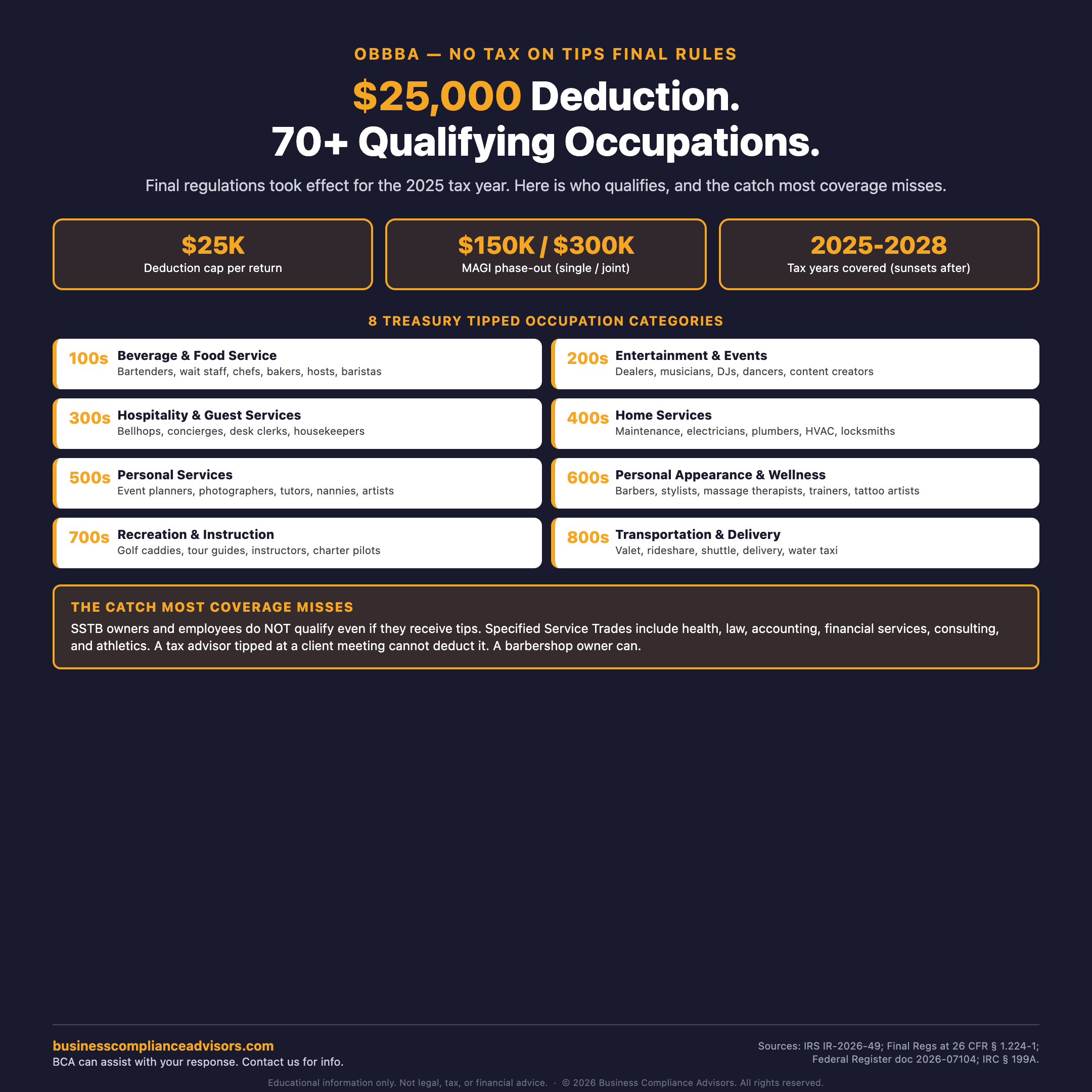
- Cap: Up to $25,000 of qualified tips per tax return.
- MAGI phase-out: Begins at $150,000 modified adjusted gross income for single filers, $300,000 for joint filers.
- Above-the-line: Available to filers who take the standard deduction. No itemizing required.
- Tax years covered: 2025 through 2028. Four years total. The deduction sunsets after the 2028 tax year unless Congress extends it.
- Self-employed cap: A self-employed individual’s deduction cannot exceed net income from the business in which the tips were earned.
- Reportable on: Form W-2, Form 1099-NEC, Form 1099-MISC, Form 1099-K, or Form 4137 (employee’s report of tips not reported to employer).
The 70+ qualifying occupations, in plain English
The Treasury Department published Table 1 of § 1.224-1(f) listing every occupation that “customarily and regularly received tips” on or before December 31, 2024. The list is organized into eight categories with three-digit codes. A worker’s job has to map to one of these codes for tips received in that role to qualify.
100s: Beverage and Food Service. Bartenders, wait staff, non-restaurant food and beverage servers, dining room and cafeteria attendants, chefs and cooks, food prep workers, fast food and counter workers, dishwashers, host staff, bakers.
200s: Entertainment and Events. Gambling dealers, gambling change and cage workers, gambling sportsbook writers, dancers, musicians and singers, disc jockeys (non-radio), entertainers and performers, digital content creators, ushers and ticket takers, locker room and coatroom attendants.
300s: Hospitality and Guest Services. Baggage porters and bellhops, concierges, hotel/motel/resort desk clerks, maids and housekeeping cleaners.
400s: Home Services. Home maintenance and repair workers, landscapers and groundskeepers, home electricians, plumbers, HVAC mechanics, appliance installers and repairers, home cleaning service workers, locksmiths, roadside assistance workers.
500s: Personal Services. Personal care and service workers, private event planners, private event and portrait photographers, private event videographers, event officiants, pet and show animal caretakers, tutors, nannies and babysitters, visual artists, floral designers.
600s: Personal Appearance and Wellness. Skincare specialists, massage therapists, barbers and cosmetologists, shampooers, manicurists and pedicurists, eyebrow and eyelash technicians, makeup artists, exercise trainers and group fitness instructors, tattoo artists and piercers, tailors, shoe and leather workers.
700s: Recreation and Instruction. Golf caddies, self-enrichment teachers, recreational and tour pilots, tour guides, travel guides, sports and recreation instructors.
800s: Transportation and Delivery. Parking and valet attendants, taxi and rideshare drivers, shuttle drivers, goods delivery people, personal vehicle and equipment cleaners, private and charter bus drivers, water taxi and charter boat workers, rickshaw and pedicab drivers, home movers, gas pump attendants.
If your role does not appear on this list, the tips are not “qualified tips” for purposes of the deduction even if they are taxable income.
The fine print most coverage will miss
The SSTB exclusion. This is the single most important caveat for BCA’s audience. Owners of a Specified Service Trade or Business and employees of an SSTB are not eligible to claim the tips deduction, even if they personally receive tips. SSTBs are defined the same way they are under IRC § 199A: health, law, accounting, actuarial science, performing arts, consulting, athletics, financial services, brokerage services, and the trade or business of investing, investment management, trading, or dealing in securities. A tax advisor who receives a tip cannot deduct it. A consulting firm employee who is tipped at a client meeting cannot deduct it. A barbershop owner can. A restaurant owner can. Look at the trade or business, not just the occupation code.
The MAGI phase-out. The deduction phases out above $150,000 single / $300,000 joint. For high-income tipped earners (concierges at premium hotels, top stylists, charter pilots), planning matters: every additional dollar of MAGI above the threshold reduces the available deduction. Confirm the current-year phase-out mechanics from the 2025 Form 1040 instructions before relying on a specific dollar value.
Service charges versus tips. A “service charge” the customer cannot remove or change is wages, not a tip. It does not qualify for the deduction. If the customer can override the suggested amount or remove the charge entirely, it can qualify.
Tip pooling counts. Tips received through a mandatory or voluntary tip-sharing arrangement (a tip pool) qualify, as long as the underlying tip from the customer was voluntary.
Cash plus electronic. Qualified tips include cash, checks, credit and debit card tips, gift card tips, and mobile payment app tips (Venmo, Zelle, Cash App, Square, etc.). Tokens that are exchangeable for a fixed cash amount qualify too.
For employers: what to do
- Audit your occupation codes. If you employ any role that fits the Table 1 list, your tipped employees are eligible. Map each role to a Treasury Tipped Occupation Code so you can document eligibility cleanly.
- Verify your trade or business is not an SSTB. Restaurants, salons, hotels, transportation, recreation, and similar service businesses are typically not SSTBs. Health (medical practices), law firms, and accounting firms are. If you are uncertain, this is the question to bring to BCA before W-2s are finalized for 2025.
- Report tips correctly on Form W-2. Tips must appear in Box 1 (wages, tips, other compensation), Box 5 (Medicare wages), and Box 7 (Social Security tips). Allocated tips, if you have a tip allocation system, go in Box 8. The new deduction does not change what employers report. It changes what employees can deduct on their personal returns.
- For 2025 returns being filed now: if you reported tips on W-2s issued in January 2026, your employees already have what they need to claim the deduction. They claim it on the new line for the qualified tips deduction (the IRS published the line number in the 2025 Form 1040 instructions).
- For 1099 contractors who receive tips: tips paid through Form 1099-NEC, 1099-MISC, or 1099-K already flow to the contractor’s Schedule C. They claim the deduction the same way employees do, subject to the self-employed net income cap.
For tipped workers and self-employed individuals: what to do
- Confirm your role is on the list. If you are unsure which Treasury Tipped Occupation Code applies, the IRS list at IRS.gov/forms-pubs is searchable.
- Pull together your 2025 tip records. W-2 Box 7, any 1099 forms, Form 4137 if you reported unreported tips, plus your own records (POS reports, app payouts, tip pool statements).
- Check your MAGI. If you expect modified adjusted gross income above $150,000 single or $300,000 joint, the phase-out reduces your deduction. Plan accordingly.
- If you are self-employed: your deduction cannot exceed the net income from the business in which you earned the tips. This means careful tracking of business expenses against tip income.
- If you work for a tipped employer in a non-tipped role: you do not qualify. The deduction follows the role, not the workplace. A back-office bookkeeper at a restaurant does not get the deduction.
Common mistakes BCA expects to see this filing season
- Claiming the deduction on tips received as a W-2 employee of an SSTB. Fitness instructors at a hospital wellness program, photographers contracted to a law firm event – the SSTB exclusion catches them.
- Counting service charges as tips. A 20 percent automatic gratuity that the customer cannot remove is wages. Reporting it as a qualified tip is incorrect.
- Self-employed claiming more than net income. A rideshare driver with $30,000 in tips and $35,000 in business expenses has zero net income. The deduction is zero, not $25,000.
- Filing before reviewing 2025 W-2 Box 7. If your employer underreported tips, you cannot deduct what was not reported. Get the W-2 corrected first.
- Assuming the deduction is permanent. It expires after 2028. Multi-year tax planning needs to model the cliff.
When to bring BCA in
Three scenarios worth a call before filing:
- You are uncertain whether your business is an SSTB (or whether the line of work that earns the tips is part of an SSTB).
- You operate a multi-role business (a salon with both stylists and a tax preparer on staff, a hotel with a legal department, a restaurant with a side catering arm) and need to map roles to occupation codes correctly.
- You have a tipped employee whose 2025 earnings put them near or over the MAGI phase-out and want to model the deduction value.
BCA advisors bring business and compliance experience to the planning side. We help you organize the records, advise on how the rules apply to your specific situation, and walk through how the tips deduction interacts with the rest of OBBBA (overtime deduction, QBI, bonus depreciation). The returns and decisions stay yours; our role is to advise and assist.
Sources
- U.S. Internal Revenue Service. “Treasury, IRS issue final regulations listing occupations where workers customarily and regularly receive tips under the One, Big, Beautiful Bill.” IR-2026-49, April 10, 2026.
- U.S. Internal Revenue Service. “One, Big, Beautiful Bill Act: Tax deductions for working Americans and seniors.” IRS.gov.
- U.S. Internal Revenue Service. “Occupations that customarily and regularly received tips on or before December 31, 2024.” IRS Forms-Pubs reference list.
- Federal Register. “Occupations That Customarily and Regularly Received Tips; Definition of Qualified Tips.” 26 CFR Part 1, document 2026-07104, published April 13, 2026.
- Internal Revenue Code § 199A (definition of Specified Service Trade or Business).
This information is provided for general educational purposes and reflects opinions based on experience. Individual circumstances may vary. The interaction between the tips deduction, SSTB rules, MAGI phase-out, and other OBBBA provisions can be complex. BCA advisors bring business and compliance experience to help you evaluate documentation, advise on how the rules apply to your situation, and weigh the planning options before filing.