
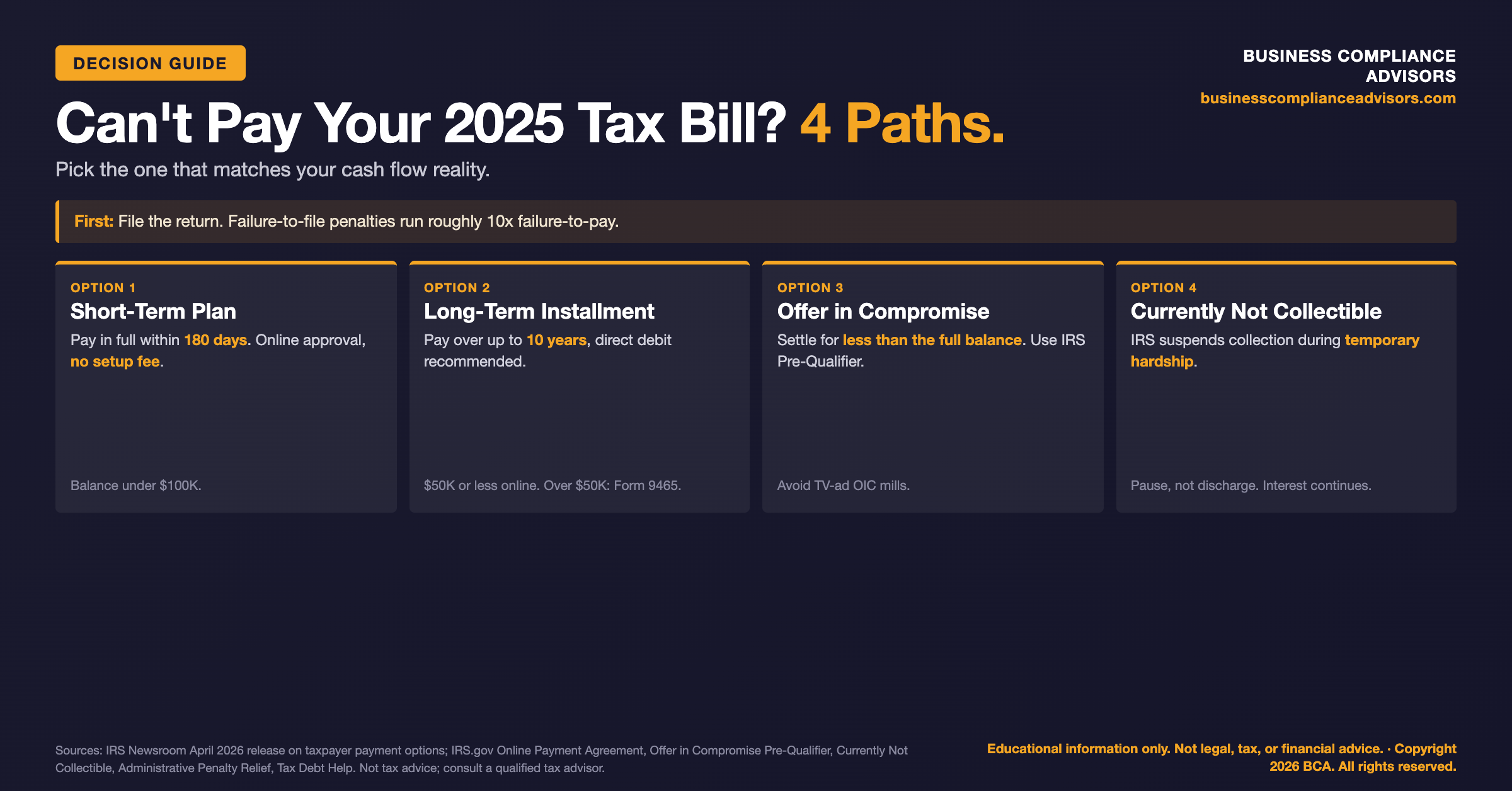
File the return first. Then pick the repayment path that matches your cash flow reality.
A 2025 tax bill you cannot pay in full is common in small business. Q1 receivables slipped, a customer paid late, or the business took a loss you had to fund personally. The balance is real, the IRS will want its money, and ignoring the problem costs roughly ten times more than picking the wrong repayment option.
This piece walks through the four decisions that determine which IRS path is right for you.
First, file the return no matter what
Before any repayment conversation, the return has to be filed. Failure-to-file penalties run about ten times the failure-to-pay penalty. If you missed April 15, start with our full action list for late filers. If you are still in the extension window, file as soon as possible. Every option below assumes a return is on file.
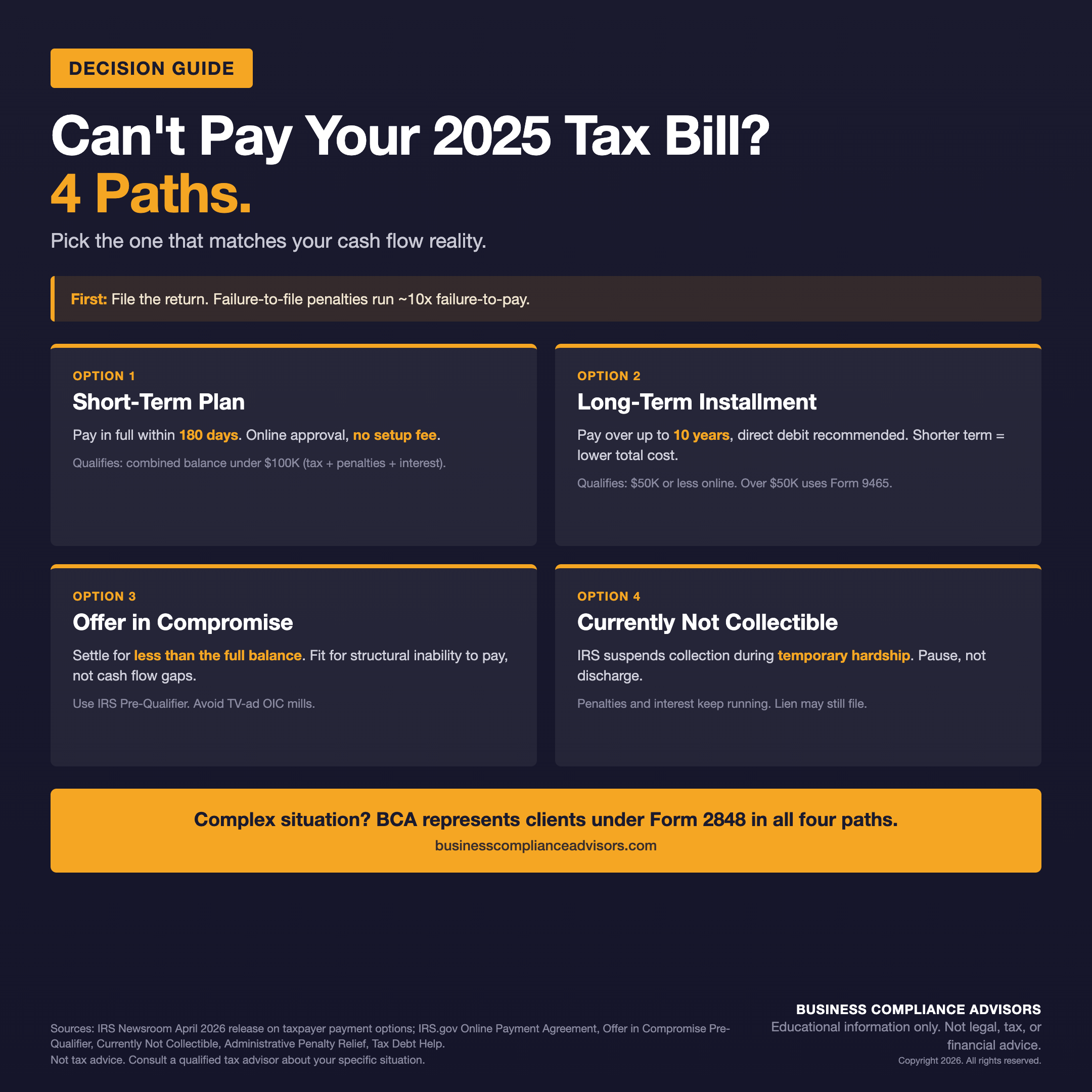
Decision 1: Can you pay in full within 180 days?
If cash flow will clear up inside six months, the right tool is the short-term payment plan. Combined balance of tax, penalties, and interest under $100,000 qualifies. Apply online through the IRS Online Payment Agreement tool on IRS.gov. There is no setup fee. You still accrue interest and penalties while the balance remains, but no long-term debt, no direct-debit authorization, no paperwork.
Best fit: seasonal businesses waiting on a known receivable, a refinance closing in 60 to 120 days, or a liquidity event already scheduled.
Decision 2: Can you pay in full eventually, just not in six months?
This is where the long-term installment agreement fits. Balance of $50,000 or less in combined tax, penalties, and interest qualifies for online setup. Up to ten years to pay, with direct debit strongly recommended so you do not default on a missed payment.
Setup fees apply (waived or reduced for low-income taxpayers). Interest and penalties keep running on the unpaid balance until it is retired, so a shorter term is always cheaper. Model both scenarios before you choose: the monthly payment you can sustain, and what the total cost looks like over five, seven, or ten years.
If the balance is between $50,000 and $100,000, you may still be eligible for an installment agreement but the application moves offline with Form 9465, and the IRS may require a streamlined or partial-pay review with financial disclosure.
Decision 3: Is full payment realistically possible at all?
If the answer is no for structural reasons (permanent loss of earning capacity, business closure, medical inability to work), the Offer in Compromise may allow the IRS to settle for less than the full balance. The IRS Offer in Compromise Pre-Qualifier tool on IRS.gov is the right first screen. If you look viable, the full Form 656 package requires detailed financial disclosure and a $205 application fee (waived for low-income applicants).
Two cautions. First, OIC acceptance rates hover around one in five and the IRS typically takes six to twelve months to process an offer. Second, “OIC mills” advertising on radio or cable television routinely charge thousands in upfront fees to tell you what the free pre-qualifier already tells you. Do not pay a flat fee upfront to someone you saw on TV.
Decision 4: Is this a temporary hardship rather than a permanent one?
If paying would mean you cannot cover basic living expenses right now, but your financial picture will improve, request Currently Not Collectible status. The IRS will suspend active collection until your financial condition improves. Penalties and interest continue to accrue, and the IRS will revisit the case periodically. A federal tax lien may still be filed, which affects credit and business borrowing.
CNC is a pause, not a discharge. Plan for the day collection resumes.
What about penalty abatement?
First-time penalty abatement is available if you filed and paid on time for the prior three years. It covers the failure-to-file or failure-to-pay penalty but not the interest. You have to request it. The IRS does not apply it automatically.
Reasonable-cause abatement is available for circumstances outside your control: serious illness, natural disaster, destroyed records, death in the family. Document everything and submit in writing. Do not bundle reasonable-cause with first-time abatement on the same tax year. File separately if both might apply.
Before you apply for anything
A few moves that save money and avoid surprises:
- Run the IRS Tax Debt Help tool on IRS.gov. It is a short decision aid that routes you to the right program based on your numbers.
- Pull your IRS account transcript. Know the exact balance including accrued penalties and interest, not your best estimate.
- Do not forget state tax. Most states have parallel payment programs and they will not wait for the federal IRS to finish first.
- If a business is involved, the Business Tax Account now covers partnerships, governments, and tax-exempt organizations in addition to corporations. Use it to see balances across linked entities in one view.
When to bring BCA in before you apply
Most taxpayers with a clean prior history and a straightforward balance can handle the online tools themselves. Situations that justify advisor help before you apply:
- Prior-year balances already in an installment agreement
- Multi-state exposure with parallel state collection actions
- An existing IRS notice, audit, or correspondence you have not answered
- Business and personal liability tangled together (pass-through entities, payroll tax issues)
- Offer in Compromise where financial disclosure gets complicated or assets are hard to value
In those cases, the right sequence is different. A straight online application can lock you into a worse deal than strategic representation under Form 2848 Power of Attorney.
Reach out to BCA before your first call to the IRS if any of the above apply. We negotiate with the IRS on behalf of clients in all four of these paths and can often structure a faster, cheaper outcome than you would get filing an online application cold.
Sources
- IRS Newsroom, Options for taxpayers who need help paying their tax bill (April 2026)
- IRS.gov Online Payment Agreement and installment agreement pages
- IRS.gov Offer in Compromise, Offer in Compromise Pre-Qualifier, Form 656 booklet
- IRS.gov Currently Not Collectible status page
- IRS.gov Administrative Penalty Relief page
- IRS.gov Tax Debt Help tool
- IRS Data Book 2024, Offer in Compromise statistics (FY 2024)