
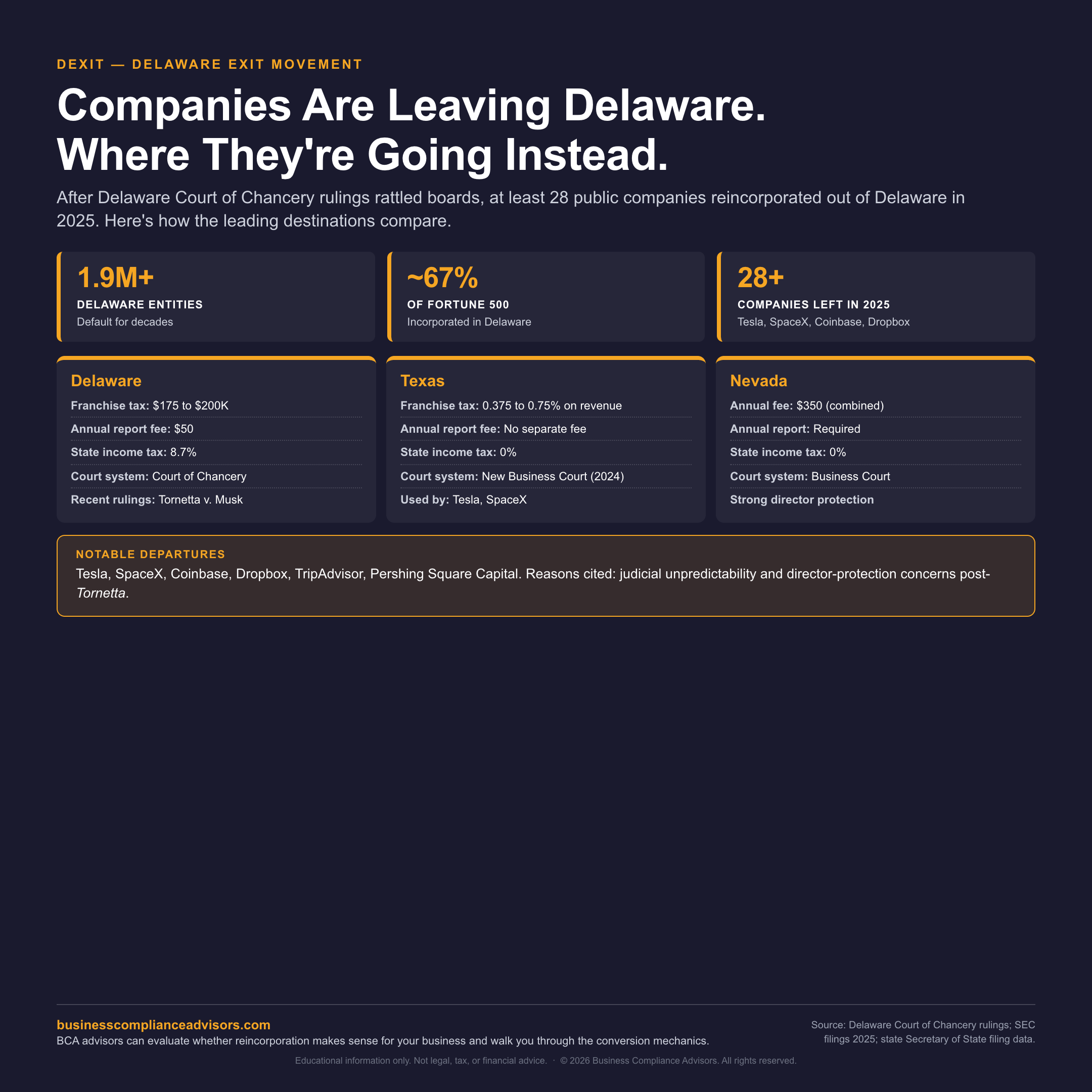
If you’ve incorporated your business in Delaware, you’re not alone. For decades, Delaware has been the default choice for American companies, from startups to Fortune 500 giants. Over 1.9 million business entities call Delaware home, and roughly two-thirds of Fortune 500 companies are incorporated there.
Yet something has shifted. A movement now known as “DEXIT” (short for Delaware Exit) is gaining real momentum. In 2025, at least 28 public companies formally reincorporated out of Delaware. That number may sound small against the total, but the names involved tell a bigger story: Tesla, SpaceX, Coinbase, Dropbox, TripAdvisor, and Pershing Square Capital Management have all packed up and left.
For small business owners, sole proprietors, and startup founders, the question is no longer “Should I incorporate in Delaware?” It’s “Should I still be there, and if not, where should I go?”
What Triggered the Exodus
The DEXIT movement traces back to a pair of Delaware Court of Chancery decisions that rattled the business community. In Tornetta v. Musk, the court voided Elon Musk’s $56 billion Tesla compensation package, ruling that the board process was flawed because of Musk’s controlling influence. In Maffei v. Palkon (involving TripAdvisor), the court scrutinized transactions involving controlling stockholders under standards that many business leaders saw as unpredictable.
These decisions sent a clear message: if you’re a founder, majority stockholder, or controlling shareholder, Delaware courts might second-guess your deals, even when disinterested directors and independent committees approved them.
Musk moved Tesla to Texas within weeks. Others followed.
Delaware Fought Back. But Is It Enough?
Delaware didn’t sit idle. On March 25, 2025, Governor Matt Meyer signed Senate Bill 21 (SB 21) into law. The legislation overhauled key sections of the Delaware General Corporation Law, aiming to restore confidence among corporate boards and controlling stockholders.
The major changes under SB 21 include:
- Clearer definitions of “controlling stockholder” and what constitutes a “material relationship” with directors
- New safe harbor provisions that protect controlling stockholder transactions if approved by a majority of disinterested directors or disinterested stockholders
- Reduced liability exposure for controlling stockholders, limiting monetary damages to breaches of the duty of loyalty, bad faith, and improper personal benefit
- Tighter rules on books and records requests under Section 220, limiting scope to formal corporate documents and board materials (excluding emails and texts)
The Delaware Supreme Court upheld SB 21’s constitutionality in March 2026, which may slow the bleeding. And the numbers back that up: about 30% more new Delaware entities formed in 2025 compared to 2024. But the companies leaving are the big names, and that shapes how the market sees Delaware going forward.
Where Are Companies Going?
The top destinations for departing companies have been Nevada, Texas, and to a lesser extent Wyoming, Indiana, and Florida. Each state offers a different mix of advantages depending on your business type, size, and priorities.
Here’s where the notable departures landed:
- Texas: Tesla, SpaceX, Coinbase, Dillard’s
- Nevada: Neuralink, Dropbox, TripAdvisor, Pershing Square
- Indiana: Simon Property Group
State-by-State Comparison: Formation Costs
Cost is often the first thing small business owners look at, and the differences are substantial. Below is a comparison of what it costs to form and maintain a C Corporation or LLC in the states most commonly considered.
Initial Formation Filing Fees
| State | C Corp Filing Fee | LLC Filing Fee | Notes |
|---|---|---|---|
| Delaware | $99 | $90 | Plus optional expedited fees |
| Nevada | $325 | $325 | Includes state business license |
| Wyoming | $100 | $100 | Lowest total cost option |
| Texas | $300 | $300 | Straightforward single fee |
| South Dakota | $150 | $150 | Low cost with strong privacy |
| Florida | $70 | $125 | Lowest C Corp filing fee |
Annual Maintenance Costs
| State | Annual Report Fee | Franchise/Business Tax | Total Minimum Annual Cost |
|---|---|---|---|
| Delaware | $50 | $175 minimum (corps) | $225+ |
| Nevada | $150 (list filing) | $200 (business license) | $350 |
| Wyoming | $52 (LLC) / $52 (Corp) | None | $52 |
| Texas | $0 (biennial, no fee) | $0 if revenue under $2.47M | $0 |
| South Dakota | $50 | None | $50 |
| Florida | $138.75 | None for small corps | $138.75 |
The Delaware franchise tax trap: That $175 minimum sounds manageable, but it can escalate fast. Delaware calculates franchise tax using either the Authorized Shares Method or the Assumed Par Value Capital Method. A startup that authorized 10 million shares (common for companies planning to raise venture capital) could owe $85,000 or more in franchise tax under the default calculation. Most tax advisors will switch you to the Assumed Par Value method to bring it down, but you need to know to ask. The maximum franchise tax is $200,000 for most corporations, or $250,000 for “Large Corporate Filers.”
Tax Treatment Comparison
| Factor | Delaware | Nevada | Wyoming | Texas | South Dakota |
|---|---|---|---|---|---|
| State Corporate Income Tax | 8.7% | None | None | None | None |
| State Personal Income Tax | 2.2% – 6.6% | None | None | None | None |
| Franchise Tax | $175 – $250,000 | None | None | 0.375% (over $2.47M revenue) | None |
| Sales Tax | None | 6.85% + local | 4% + local | 6.25% + local | 4.2% + local |
| Property Tax on Digital Assets | May apply | None specifically | Exempt by statute | Not addressed | None specifically |
Privacy and Anonymity
Privacy protections vary significantly across states. For business owners concerned about personal security, competitive exposure, or public disclosure, choosing the right state matters.
| Privacy Feature | Delaware | Nevada | Wyoming | South Dakota |
|---|---|---|---|---|
| Owner Names on Formation Docs | No | No | No | No |
| Officer/Director Names Required | No (at formation) | Yes (annual list, not public) | No | No |
| Nominee Officers Allowed | Yes | Yes | Yes | Yes |
| Public Database Searchable | Limited | Moderate | Minimal | Minimal |
| Beneficial Ownership (Federal CTA) | Exempt (as of March 2025) | Exempt | Exempt | Exempt |
Important update on the Corporate Transparency Act: As of March 26, 2025, all domestic U.S. entities are exempt from FinCEN’s beneficial ownership reporting requirements under the CTA. This means the federal-level privacy concerns that pushed many businesses toward anonymous LLC states have been significantly reduced. However, the exemption applies only to domestic entities. Foreign-owned companies still must report.
Registered Agents: A Hidden Cost to Factor In
Every state requires your business to have a registered agent with a physical street address in that state. If you incorporate in a state where you don’t have an office or residence, you’ll need to hire a commercial registered agent service. This is an ongoing annual cost that many business owners overlook when comparing states.
A registered agent receives legal documents, service of process, and state correspondence on your behalf. They must be available at a physical address during normal business hours. You can’t use a P.O. box or mail forwarding service.
Many commercial registered agent services go well beyond just accepting mail. Depending on the provider, you may also get mail scanning (documents are scanned and uploaded to an online portal so you can view them from anywhere), mail forwarding to your home or office address, compliance reminders for annual report deadlines and franchise tax due dates, and sometimes basic filing assistance for annual reports. For founders running a business remotely or from another state, these services can save real headaches. When comparing agent providers, look at what’s included in the base fee versus what costs extra.
Registered Agent Annual Fees by State
| State | Typical Annual Fee | Common Add-On Services | Notes |
|---|---|---|---|
| Delaware | $50 – $175 | Mail scanning, compliance alerts, annual report filing | High competition keeps prices low; many formation services bundle agent fees |
| Nevada | $100 – $200 | Mail scanning, mail forwarding, virtual office packages | Agent must maintain a physical NV address; many providers available |
| Wyoming | $25 – $150 | Mail scanning, mail forwarding, compliance calendar | Agent must be a WY resident or authorized WY business entity; lowest cost options |
| Texas | $100 – $200 | Mail scanning, mail forwarding, annual report filing | Large state with many provider options |
| South Dakota | $100 – $200 | Mail scanning, mail forwarding | Fewer providers; pricing may be higher in practice |
Wyoming registered agent details: Wyoming law requires that an individual registered agent must be at least 18 years old, reside in Wyoming, and maintain a physical street address in the state (no P.O. boxes). If you’re forming a Wyoming entity from out of state, you’ll need to use a commercial registered agent service. Wyoming has some of the lowest agent fees in the country, with several providers offering service for $25 to $100 per year. Commercial registered agent companies register with the Wyoming Secretary of State and pay a $50 annual registration fee.
If you operate in multiple states: You’ll need a registered agent in each state where your business operates or is registered to do business, not solely in your state of incorporation. A company incorporated in Wyoming but operating in California needs agents in both states. Budget accordingly.
Why Crypto and Digital Asset Companies Should Pay Attention
If your business holds, trades, or manages cryptocurrency or digital assets, your state of incorporation matters more than you might think.
Wyoming has been a national leader in digital asset legislation. The state has enacted over 30 blockchain-related laws, including:
- Legal recognition of virtual currency, digital securities, and digital consumer assets as property
- Special Purpose Depository Institution (SPDI) charters for digital asset custody
- Legal recognition of Decentralized Autonomous Organizations (DAOs) as LLCs
- Explicit exemption of digital assets from state property tax
Nevada offers no state corporate income tax and no franchise tax, making it attractive for crypto companies focused on minimizing tax exposure. But Nevada hasn’t matched Wyoming’s regulatory clarity on digital assets specifically.
Coinbase’s move to Texas in late 2025 (valued at roughly $80 billion with $7.7 billion in annual revenue) was the highest-profile crypto company departure from Delaware. Coinbase’s Chief Legal Officer Paul Grewal stated that Delaware “left them with little choice,” citing the loss of legal consistency and predictability.
Which State Is Right for Your Business?
There’s no single best answer. The right choice depends on your specific situation.
| If Your Priority Is… | Best Fit | Why |
|---|---|---|
| Raising venture capital / IPO track | Delaware or Nevada | Some VCs and institutional investors still prefer Delaware governance, though this is increasingly a preference rather than a requirement as other states mature |
| Lowest ongoing costs | Wyoming or Texas | Wyoming: $52/year. Texas: $0 for businesses under $2.47M revenue |
| Maximum owner privacy | Wyoming or South Dakota | Minimal public disclosure, no member/manager names on file |
| Crypto / digital asset business | Wyoming | Broadest digital asset legal framework in the country |
| Large public company / controlled entity | Nevada or Texas | Stronger director protections, less aggressive courts on controlling stockholder transactions |
| Sole proprietor / single-member LLC | Your home state or Wyoming | Avoid paying for registered agents in two states; Wyoming if privacy matters |
What This Means for BCA Clients
If you’re already incorporated in Delaware and your business is running smoothly, there’s no reason to panic. Delaware still has the most developed body of corporate case law in the country, and SB 21 addressed many of the concerns that triggered the initial wave of departures.
But if you’re forming a new entity, or if you’re a small business owner paying Delaware franchise taxes that don’t make sense for your size, it’s worth running the numbers. A Wyoming LLC costs $100 to form and $52 per year to maintain. A Texas entity with under $2.47 million in revenue pays no state franchise tax at all.
One cost that catches many new business owners off guard is licensing. Depending on where you operate (not just where you incorporate), you may need business licenses at the state, county, and city level. Many cities require a general business license just to operate within city limits, and some industries require additional permits or professional licenses. These fees vary widely. A general business license in Las Vegas, for example, costs between $50 and $200 per year depending on business type, while a contractor license in California can run over $400 plus exam and bonding costs. Before choosing a state of incorporation, research the licensing requirements in every jurisdiction where you plan to do business.
At BCA, we help clients evaluate their incorporation state as part of our overall compliance and tax strategy review. If you’re unsure whether your current structure still makes sense, reach out to our team. The rules have changed, and what made sense five years ago may not make sense today.
Disclaimer: This article is for informational purposes only and is not legal, tax, or financial advice. BCA is not a licensed professional services firm. We help clients assess their situations and work with licensed attorneys, tax advisors, and other qualified professionals on your behalf. Read our full Disclaimer and Terms of Use. Have questions? Contact BCA and let us put the right team together for you.
Sources and Further Reading
- Foley & Lardner LLP, “DExit: Why Some Companies Are Leaving Delaware” (September 2025) – foley.com
- Harvard Law School Forum on Corporate Governance, “Delaware Revamps Its General Corporation Law” (April 2025) – corpgov.law.harvard.edu
- Glass Lewis, “The State of US Reincorporation in 2025” – glasslewis.com
- CNBC, “Despite Coinbase Departure, Only 28 Companies Left Delaware This Year” (November 2025) – cnbc.com
- Delaware Division of Corporations, Franchise Tax Information – corp.delaware.gov
- Nelson Mullins, “Coinbase Leaves Delaware and Saddles Up for Texas” – nelsonmullins.com
- Wyoming Secretary of State, Digital Asset Legislation – wyomingllcattorney.com
- Wyoming Secretary of State, Registered Agent Requirements – sos.wyo.gov
- Wolters Kluwer, “Anonymous LLCs: Privacy, States & Formation Steps” – wolterskluwer.com