
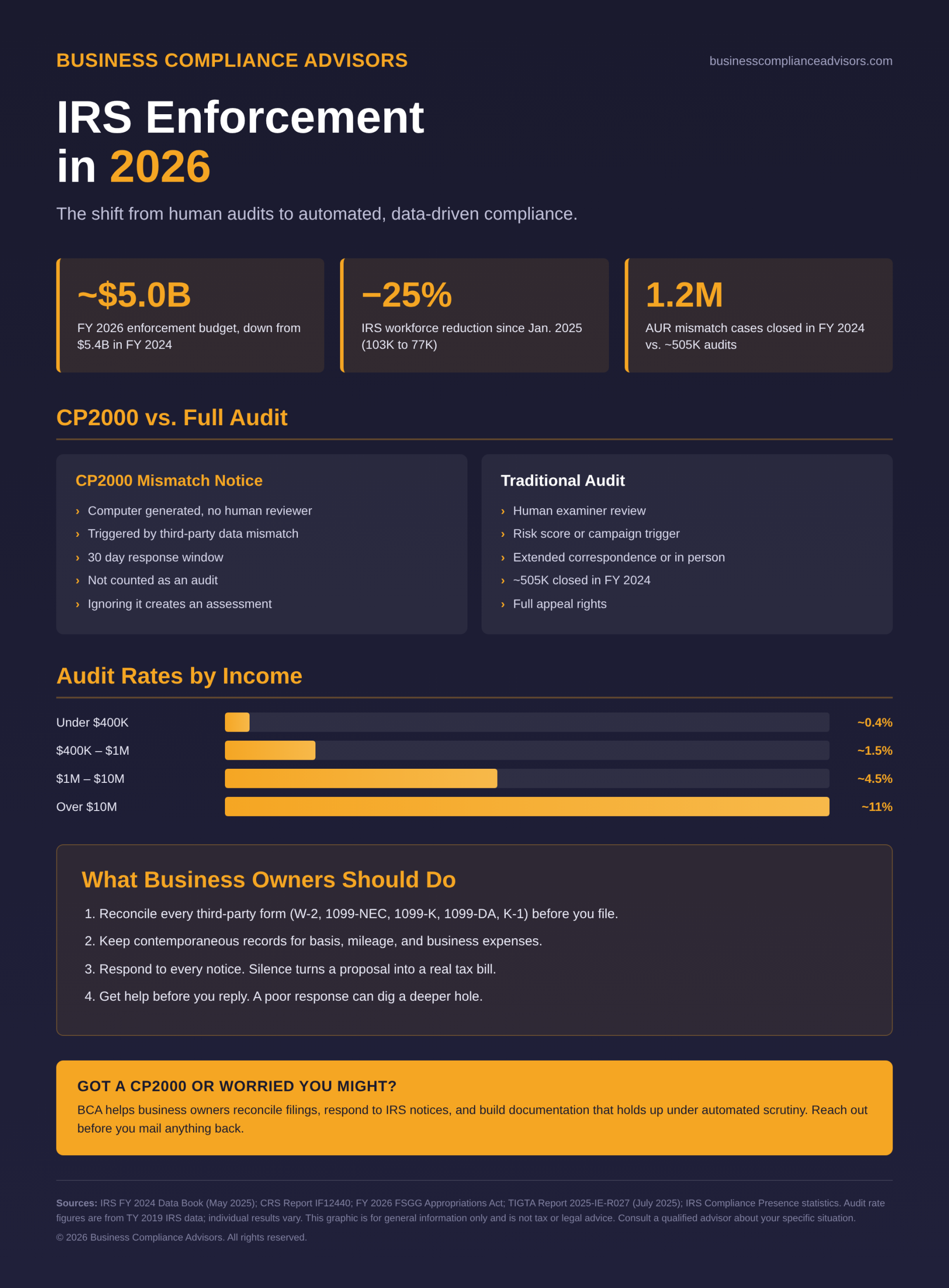
If you hear from the IRS in 2026, the odds are high it won’t be from a person. It will be a computer-generated letter triggered by a data mismatch, sent before any examiner has looked at your return. That shift is the single most important thing small business owners and self-employed taxpayers need to understand about enforcement this year.
The IRS is running on a smaller budget and a smaller workforce. Congress cut the enforcement appropriation from $5.4 billion in FY 2024 to roughly $5.0 billion in FY 2026, a reduction of about $440 million. At the same time, the agency’s overall headcount dropped from approximately 103,000 employees in January 2025 to around 77,000 by May 2025, a decline of about 25%. Revenue agents, who handle enforcement cases, saw roughly 31% of their ranks depart. With fewer examiners, the agency is leaning harder on the tools that scale: automated data matching, AI-assisted return scoring, and third-party information reporting. The result is an enforcement model that is faster, narrower, and much more algorithmic than what most business owners are used to.
The Automated Underreporter Is Doing the Heavy Lifting
The IRS program behind most of the notices going out is called the Automated Underreporter, or AUR. It compares what you reported on your Form 1040 against what payers, brokers, banks, employers, and crypto exchanges reported to the IRS on your behalf. When the numbers don’t line up, the system generates a notice. No human reviews it first in most cases.
The scale matters. AUR closed 1.2 million cases in FY 2024 alone, generating $7.7 billion in additional assessments. Traditional audits, by comparison, closed about 505,000 in the same year. If you get a letter this year, it is far more likely to be an automated mismatch notice than a real audit. That distinction changes everything about how you should respond.
CP2000 Is Not an Audit, But Don’t Treat It Like Junk Mail
The most common mismatch notice is the CP2000. It proposes changes to your return based on information the IRS received from third parties. It is not a formal audit. It does not count in official audit statistics. But ignoring it is the fastest way to turn a small problem into a big one.
Here’s what a CP2000 looks like in practice. A broker reports $105,000 in proceeds from crypto sales on a new Form 1099-DA. Your tax software shows $100,000 because your basis math was slightly different. The IRS computer sees a $5,000 discrepancy and mails you a proposed assessment. If you don’t respond within the window (usually 30 days), the proposed change becomes a real tax bill, with penalties and interest attached.
CP2000s are fast and cheap for the IRS. They are also blunt. The computer doesn’t know about your cost basis, your timing adjustments, or the context behind a number. You have to tell it. You do that with a written response and supporting records.
Who Gets Targeted: It’s Not Random
Audit selection has been data-driven for years, but the model is sharper in 2026. The IRS uses statistical scoring (the old DIF score) plus newer AI and machine-learning systems to rank returns by examination potential. With fewer people to run audits, the agency is concentrating human attention where the dollars are biggest.
The pattern looks like this. For tax year 2019 (the most recent year with complete data), taxpayers with total positive income over $10 million faced an 11% audit rate. Large partnerships and complex pass-through entities draw heavy scrutiny, especially around basis adjustments, transfer pricing, and international reporting on Forms 5471, 5472, and FBARs. The IRS has publicly committed not to raise audit rates for filers under $400,000, and that promise has held for traditional audits. Automated matching, though, applies to everyone.
Earned Income Tax Credit filers still see elevated correspondence audit rates because EITC errors are easy for the system to flag. Self-employed filers and gig workers sit in an uncomfortable middle zone: low enough that they rarely face a full field audit, but high enough in documentation complexity that mismatch notices are common.
Crypto Is Where the New Pressure Is Landing
The rollout of Form 1099-DA for digital asset proceeds is the single biggest new source of CP2000s in the 2026 filing season. Brokers and exchanges are now reporting proceeds to the IRS, and the automated system is matching those reports against what taxpayers put on Schedule D and Form 8949.
There’s a catch that is catching a lot of people. Most 1099-DA forms report proceeds without cost basis. If you sold $50,000 in crypto that you bought for $48,000, the exchange may only report the $50,000 figure. The IRS computer, seeing no offsetting basis, treats the whole $50,000 as gain. You’ll get a notice proposing tax on an amount that isn’t really income. Reconciling that requires records: dates of purchase, purchase prices, wallet histories, and transfers between exchanges.
What Business Owners Should Actually Do
The playbook for 2026 enforcement is less about fighting audits and more about avoiding mismatches in the first place. A few things matter more than they used to.
Reconcile every third-party form before you file. W-2s, 1099-NECs, 1099-Ks, 1099-DAs, K-1s, and 1098s all flow into the AUR system. If your return doesn’t tie to the forms the IRS has, the letter is coming. Wait for the forms. Check them against your records. Don’t file in February on the assumption that late-arriving 1099s will work themselves out.
Keep contemporaneous records. Basis for crypto and securities. Mileage logs for vehicle deductions. Receipts and business purpose for entertainment and travel. The automated system can’t see any of this, and by the time you get a notice, you’ll be reconstructing it under a deadline. Do it as you go.
Respond to every notice, even the ones that look wrong. CP2000s have response windows. Miss them and the proposed assessment becomes real. Even a short letter explaining the discrepancy, with documents attached, is enough to get the case back into review. Silence is the worst response.
Get help before you reply. Automated notices look simple, but a poor response can dig a deeper hole. This is where business owners most often try to handle things themselves and regret it later. A short conversation with a qualified advisor before you mail anything back can save months of cleanup.
How BCA Helps
BCA works with business owners on exactly this kind of situation. We help clients reconcile their third-party reporting before filing, build the documentation that holds up under automated scrutiny, and draft CP2000 responses that actually move the case. If you’ve received an IRS notice and don’t know what it means, or if you want to get ahead of the 2026 filing season before the mismatches start landing in your mailbox, reach out. The earlier we get involved, the cheaper the fix tends to be.
Sources: IRS FY 2024 Data Book (May 2025); CRS Report IF12440, “Internal Revenue Service Appropriations, FY2024”; FY 2026 Financial Services and General Government Appropriations Act; TIGTA Report 2025-IE-R027, “Snapshot Report: IRS Workforce Reductions as of May 2025” (July 2025); IRS Compliance Presence statistics; National Taxpayer Advocate Annual Report to Congress; IRS e-News for Tax Professionals, Issues 2026-02 and 2026-14.