If a credit card account has charged off, been sold to a debt buyer, or is generating collector communications, the conversation has changed. The math from BCA’s Credit Card Debt Strategy Guide describes how to pay down balances that are still current; this guide picks up where that math stops applying. The reader here is not asking how to optimize a paydown plan. The reader is asking what to do when the issuer has stopped sending statements and a third-party collector has started sending notices, or when an issuer’s collections department is calling before any of that happens.
This is a workflow guide, not a litigation manual and not a settlement-promise page. It walks through two distinct tracks (original creditor and third-party collector), the federal floor that governs the third-party-collector conversation, the validation-and-negotiation sequence, the operational steps for each kind of letter the consumer sends, the settlement section with its honest tradeoffs and 1099-C tax bridge, and the contact-logging discipline that matters if any of it later escalates. Six BCA-authored printable templates are available to Premium and beta members as companion downloads.
Out of scope: bankruptcy planning (consult a bankruptcy attorney if that path is being considered), credit-repair tactics, IRS resolution work (covered in BCA’s IRS Enforcement Field Manual), specific lender or product recommendations, state-specific legal advice, and self-pretender legal-advice posture. The guide names where attorney engagement starts and stops short of pretending to replace it.
A note on Phase 2: the math behind paydown, the minimum-payment trap, and the avalanche/snowball decision logic are all in BCA’s Credit Card Debt Strategy Guide. This Phase 3 piece assumes that math is done or no longer applies and focuses on the conversation that follows.
1. Two Tracks
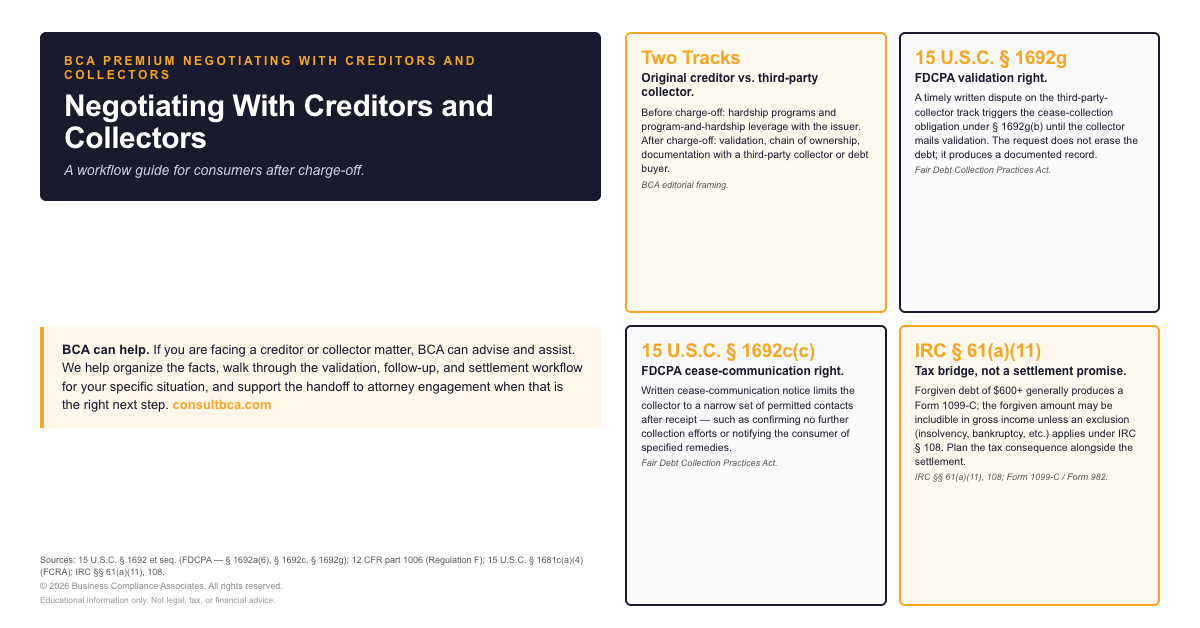
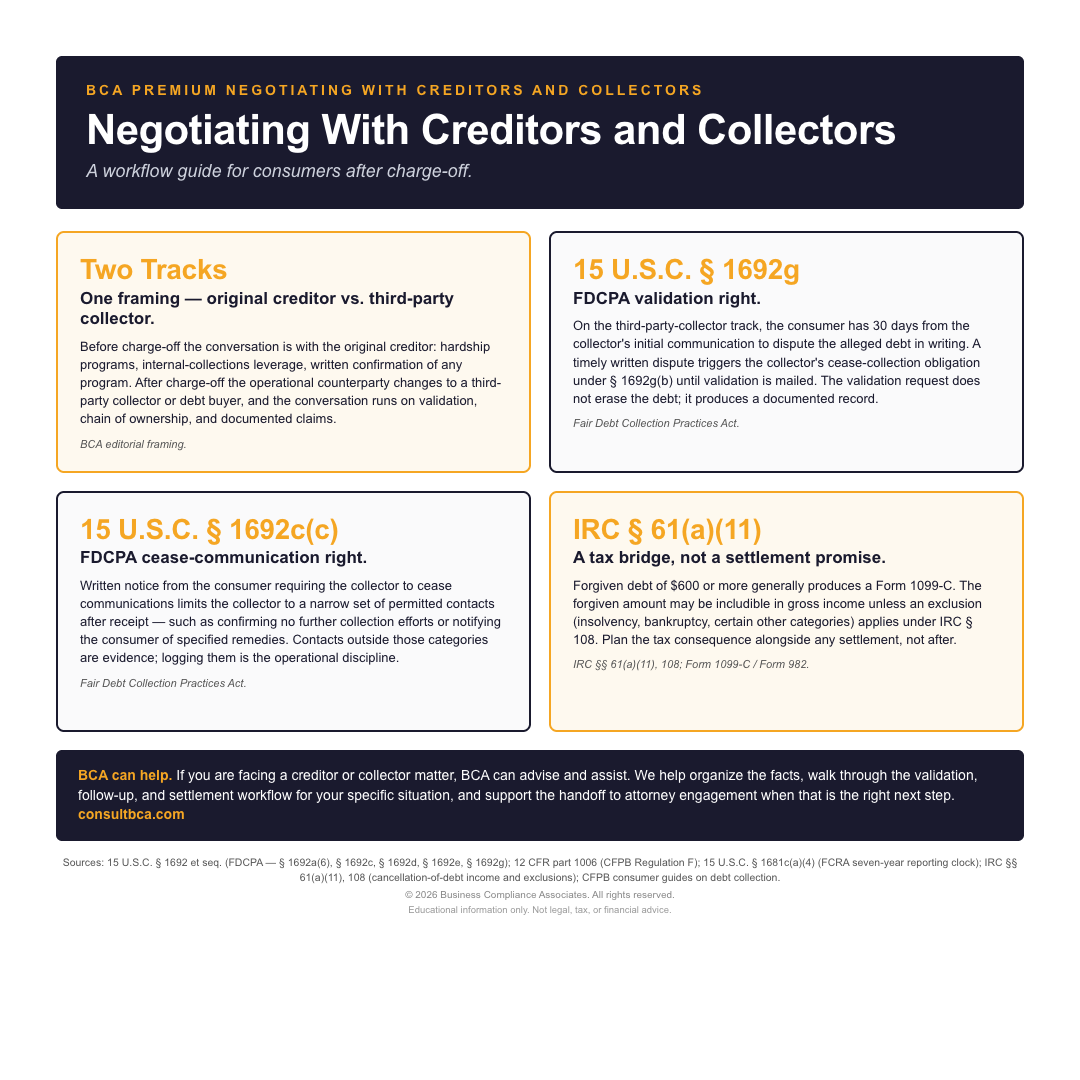
The single most important framing in this guide is that there are two different conversations, and which one applies depends on whether the original issuer still holds the debt.
Track 1 — Original creditor, before charge-off. The bank or issuer that originally extended the credit still holds the account on its own books. Conversations happen with the issuer’s customer service or collections department. The leverage shape is hardship-and-program oriented: the issuer prefers to recover something rather than charge off the account, so internal hardship programs, reduced-rate offers, and structured repayment plans are the operating tools. The consumer’s leverage is highest before charge-off, when the issuer is still trying to keep the account on the books. After charge-off, the original creditor’s interest in working with the consumer typically drops because the debt has been written off the books or sold.
Track 2 — Third-party collector, after charge-off. Once the original issuer has charged off the account, the operational counterparty changes. The debt may be assigned to a third-party collector for a fee, or sold outright to a debt buyer at a fraction of face value. Each subsequent sale further reduces the price paid for the debt. Conversations happen with the third-party entity, not the original creditor. The federal Fair Debt Collection Practices Act regulates this track (covered in §2). The leverage shape is documentation-and-validation oriented: the consumer’s first move is to make the collector prove the debt before any negotiation.
Why the distinction matters in practice. The same underlying debt looks like two different problems depending on which track it is on. On the original-creditor track, the conversation is “can we work something out before this account gets sent to collections.” On the third-party-collector track, the conversation is “can you prove this debt belongs to me, in this amount, and that you have the right to collect it.” Different counterparties, different rules, different leverage, different tools.
Charge-off is usually the operational pivot, but the real divider is the counterparty: once the conversation shifts from the issuer to a third-party collector or debt buyer, Track 2 has begun. (For what charge-off is and is not, including the typical 180-day FFIEC-guidance threshold, see Phase 2 §6.)
The next two sections cover the federal floor that applies on Track 2 and the basic sequence rule on each track.
2. The Federal Floor on the Third-Party-Collector Track
The Fair Debt Collection Practices Act (15 U.S.C. § 1692 et seq.) is the federal framework that governs third-party debt collectors. The Act defines “debt collector” at 15 U.S.C. § 1692a(6) — generally, third parties collecting debts owed to others. Original creditors collecting their own debts are generally outside the federal Act. State-level overlays exist; some states (California’s Rosenthal Act is one example) extend FDCPA-style protections to original creditors at the state level. State coverage varies and stays concept-level in this guide.
The FDCPA’s load-bearing consumer rights, applicable on the third-party-collector track:
- Validation. Within five days of initial communication, the collector must send a written notice with the amount of the debt, the creditor’s name, and a statement of the right to dispute the debt within 30 days. A written dispute within that window obligates the collector to cease collection until validation is provided. (15 U.S.C. § 1692g.)
- Cease communication. The consumer can require the collector to cease communications by sending a written cease-and-desist notice. After receipt, the collector may communicate only in the limited ways the statute permits — such as confirming no further collection efforts or notifying the consumer that the collector may invoke or intends to invoke specified remedies. (15 U.S.C. § 1692c(c).)
- Conduct restrictions. The collector cannot harass, oppress, abuse, threaten, or use deceptive practices in connection with collection. (15 U.S.C. §§ 1692d, 1692e.)
- Time and place restrictions. The collector cannot communicate at unusual or inconvenient times or places, or contact the consumer at work if the employer prohibits it. (15 U.S.C. § 1692c(a).)
The CFPB’s Debt Collection Rule (Regulation F, 12 CFR part 1006) operationalizes the FDCPA for the modern era — call-frequency limits, electronic-communication requirements, validation-notice content. Reg F is the place to look for the operational mechanics behind the statute.
The federal floor is a starting point. The full operational kit — what an adequate validation response looks like, what to do when the collector’s response is incomplete, what a clean settlement letter must contain — is below.
3. The Basic Sequence on Each Track
The sequence rule is different on each track, and the two should not be conflated.
On the third-party-collector track: validate before negotiate. The collector’s initial communication starts the 30-day validation window under 15 U.S.C. § 1692g. A written dispute within that window obligates the collector to substantiate the debt before further collection. Negotiating with a collector who has not yet documented who they are, what they are claiming, and what supports the claim leaves the consumer working blind. As an operational rule: do not send payment to a third-party collector before you understand who is collecting, what is claimed, and what documentation supports the claim. The validation request is the move that produces that understanding.
On the original-creditor track: the FDCPA validation framework does not apply, because the original creditor collecting its own debt is generally outside the federal Act. The conversation is program-and-hardship driven. Issuer customer-service or hardship channels are the right starting points. The discipline that carries over from the third-party-collector track is documentation: program changes (reduced rate, fixed payment, deferred payment) should be confirmed in writing with the issuer.
On either track: keep a clean contact log from the first conversation forward, and do not acknowledge a possibly time-barred debt in writing without confirming your state’s restart-the-clock rule first. (See Phase 2 §7 for the state SOL framing.)
The full guide below covers each track’s workflow in operational depth, the validation-and-challenge letter sequence, the settlement section with its honest tradeoffs, and the contact-logging and evidence discipline that preserves the consumer’s position if anything escalates.
Closing
If you are dealing with creditor or collector communications and want a printable version of this workflow, the full guide above unlocks for BCA Premium beta members. Inside the gate are operational depth on the original-creditor and third-party-collector tracks, the validation and follow-up challenge workflows, the pre-legal response workflow, settlement framing with the 1099-C tax bridge, contact-logging and evidence discipline, and the attorney handoff package structure. Six BCA-authored printable templates are anchored in the relevant sections as Premium downloads: the debt validation letter, the follow-up challenge, the pre-legal response, the collector contact log, the violation evidence checklist, and the attorney briefing template.
Beta access to BCA Premium is currently open at no cost while we continue to expand the library. Activate beta access on the subscribe page — registration takes about a minute and includes thirty days of automatic Premium access. The same beta entry unlocks BCA’s other Premium flagships:
- The 1099-C Cancellation of Debt tax-implications guide — the tax-side mechanics that pair with the settlement conversation in §9.
- The Credit Card Debt Strategy Guide — the paydown math and triage framework for the period before charge-off.
- The IRS Enforcement 2026 Field Manual — small-business compliance posture under the current enforcement environment.
If you are facing a creditor or collector matter that may need direct advisory support, BCA can advise and assist. We do not negotiate on a consumer’s behalf and we do not replace counsel where counsel is the right call; what we do is help organize the facts, walk through the workflow above for the specific situation, and support the handoff to attorney engagement when that becomes the right next step. Contact BCA to discuss your situation.