

The China trade headlines from last week are worth watching, but they are not a reason for importers to change landed-cost assumptions yet.
After President Trump’s China visit, the White House and USTR described new trade channels, agricultural purchase commitments, movement on non-tariff barriers, and attention to rare earth and critical mineral supply issues. Those are meaningful signals for exporters, food producers, manufacturers, and companies that sell into China-facing supply chains.
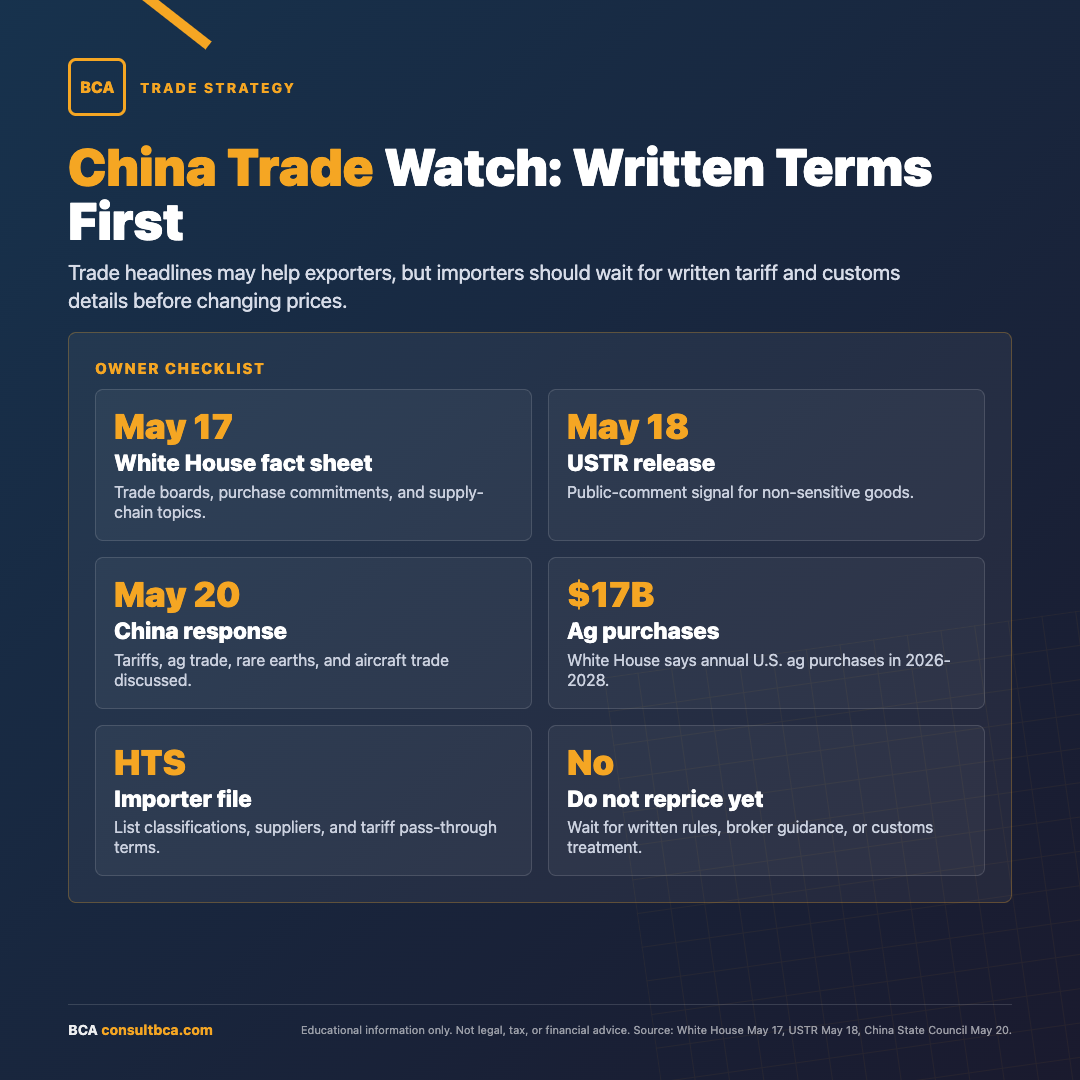
For importers, the practical takeaway is more cautious: wait for written terms before changing prices, purchase orders, inventory plans, or customer quotes.
What changed
The White House said the United States and China chartered a U.S.-China Board of Trade and a U.S.-China Board of Investment. USTR said the trade work is expected to focus on non-sensitive goods and that the U.S. side plans to seek public comment before using that framework.
That public-comment point matters. It means small and medium businesses may get a chance to explain which inputs, components, or export categories matter to them before detailed trade terms are finalized.
The White House also said China will buy at least $17 billion per year of U.S. agricultural products in 2026, 2027, and 2028, with 2026 prorated. It also described renewed market access for U.S. beef facilities and resumed poultry imports from eligible states.
Why this matters to small and medium businesses
For exporters, this may create openings in agriculture, food, aviation supply chains, medical devices, and other goods the administration identifies as non-sensitive. For manufacturers and technology-enabled businesses, the rare earth and critical mineral references matter because shortages or licensing delays can move production schedules even when a company does not buy directly from China.
For importers, nothing in these releases is a substitute for a broker ruling, customs guidance, revised tariff schedule, purchase-order addendum, or written supplier term. Treat the headlines as a planning signal, not an operational instruction.
What BCA readers should do
If you import from China, ask your customs broker or freight partner to identify which HTS classifications and supplier invoices would be affected if product-specific tariff changes are announced. Keep a separate list of components that are hard to source outside China.
If you export, review whether your products fall into agriculture, food, aviation, medical devices, industrial inputs, or other non-sensitive goods that could be raised in the public-comment process. A small business does not need a global trade department to prepare a useful comment. It needs a clear description of the product, the jobs or customers affected, and the specific market barrier or cost issue.
For S corps, LLCs, and owner-operated companies, the best move this week is simple: do not change pricing on headlines alone, but do start a one-page China exposure file.
Sources
- The White House, Fact Sheet: President Donald J. Trump Secures Historic Deals with China, Delivering for American Workers, Farmers, and Industry, May 17, 2026. https://www.whitehouse.gov/fact-sheets/2026/05/fact-sheet-president-donald-j-trump-secures-historic-deals-with-china-delivering-for-american-workers-farmers-and-industry/
- Office of the United States Trade Representative, President Trump’s State Visit to China Delivers Historic Deals and Greater Market Access for American Farmers, Ranchers, Workers, and Businesses, May 18, 2026. https://ustr.gov/about/policy-offices/press-office/press-releases/2026/may/president-trumps-state-visit-china-delivers-historic-deals-and-greater-market-access-american
- The State Council of the People’s Republic of China / Xinhua, China’s commerce ministry elaborates on outcomes of China-U.S. economic, trade consultations, May 20, 2026. https://english.www.gov.cn/news/202605/20/content_WS6a0d3a5ac6d00ca5f9a0b1d1.html
Disclaimer
This article is for general educational purposes. It is not customs, legal, tax, or financial advice. Tariff treatment depends on product classification, country of origin, customs guidance, contract terms, and current law. Confirm import or export decisions with qualified trade counsel, customs brokers, and logistics advisors.