
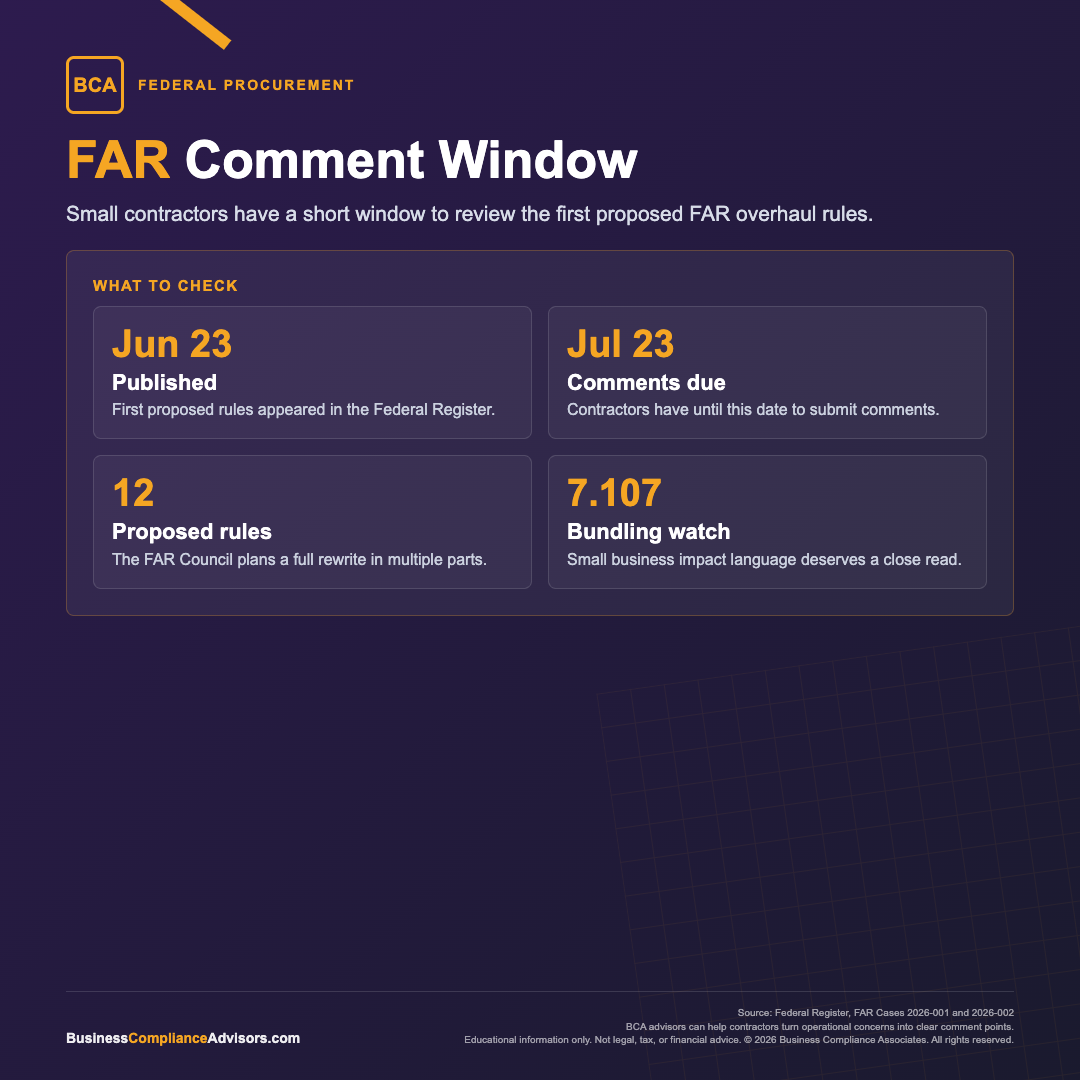
The federal procurement rulebook is moving through a major rewrite, and the first comment deadline is close. On June 23, 2026, the FAR Council published proposed rules covering multiple parts of the Federal Acquisition Regulation. Comments on those proposals are due July 23, 2026.
That’s not a lot of time for small contractors to read, compare, and decide whether the proposed language creates practical problems.
Why this matters to small contractors
Federal contracting rules aren’t just agency paperwork. They shape how opportunities are posted, how requirements are combined, how contractors contest decisions, and how small firms find room to compete.
One proposed rule covers FAR parts 1, 2, 4, 33, 39, 40, 52, and 53. Another covers FAR parts 6, 7, 10, 18, 26, 37, and 41. The second proposal includes language on consolidation and bundling, which is where small contractors should pay close attention.
Bundling can reduce the number of separate opportunities in a market. The proposed language still includes small business impact analysis, SBA notice mechanics, and public notice provisions, but contractors should read the details against how their agencies actually buy.
Do not wait for the final rule
A final rule isn’t the time to first notice a problem. If a proposed change affects how your company competes, teams, subcontracts, or protests, the comment window is the formal opportunity to put that issue in the record.
Small firms don’t need to comment on every part of the rewrite. A useful comment can focus on one operational point, such as how bundled requirements affect local competition, how telework restrictions are evaluated, or how a proposed clause would work in practice.
What BCA readers should do
Pull the solicitations your company has chased in the last 12 months. Then compare them to the FAR parts in the June 23 proposals, especially parts 6, 7, 10, 18, 26, 37, and 41 if consolidation, bundling, services, or market research affect your market.
If you see a practical issue, document it with examples and submit before July 23. The strongest comment isn’t a broad complaint. It’s a clear explanation of how the proposed language changes competition, cost, timing, or small business participation.
Sources
- Federal Register, “Federal Acquisition Regulation: Revolutionary Federal Acquisition Regulation Overhaul Parts 1, 2, 4, 33, 39, 40, and 53,” 91 FR 37550, June 23, 2026. https://www.federalregister.gov/documents/2026/06/23/2026-12559/federal-acquisition-regulation-revolutionary-federal-acquisition-regulation-overhaul-parts-1-2-4-33
- Federal Register, “Federal Acquisition Regulation: Revolutionary Federal Acquisition Regulation Overhaul Parts 6, 7, 10, 18, 26, 37, and 41,” 91 FR 37635, June 23, 2026. https://www.federalregister.gov/documents/2026/06/23/2026-12560/federal-acquisition-regulation-revolutionary-federal-acquisition-regulation-overhaul-parts-6-7-10-18
- Schwabe, “The Revolutionary FAR Overhaul Enters Phase Two,” July 2026. https://www.schwabe.com/publication/the-revolutionary-far-overhaul-enters-phase-two/
- Sheppard Mullin, “Rulemaking Phase Begins with the Issuance of Four Proposed Rules,” June 2026. https://www.sheppard.com/insights/blogs/revolutionary-far-overhaul-update-rulemaking-phase-begins-with-the-issuance-of-four-proposed-rules
Disclaimer
This article is for general educational purposes. It is not legal, tax, payroll, financial, or regulatory advice. Rules can change, and the right answer depends on the facts. BCA can help readers organize the issue and coordinate with the appropriate licensed advisor when needed.