
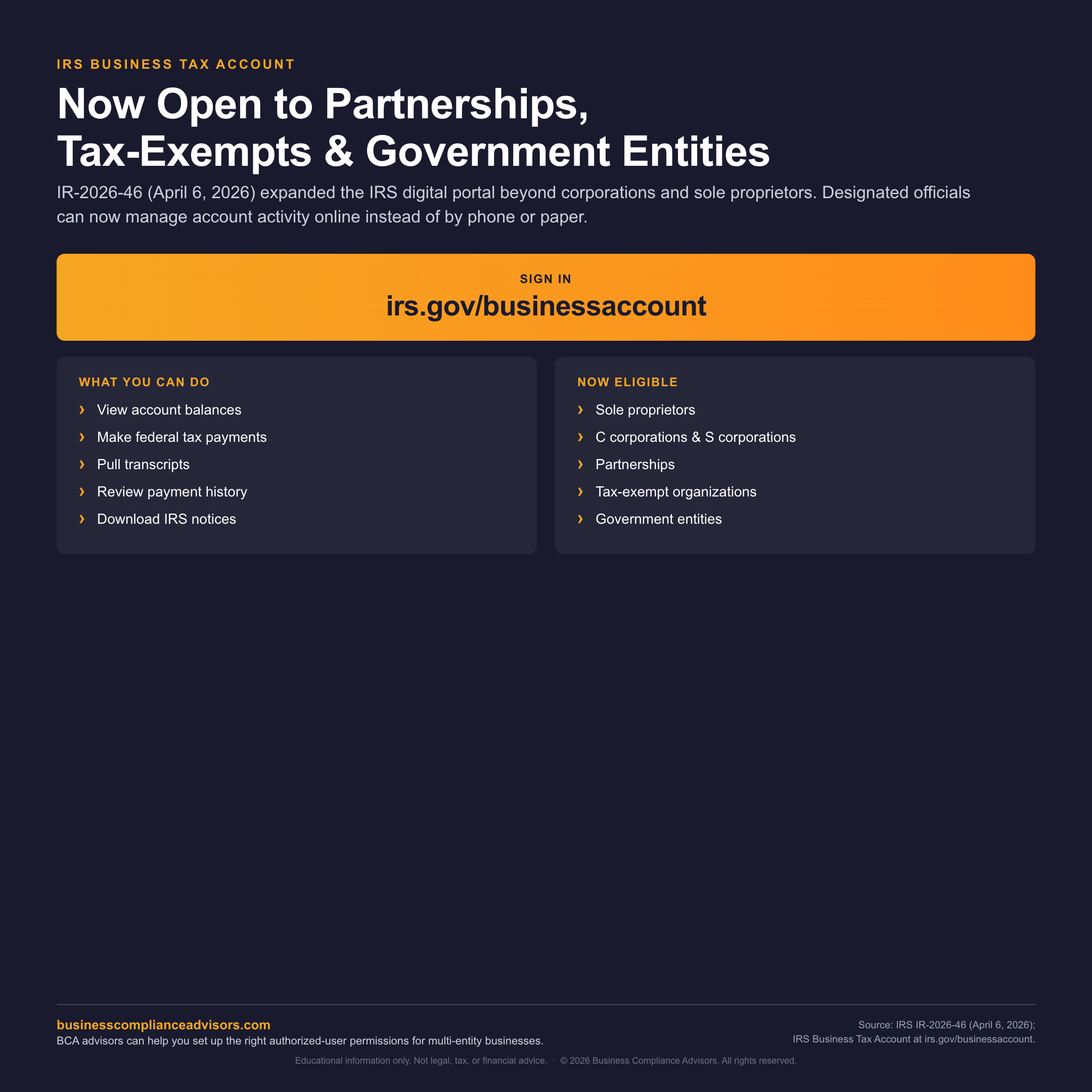
The IRS just opened its Business Tax Account portal to millions of additional entities, including partnerships, S corporations, government entities, and tax-exempt organizations. If your business or organization was previously locked out of digital IRS account access, that changed on April 6, 2026, with the release of IR-2026-46.
Most business owners have never heard of the IRS Business Tax Account. That’s understandable — it launched quietly and expanded slowly. But it’s become one of the more useful tools in the IRS digital toolkit, and now that it’s open to a much wider range of entities, it’s worth understanding what it is and how to use it.
What the IRS Business Tax Account Actually Is
The Business Tax Account (BTA) is a secure online portal at irs.gov/businessaccount that lets businesses and organizations manage their IRS account digitally — without calling the IRS or waiting for paper correspondence. Think of it as the business version of the individual “IRS Online Account” that individual taxpayers already use.
Through the BTA, designated users can view account balances, make payments, pull transcripts, review payment history, and download certain IRS notices — all without picking up the phone. For anyone who has spent time on hold with the IRS, that’s a meaningful change.
Who Can Now Access It
Before the April 2026 expansion, Business Tax Account access was limited to sole proprietors, single-member LLCs, and certain C corporations. The new expansion adds four major categories:
- Partnerships (Form 1065 filers) — both general partners and managing members of LLCs can now register
- S Corporations (Form 1120-S filers) — previously eligible in limited form, now with expanded Designated Official access
- Federal, state, and local government entities
- Tax-exempt organizations — 501(c) organizations whose officers (president, VP, treasurer, CEO, CFO, COO) or board chairpersons can now serve as Designated Officials
Indian tribal governments are also newly included in the expansion.
What You Can Do in the Portal
Once registered, authorized users can do the following in the IRS Business Tax Account:
- View current tax balances
- Make federal tax deposits and payments
- Review complete payment history
- Download select digital IRS notices
- Access payroll and income tax transcripts
- Request a tax compliance check
- Use the Income Verification Service (IVES) for third-party authorization
- Verify business name and address on file with the IRS
The Tiered Access Model — Who Gets What
Access is structured in two tiers: Designated Officials (full access) and, for partnerships, individual partners with limited access.
For partnerships, the Designated Official must be a general partner or managing partner of an LLC. Individual partners who received a Schedule K-1 and have a Social Security Number or ITIN can access limited account information for tax years 2012 through 2023.
For S corporations and C corporations, Designated Officials must pass a three-part test: they must be an officer or managing member, a current W-2 employee for the most recent tax year, and legally authorized to bind the entity.
For tax-exempt organizations, Designated Officials must be an officer of the organization (president, vice president, treasurer, secretary, CEO, CFO, or COO) or the board chairperson or trustee of a trust.
Annual Revalidation — A Detail You Don’t Want to Miss
The IRS is requiring annual revalidation for Business Tax Account access. Revalidation windows open in June and October 2026, with the specific timing depending on your entity type. If you register and then miss revalidation, you’ll lose access until you go through the process again. Put a calendar reminder now.
Why This Matters for BCA Clients
Digital IRS access changes how you interact with the agency in practical ways. When the IRS sends a notice, you can now view it online the same day instead of waiting for a letter. If you need to verify a payment was received or check whether a balance is outstanding, you can do it yourself in seconds rather than calling and waiting on hold.
For partnerships and tax-exempt organizations in particular, this kind of direct account visibility has simply never existed before. It reduces the risk of missing a notice, missing a payment due date, or discovering an IRS issue only after it’s become a problem.
BCA can help your organization get registered, identify the right Designated Official, and build the kind of tax monitoring routine that keeps you ahead of IRS correspondence rather than reacting to it. If you’d like to walk through what the BTA can do for your specific entity type, reach out through our contact page.
Source: IRS IR-2026-46, April 6, 2026 — IRS Expands Business Tax Account Access to Partnerships, Government Entities, and Tax-Exempt Organizations. Additional coverage: Accounting Today.