

An offer in compromise can be the right answer for some taxpayers who cannot pay the IRS in full. It is also one of the most heavily marketed tax-debt products, which is why taxpayers need to separate the real IRS program from the sales pitch.
IRS Tax Tip 2026-40 is a useful reset. An offer in compromise is an agreement between a taxpayer and the IRS to settle a tax debt for less than the full amount owed. The IRS looks at income, expenses, asset equity, and ability to pay.
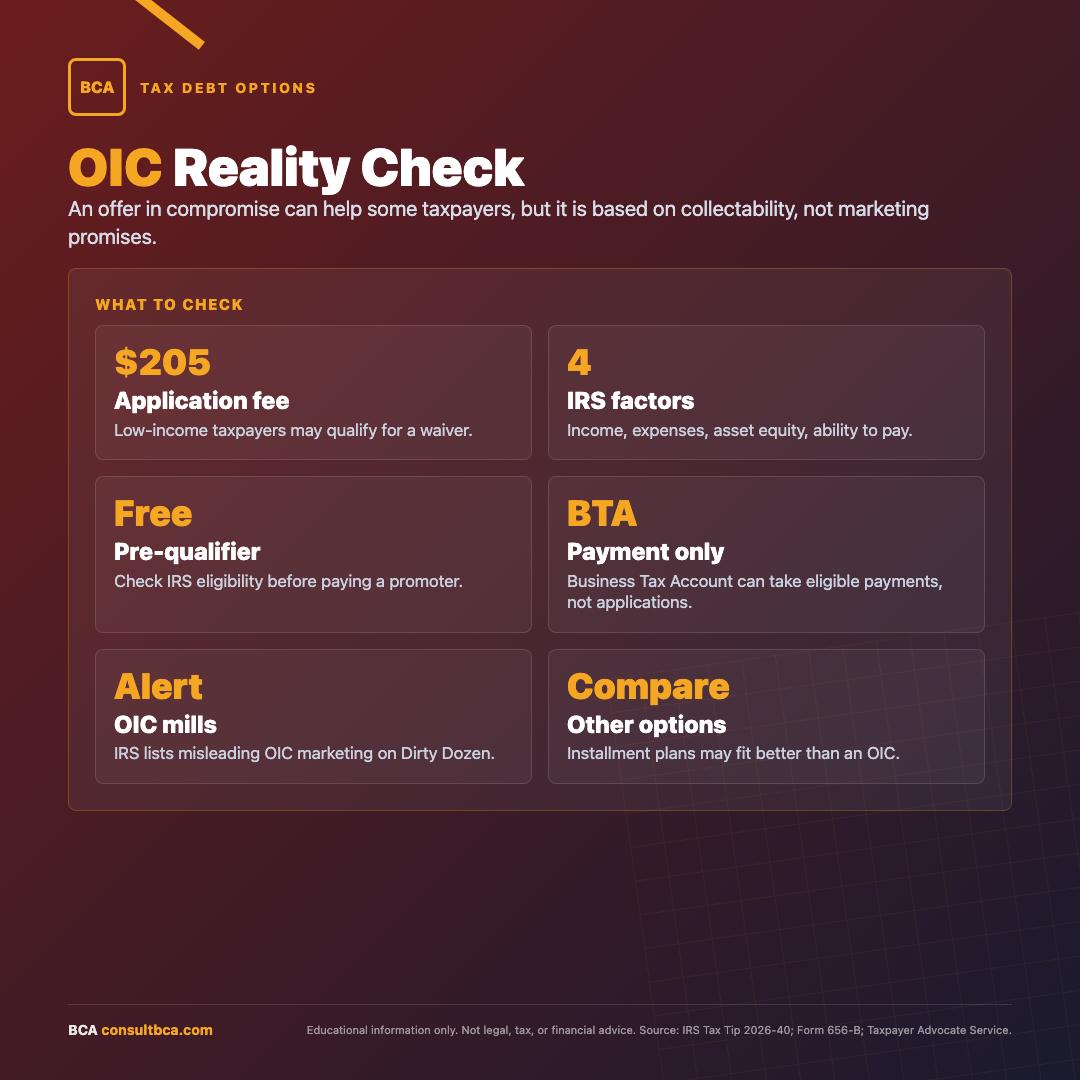
That means an OIC is not based on what a taxpayer wishes the debt were. It is based on what the IRS believes it can reasonably collect.
Start with the pre-qualifier
Before paying a promoter, use the IRS Offer in Compromise Pre-Qualifier Tool. It is free, and it gives taxpayers a first look at whether an OIC is even worth preparing.
The OIC application generally requires a $205 fee and an initial payment. Low-income taxpayers may qualify to have those initial costs waived, but they should confirm that using the current Form 656-B instructions.
Compare it against payment alternatives
An OIC is one option. It is not the only option.
For some taxpayers, an installment agreement, short-term payment plan, penalty-abatement request, or currently-not-collectible analysis may be a better first step. The right path depends on the amount owed, compliance history, cash flow, assets, and whether all required returns are filed.
Business Tax Account payment note
The IRS says eligible taxpayers who use Business Tax Account can now make OIC payments through BTA. That does not mean BTA can be used to submit the offer. The offer process still runs through the OIC application package and related IRS procedures.
Watch for OIC mills
The IRS includes OIC mills on its 2026 Dirty Dozen list. These are aggressive or misleading marketing schemes that often overpromise results and charge high fees to taxpayers who may not qualify.
The safe order is simple: check eligibility first, review Form 656-B, compare payment alternatives, and only then decide whether professional help is worth the cost.
What BCA readers should do
If you owe the IRS and cannot pay in full, gather the basics before making any commitment: current balance, all unfiled returns, income, necessary living or business expenses, bank balances, equity in assets, and current collection notices.
Then compare options. The question is not “Can someone get me pennies on the dollar?” The question is “What will the IRS view as collectable based on the facts?”
Sources
- Internal Revenue Service, Tax Tip 2026-40, “Eligible taxpayers may be able to resolve tax debt through an offer in compromise,” May 14, 2026. https://www.irs.gov/newsroom/eligible-taxpayers-may-be-able-to-resolve-tax-debt-through-an-offer-in-compromise
- Internal Revenue Service, Offer in Compromise Pre-Qualifier Tool. https://irs.treasury.gov/oic_pre_qualifier/
- Internal Revenue Service, Form 656-B, Offer in Compromise Booklet. https://www.irs.gov/pub/irs-pdf/f656b.pdf
- Taxpayer Advocate Service, “Owe Taxes But Can’t Pay the IRS in Full? Don’t Panic, You Have Options,” updated May 12, 2026. https://www.taxpayeradvocate.irs.gov/news/nta-blog/owe-taxes-but-cant-pay-the-irs-in-full-dont-panic-you-have-options/2026/03/
Disclaimer
This article is for general educational purposes. It is not legal or tax advice. IRS collection options are fact-specific and may affect appeal rights, liens, levies, penalties, and future compliance obligations. Consult a qualified tax advisor before submitting an offer in compromise or making a collection decision.