
SBA announced a financing change that matters for businesses planning a serious expansion. Beginning July 4, 2026, eligible borrowers can combine SBA 7(a) and 504 financing for up to $10 million in SBA-backed capital.
That is double the prior cumulative limit SBA highlighted in its May 18 announcement. It is also one of the more practical financing changes for growth-stage small businesses this year.
What changed
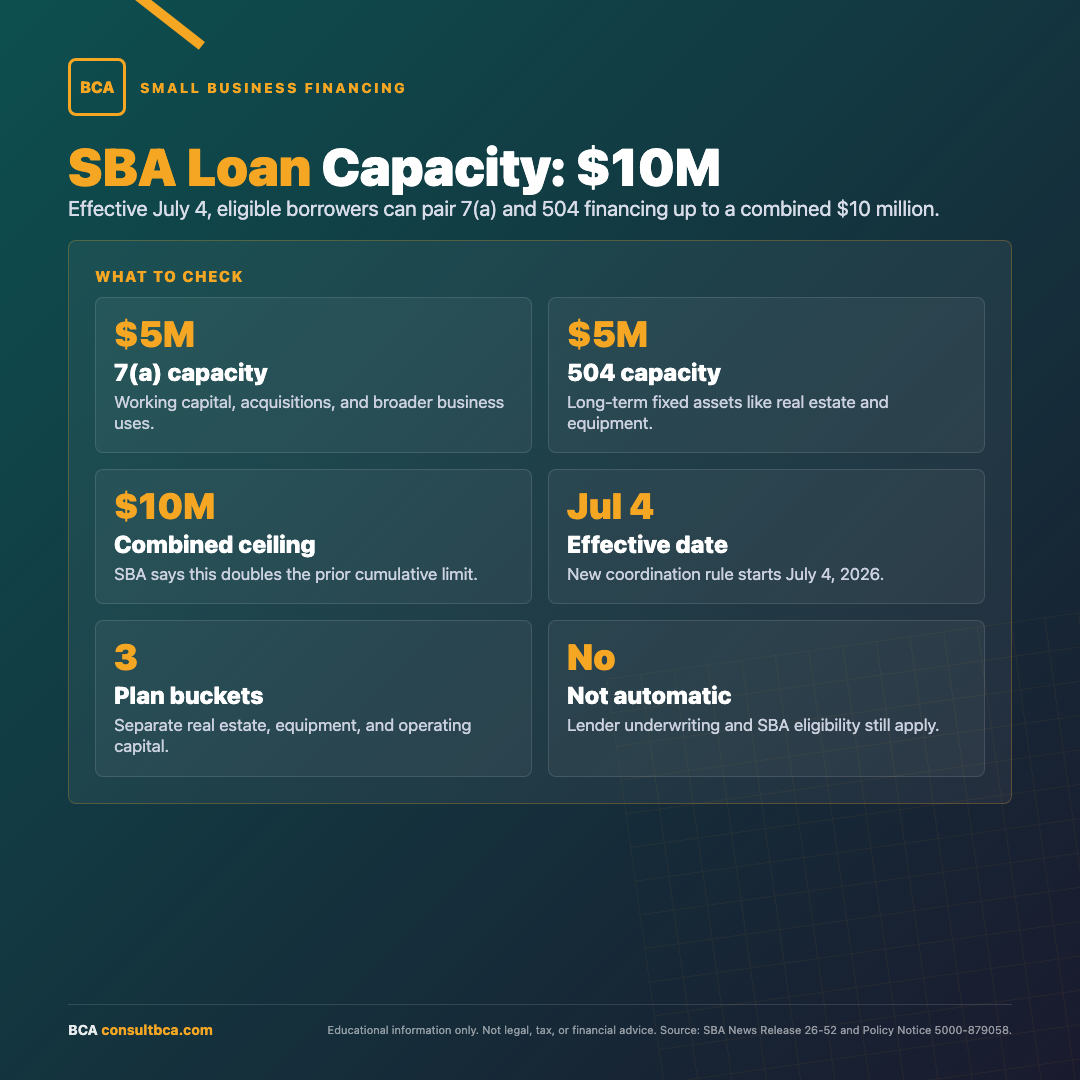
Under the new policy, a qualified borrower that secures a 7(a) loan first may access up to $5 million through the 7(a) program and up to $5 million through the 504 program, for a combined total of $10 million in SBA-backed financing.
The important word is combined. This is not one $10 million loan product. The 7(a) and 504 programs serve different purposes. The 7(a) side can support working capital, acquisitions, or broader business needs. The 504 side is built around long-term fixed assets such as real estate and major equipment.
Why this matters
Capital-intensive small businesses often need both types of money at the same time. A manufacturer may need working capital, new equipment, and a larger facility. A food producer may need buildout capital plus inventory and payroll support. A logistics company may need property, vehicles, and operating liquidity.
Before this change, borrowers could hit a cumulative SBA ceiling that made the full capital stack harder to plan. SBA’s new coordination rule gives qualified businesses more room to pair operating capital with long-term asset financing.
What it does not mean
This does not mean every small business can borrow $10 million. Lenders will still underwrite repayment ability, collateral, equity injection, credit history, ownership eligibility, industry eligibility, and project purpose.
It also does not remove the need to choose the right structure. A business buying a building, expanding production, and funding payroll during the ramp-up period should separate those uses before talking to lenders. Mixing every need into one general loan request makes underwriting harder.
What BCA readers should do
If you are planning a large expansion after July 4, separate the capital need into three buckets: real estate, equipment, and operating capital. Then map which pieces fit 504, which fit 7(a), and which should not be debt-funded at all.
This is also a good time to clean up financial statements, tax returns, debt schedules, lease documents, and owner resumes. The bigger the request, the less tolerance lenders have for incomplete records.
The new cap creates room. It does not replace the work of building a financeable package.
Sources
- U.S. Small Business Administration, News Release 26-52, “SBA Doubles Cumulative 7(a) and 504 Loan Limit to $10 Million,” May 18, 2026. https://www.sba.gov/article/2026/05/18/sba-doubles-cumulative-7a-504-loan-limit-10-million
- U.S. Small Business Administration, Policy Notice 5000-879058, “Coordination of 7(a) and 504 for Maximum Loan Limits,” effective July 4, 2026. https://www.sba.gov/document/policy-notice-5000-879058-coordination-7a-504-maximum-loan-limits
- U.S. Small Business Administration, 7(a) loans. https://www.sba.gov/funding-programs/loans/7a-loans
- U.S. Small Business Administration, 504 loans. https://www.sba.gov/funding-programs/loans/504-loans
Disclaimer
This article is for general educational purposes. It is not lending, legal, tax, or financial advice. SBA eligibility, lender approval, collateral requirements, equity injection, and repayment analysis depend on the borrower, project, lender, and current SBA rules. Confirm current requirements with SBA and qualified lending professionals before applying.