
President Trump signed H.R. 2066, the Investing in All of America Act of 2025, on May 19. SBA followed with a May 21 release highlighting what the law does for the Small Business Investment Company program.
This is not a direct loan program for every small business. It is an investment-capital change that may affect which companies SBIC funds are more willing to pursue.
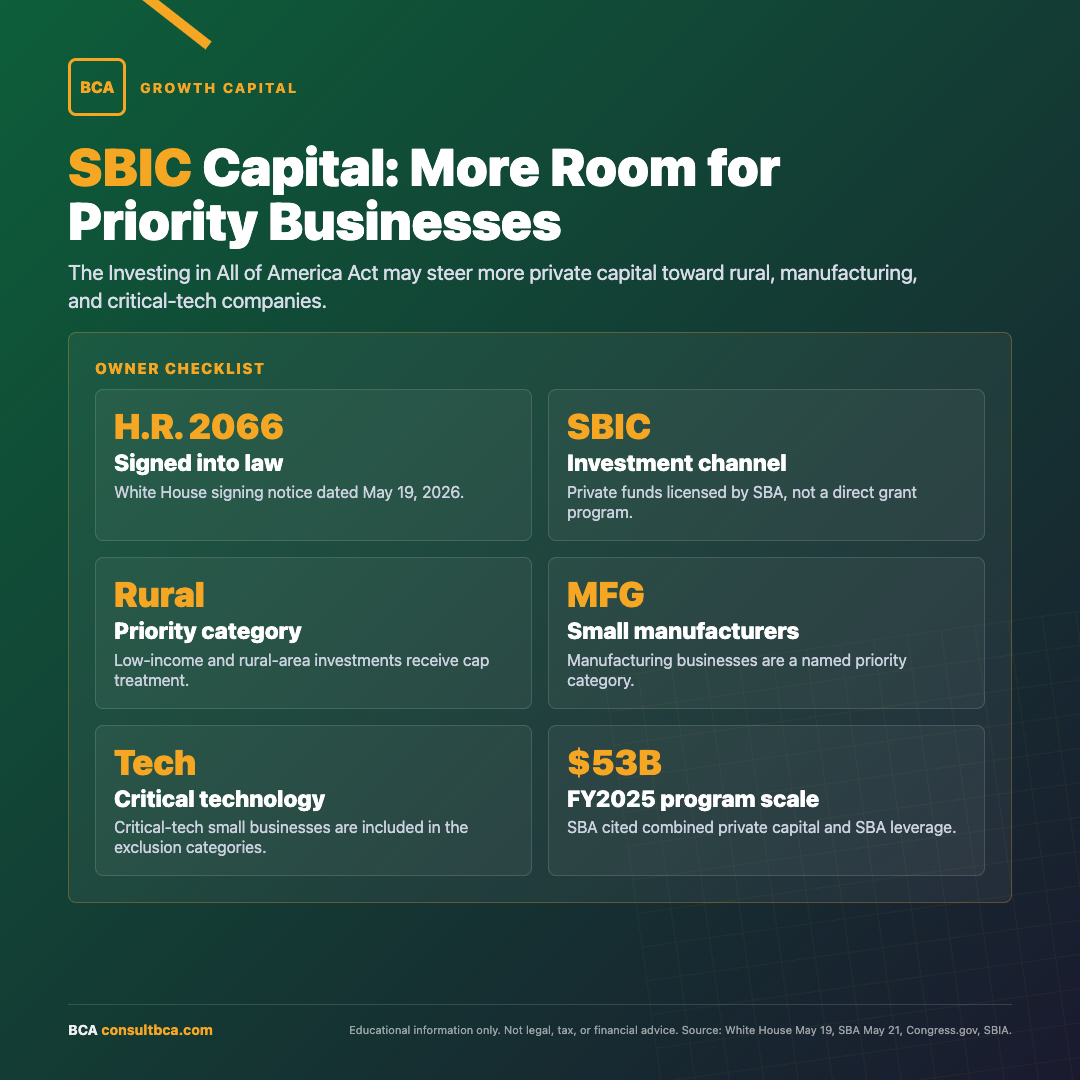
For owner-operated companies, LLCs, S corps, and lower-middle-market businesses, the important question is whether the business fits one of the categories the new law is trying to pull capital toward: rural communities, low-income areas, small manufacturers, and critical technology-focused businesses.
What changed
The White House said H.R. 2066 modifies the maximum amount of outstanding leverage available to an SBIC and excludes certain investments from the calculation of the leverage cap. Those excluded categories include investments in small businesses located in low-income or rural areas, small manufacturers, and critical technology-focused small businesses.
SBA said the SBIC program is a public-private partnership that supports investment in American small businesses. SBA also said the program reached $53 billion in combined private capital and SBA leverage in FY2025.
The practical effect is not automatic funding. It is a signal to private investment funds licensed as SBICs that certain small business categories may receive more room inside the fund’s leverage structure.
Why this matters to growth companies
Some businesses are too mature for startup-style seed funding but not a clean fit for ordinary bank debt. A manufacturer buying equipment, a rural business scaling production, or a critical-tech supplier with purchase orders may need patient growth capital instead of another short-term loan.
That is where SBICs can matter. They can provide debt, equity, or hybrid capital, depending on the fund and the deal. The owner still needs a financeable story: credible revenue, clean books, a use of funds, customer concentration details, management depth, and a plan for how the capital gets repaid or returned.
What BCA readers should do
If your business sits in manufacturing, critical technology, rural operations, energy, food production, logistics, defense supply chains, or specialized industrial services, update your capital strategy file. Identify what kind of money you actually need: bank debt, SBA-backed debt, private debt, equity, or a mix.
Then prepare a two-page investor and lender summary. Include ownership, entity structure, last three years of revenue, margins, debt, major customers, key contracts, equipment or facility needs, and the use of funds.
The law may improve capital flow into priority categories. It does not fix weak records, unclear ownership, messy financials, or a vague growth plan.
Sources
- The White House, Congressional Bills H.R. 972, H.R.2066 and H.R. 2815 Signed into Law, May 19, 2026. https://www.whitehouse.gov/briefings-statements/2026/05/congressional-bills-h-r-972-h-r-2066-and-h-r-2815-signed-into-law/
- U.S. Small Business Administration, News Release 26-53, Administrator Loeffler Applauds Signature of Investing in All of America Act, May 21, 2026. https://www.sba.gov/article/2026/05/21/administrator-loeffler-applauds-signature-investing-all-america-act
- Congress.gov, H.R. 2066, Investing in All of America Act of 2025. https://www.congress.gov/bill/119th-congress/house-bill/2066
- Small Business Investor Alliance, President signs the Investing in All of America Act into law, SBIA applauds bipartisan win for small business, May 19, 2026. https://sbia.org/2026/05/19/president-signs-investing-all-of-america-act/
Disclaimer
This article is for general educational purposes. It is not legal, tax, securities, lending, or investment advice. SBIC financing depends on fund strategy, eligibility, underwriting, securities rules, ownership structure, and current SBA guidance. Review capital strategy with qualified advisors before soliciting investment.