
Among the changes the One, Big, Beautiful Bill Act made effective for tax year 2026, the expansion of the employer-provided childcare credit under Section 45F is one of the largest in dollar terms and one of the most underdiscussed for small business operators. The headline numbers are eye-catching: the maximum credit more than tripled for general employers and quadrupled for eligible small businesses, and the credit rate increased by more than half. Small businesses get the biggest bump.
For small businesses considering whether to provide childcare benefits as a recruitment, retention, or culture investment, the math just changed materially.
What the credit is
Section 45F of the Internal Revenue Code lets employers claim a federal tax credit for certain childcare expenses they pay or incur on behalf of employees. It has existed since 2001 and has historically been used by larger employers because the rate and cap made it financially marginal for smaller operations.
OBBBA changed the math. For taxable years beginning after December 31, 2025, three things are different.
What changed
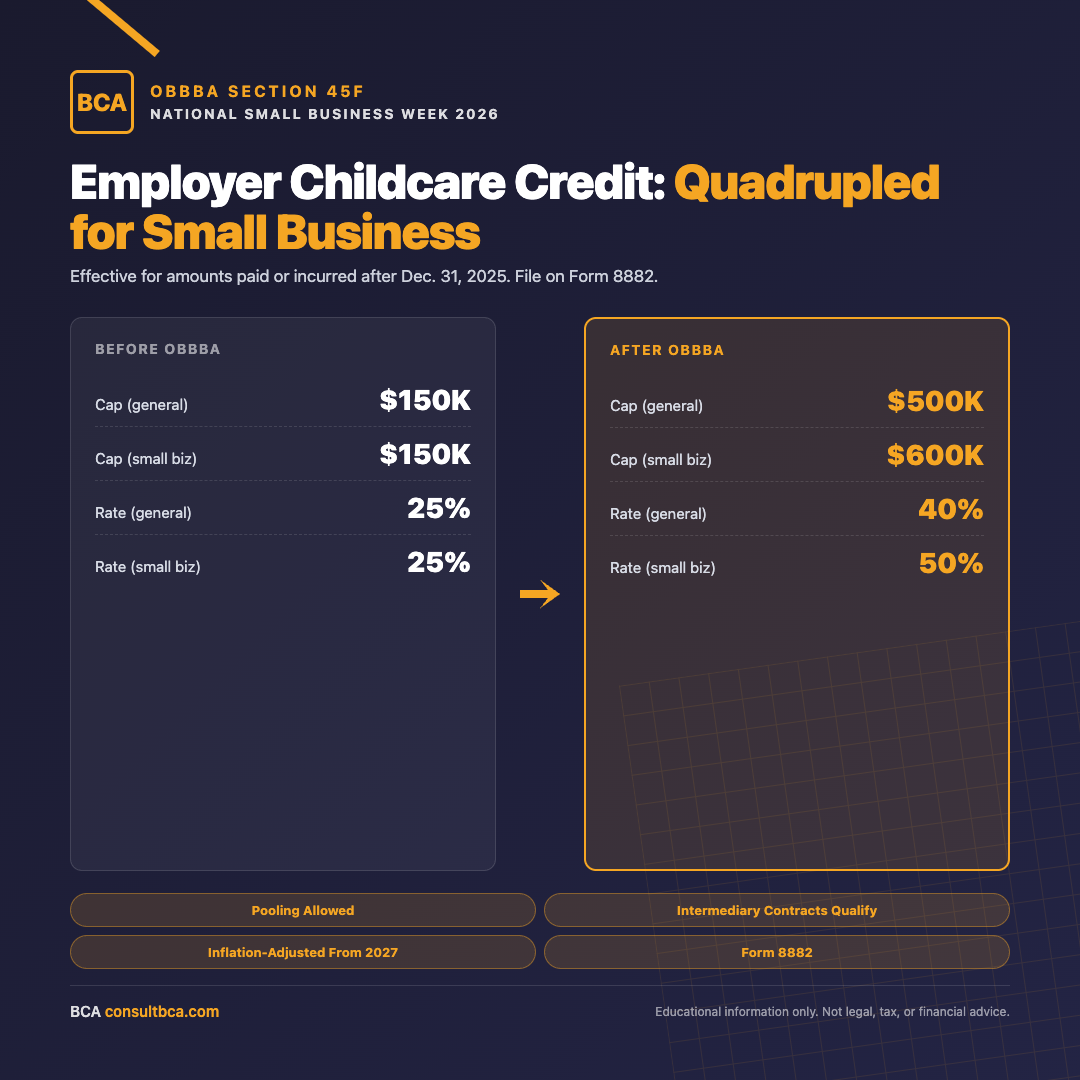
The credit cap rose sharply. The maximum annual credit goes from $150,000 to $500,000 for general employers (a 3.3x increase) and to $600,000 for eligible small businesses (a 4x increase). The “eligible small business” definition uses § 45F’s modified version of the § 448(c) gross-receipts test, applied over a 5-taxable-year period rather than the standard 3-year period. The dollar threshold for that test is set by reference to the inflation-adjusted § 448(c) amount for the applicable tax year. Future credit caps are also inflation-adjusted.
The credit rate increased. The percentage of qualified expenses the employer can claim went from 25% to 40% for general employers, and to 50% for eligible small businesses. This is a credit, not a deduction, so the dollar value is direct against tax owed.
Pooled and intermediary arrangements can qualify. This is the part most coverage misses for small business. Two operational changes make the credit reachable for employers without on-site childcare facilities:
- Eligible small businesses can pool resources to provide childcare and still claim the credit, including through third parties that facilitate childcare on the employer’s behalf.
- Qualified expenses now include amounts paid under contract with an intermediary entity that itself contracts with one or more qualified childcare facilities. Subscription, matching, and network-access fees can qualify when the structure ties back to a qualified facility under the statute. Not every “childcare technology platform” subscription qualifies on its name alone; the underlying contract structure controls.
The combined effect is that a 25-employee business does not need to build a daycare on the premises to claim the credit. Contracting with a qualified intermediary service can be enough.
What the new numbers look like in practice
Three illustrative scenarios. All numbers are illustrative and assume the employer otherwise meets Section 45F qualified-expense requirements.
Small employer using a tech platform. A 30-employee business pays $80,000 across the year for a subscription-based childcare-matching service that connects employees to vetted providers. At the 50% small-business rate, the credit is $40,000, well under the $600,000 cap. Direct reduction of federal tax liability.
Mid-sized employer with on-site facility. A 200-employee business above the § 448(c) threshold spends $1,000,000 operating an on-site daycare. As a general employer, the rate is 40% and the credit is capped at $500,000. Excess expenses do not generate credit but may still be deductible.
Small employer pooling with peers. Three small businesses in a shared office building pool resources with $250,000 in combined annual childcare contributions through a third-party operator. Each employer claims its proportional share of qualified expenses at the 50% rate. The cap applies per employer.
Eligibility and definitions
For § 45F, “eligible small business” is defined by reference to the § 448(c) gross-receipts test, modified to use a 5-taxable-year period instead of the standard 3-year period. The applicable dollar threshold is the § 448(c) amount for the relevant tax year, which is inflation-adjusted (the 2026 figure is widely reported in the $30 million range, but the controlling number is whatever IRS publishes for the tax year being claimed). The result for most businesses is straightforward: if average annual gross receipts over the relevant 5-year period stay under the indexed threshold, the small-business rate and cap apply.
Qualified childcare expenses include:
- Operating costs of an employer-provided childcare facility (utilities, staff salaries, supplies).
- Amounts paid to a qualified childcare facility on behalf of employees.
- Amounts paid under a contract with an intermediate entity that itself contracts with one or more qualified childcare facilities (new under OBBBA). Subscription, matching, or network-access fees can fall within this category when the contract structure ties back to a qualified facility, but the qualifying status depends on the contract chain, not on the platform’s marketing label.
- Resource and referral expenses paid by the employer.
Common exclusions:
- Employer payments that are part of a Section 125 cafeteria plan reimbursement to the employee (those are pre-tax to the employee, separate framework).
- Childcare provided to highly compensated employees on a discriminatory basis. Section 45F has anti-discrimination rules that mirror other fringe-benefit provisions.
- Capital expenditures for facilities the employer never opens or never uses for childcare.
How to claim it
The credit is claimed on Form 8882, “Credit for Employer-Provided Childcare Facilities and Services,” filed with the federal business income tax return. Use the version of Form 8882 and instructions applicable to the tax year claimed; IRS publishes annual updates that reflect the current cap and rate amounts.
A few documentation points BCA recommends building into payroll and accounts-payable systems before year-end:
- Track each qualified expense category separately (facility operating, payments to third-party providers, intermediary platform fees).
- Maintain employee-by-employee records of who received the benefit, especially if the employer is using a tech platform that distributes access on a subscription basis.
- Keep gross-receipts documentation for the relevant 5-taxable-year window to support the eligible-small-business determination.
Check before signing with a childcare vendor
The platforms-and-intermediaries qualification is the part of the new rule most likely to trip employers up after they’ve already paid. Before signing a subscription, matching-service, or network-access agreement and assuming the credit applies, verify:
- The vendor’s contract structure ties back to a qualified childcare facility (a facility operated to comply with applicable state and local laws and primarily used for qualifying childcare). A standalone matching app that hands off to whatever provider an employee picks does not necessarily qualify.
- The employee-eligibility distribution rules are satisfied. § 45F has anti-discrimination requirements; if the platform’s enrollment funnels predominantly to highly compensated employees, the credit can be partially or fully denied.
- The fee structure is documented in a way that lets you allocate costs to qualified categories versus non-qualified add-ons (premium concierge tiers, unrelated wellness benefits bundled into the same invoice).
- Annual reconciliation: the vendor produces a year-end statement of qualified expenses by employee, suitable for Form 8882 substantiation.
This is the conversation BCA can advise on before the contract goes in, not after.
Why this matters for hiring and retention
OBBBA’s expansion is structured in a way that explicitly favors small business. The 50% rate (versus 40% for larger employers) and the $600,000 cap (versus $500,000) make the math more attractive at the smaller scale, not less. Combined with the new intermediary-services qualification, a small business now has a federal tax credit covering half of a meaningful childcare benefit, without needing to build infrastructure.
For sectors where small businesses compete with larger employers for talent (hospitality, retail, healthcare, light manufacturing, professional services), this is a recruitment lever that did not exist at this scale before. Whether the math works depends on workforce composition, but it is now worth running.
When to bring BCA in
Three scenarios where the planning conversation matters:
- The business is considering offering a childcare benefit for the first time and wants to understand the credit’s value before negotiating with a provider or platform.
- The business already pays some childcare-related amounts (a one-off subsidy, an informal arrangement) and wants to formalize them in a way that captures the credit.
- The business operates close to the indexed § 448(c) eligible-small-business threshold and wants to model the rate-and-cap implications of crossing it in either direction.
BCA advisors bring business and compliance experience to help you evaluate the documentation, advise on how the rules apply to your specific workforce, and weigh the planning options. The returns and benefit-program decisions stay yours.
Sources
- One, Big, Beautiful Bill Act, Public Law 119-21 (July 4, 2025), Section 45F amendments. https://www.congress.gov/119/plaws/publ21/PLAW-119publ21.pdf
- 26 U.S.C. § 45F (Employer-Provided Childcare Facilities and Services Credit). https://uscode.house.gov/view.xhtml?req=granuleid:USC-prelim-title26-section45f
- 26 U.S.C. § 448(c) (gross-receipts test). https://uscode.house.gov/view.xhtml?req=granuleid:USC-prelim-title26-section448
- Grant Thornton, “2026 individual tax planning guide” — Tier 2 corroborator for the 40% / 50% rates, $500,000 / $600,000 caps, and intermediary / pooled-resource planning point. https://www.grantthornton.com/insights/alerts/tax/2025/legislative-updates/2026-individual-tax-planning-guide
- Congressional Research Service, “The Employer-Provided Childcare Tax Credit (IRC § 45F)” — used here for policy/historical context only; the current CRS page reflects rate figures that conflict with the enacted statute, so not used as the rate corroborator. https://www.congress.gov/crs-product/IF12379
- U.S. Internal Revenue Service, Form 8882, “Credit for Employer-Provided Childcare Facilities and Services.” https://www.irs.gov/forms-pubs/about-form-8882
Disclaimer
This information is provided for general educational purposes and reflects opinions based on experience. Individual circumstances may vary. The interaction between Section 45F, anti-discrimination rules under other fringe-benefit provisions, gross-receipts thresholds, and broader OBBBA provisions can be complex. The illustrative scenarios in this post are simplified for clarity; actual outcomes depend on the specific facts. BCA advisors bring business and compliance experience to help you evaluate documentation, model the credit, and advise on planning options before filing or before signing a childcare-benefit arrangement.