The IRS released a new self-service tool on April 16, 2026 designed to help taxpayers and businesses sort out the right path for unpaid tax debt. The tool is at IRS.gov/payments/get-help-with-tax-debt. It is question-based, available 24 hours a day, and does not require a login or any personally identifiable information to use.
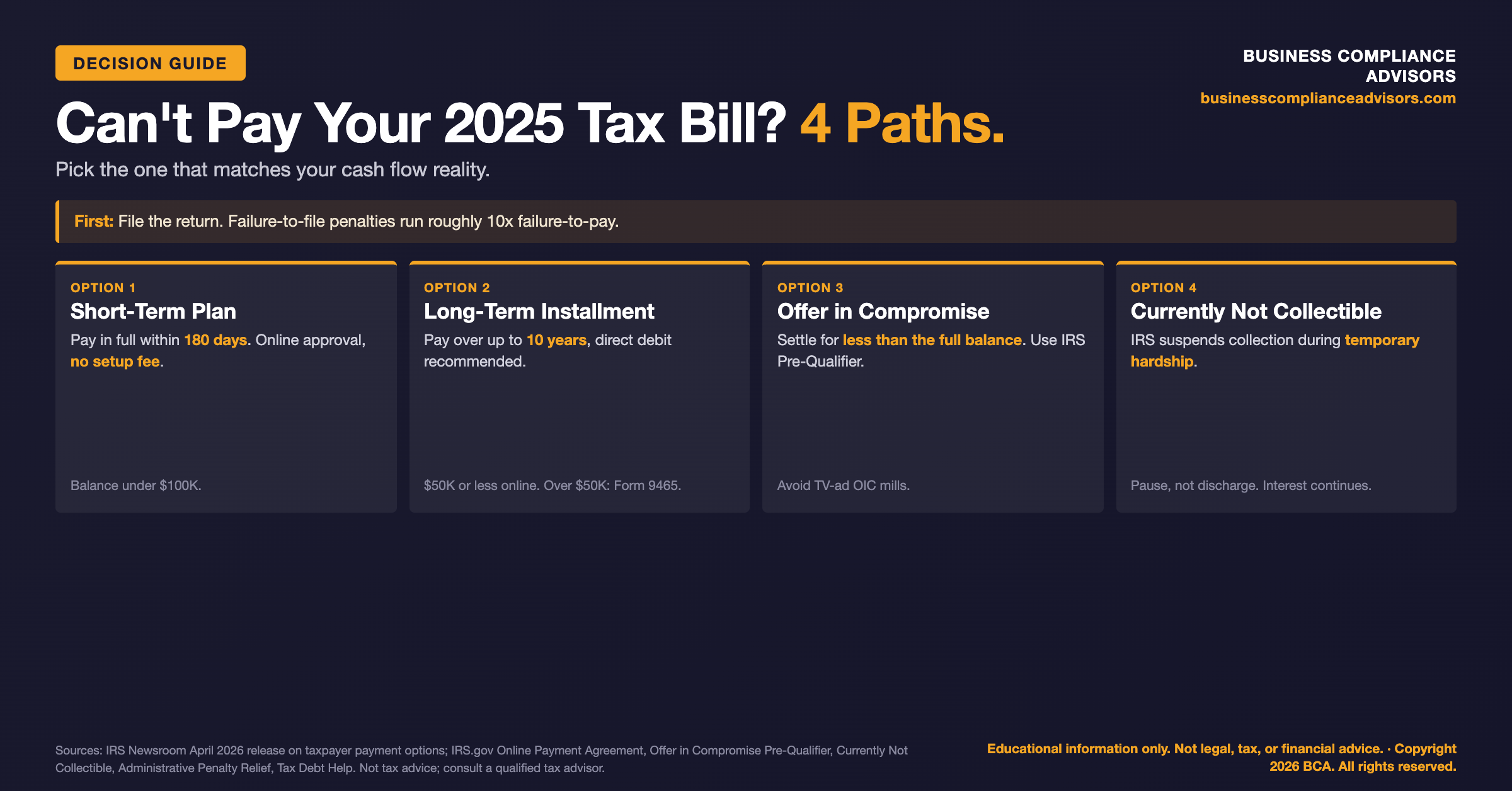
In its current form, the tool walks users through three of the four payment paths the IRS offers for taxpayers who cannot pay in full:
- Installment agreement. A payment plan, short-term or long-term, where you pay the balance over time.
- Temporary delay of collection (Currently Not Collectible). A pause on active collection while you are in financial hardship.
- Offer in Compromise. A settlement of the tax debt for less than the full amount owed.
What the tool does well: it asks plain-language questions, narrows the recommendation to one of those three paths, and links to the underlying IRS forms and instructions. For taxpayers with simple situations and a single year of unpaid tax, the tool can save the time of reading through Publication 594 cover-to-cover.
What the tool does not do: it does not consider the fourth path (filing the return first, before any payment plan applies), does not weigh interest accrual against compromise viability, does not surface first-time penalty abatement, and does not factor multi-year exposure or business entity structure. Those are the questions BCA hears most from small business owners trying to resolve a tax bill, and they are the ones that determine whether the IRS’s recommended path is actually the right one.
We covered the full four-path decision tree, including the questions the IRS tool does not ask, in our April 17 post: Can’t Pay Your 2025 Tax Bill? A Business Owner’s Decision Tree.
How to use the tool well
- Before running the tool, confirm the balance on the IRS notice you received. Pull a current account transcript at IRS.gov/account or by calling the IRS at the number on the notice. The tool’s recommendation is only as good as the balance you bring to it, and IRS notices occasionally reflect prior-year balances that have already been paid, abated, or applied from a refund. Verify before you commit to a payment path.
- Run the tool to get the IRS’s recommended path. Print or screenshot the result.
- Compare it against your actual situation: prior-year balances, multi-state exposure, entity type, cash flow reality.
- If the IRS tool recommends Offer in Compromise, do not file Form 656 cold. The acceptance rate is roughly one in three, and the application fee is $205. Third-party OIC submission services are heavily marketed to taxpayers in distress; their acceptance rates are not better than self-prepared offers, and several have been the subject of FTC enforcement actions and IRS Dirty Dozen warnings. Verify any submission path before paying a fee.
- If the tool recommends Currently Not Collectible, understand it is a pause, not a discharge. Interest keeps running.
- If the tool recommends an installment agreement, model the total interest cost over the term before signing.
When to bring BCA in
Use the tool to identify the IRS’s recommended path. Bring the result to BCA before signing or paying anything. Compromise offers, hardship status applications, and installment agreements all have deadlines and paperwork requirements that are easy to get wrong. Our role is to advise and assist; the agreements you sign go out under your name.
Sources
- U.S. Internal Revenue Service. “IRS launches new online tool to help taxpayers resolve tax debt.” IR-2026-53, April 16, 2026.
- U.S. Internal Revenue Service. “Get help with tax debt.” Available at IRS.gov/payments/get-help-with-tax-debt.
This information is provided for general educational purposes and reflects opinions based on experience. Individual circumstances may vary. BCA advisors bring business and compliance experience to help you evaluate documentation, advise on written disputes, and weigh the paths available with the IRS before any agreement is signed.