
If your business imports products, parts, packaging, ingredients, equipment, or inventory, the practical question is not “What do I think about tariffs?” The practical question is: did your broker apply HTSUS 9903.03.01 to your entry, and if so, did anyone check the exceptions?
Proclamation 11012 imposed a temporary 10% import surcharge under Section 122 of the Trade Act of 1974. The surcharge took effect at 12:01 a.m. ET on February 24, 2026 and runs through 12:01 a.m. ET on July 24, 2026 unless suspended, modified, terminated, or extended by Congress. It is broad, but it is not exception-free.
The correct operating frame is narrow and practical: a broad temporary surcharge applies to imported articles of every country unless the article fits an exception in the proclamation, the annexes, or CBP’s Chapter 99 implementation guidance.
The importer checklist
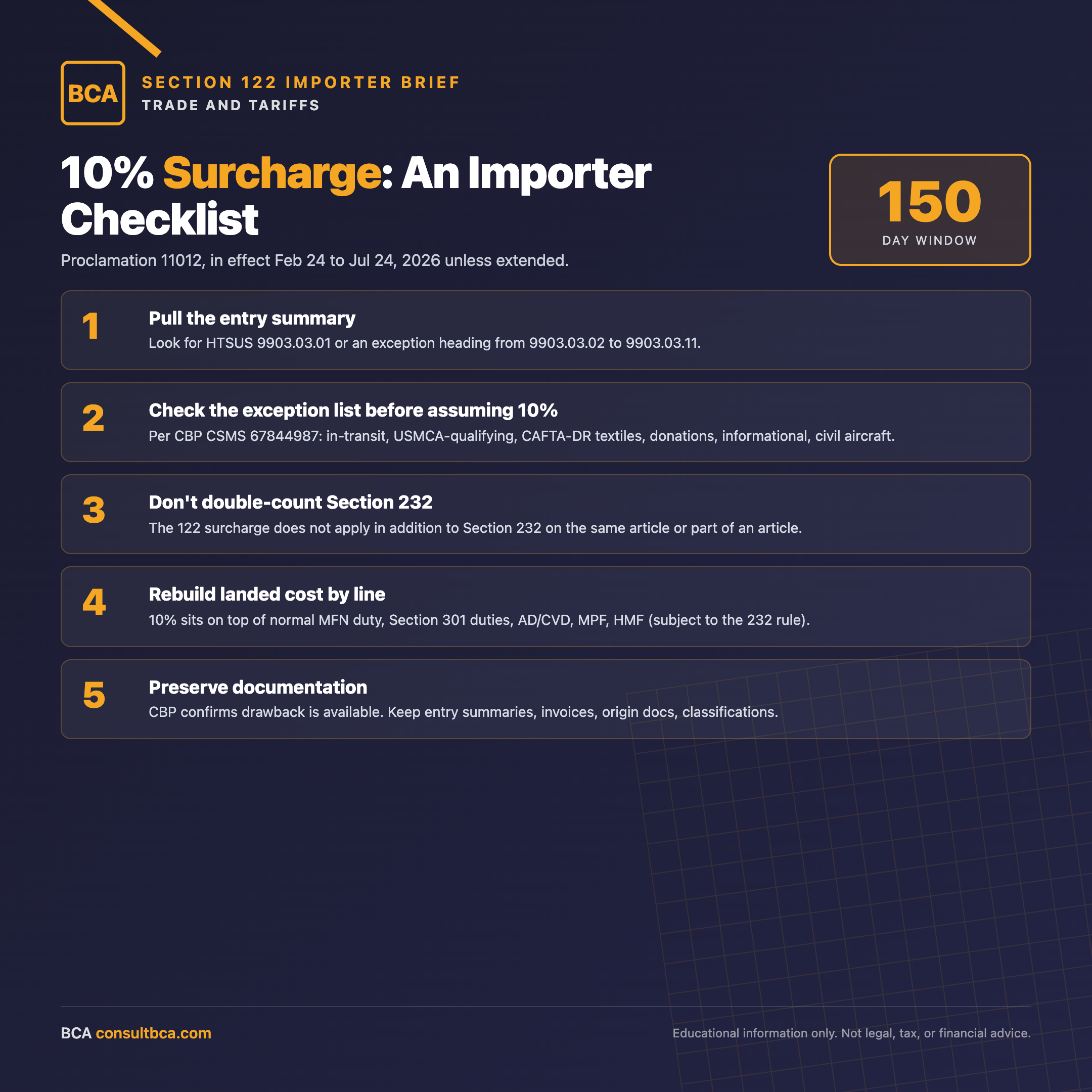
1. Pull the entry summary. Ask your broker for the entry summary line detail, not just the invoice total. You are looking for HTSUS 9903.03.01 or an exception heading from 9903.03.02 through 9903.03.11.
2. Check the exception list before assuming the 10% applies. CBP’s CSMS 67844987 lists exception headings for in-transit goods, certain agricultural and specialty goods, civil aircraft articles, certain Section 232-covered products, USMCA-qualifying Canada and Mexico goods, CAFTA-DR textile and apparel goods, donations, informational materials, and certain Chapter 98 entries.
3. Do not double count Section 232. Proclamation 11012 says the Section 122 surcharge does not apply in addition to Section 232 tariffs. If only part of an import is subject to Section 232, the surcharge may apply to the non-232 part. That is a broker and classification question, not a guess.
4. Rebuild landed cost by line item. The 10% surcharge can sit on top of normal MFN duty, Section 301 duties, antidumping or countervailing duties, merchandise processing fees, harbor maintenance fees, and other charges, subject to the Section 232 rule above. A product that looked profitable on a purchase-order quote may not stay profitable at entry.
5. Preserve documentation for drawback, pricing, and dispute posture. CBP confirms drawback is available for the additional Section 122 duties. Whether you are pursuing drawback, supplier renegotiation, customer surcharge language, or a later refund pathway, you need entry summaries, commercial invoices, origin documents, HTS classifications, broker instructions, and proof of duty paid.
What Section 122 does
Section 122, codified at 19 U.S.C. 2132, is a balance-of-payments authority. It allows the President, when fundamental international payments problems require special import measures, to impose a temporary import surcharge not exceeding 15% ad valorem for no more than 150 days unless Congress extends the period.
The statute also requires broad and uniform product coverage, but it allows exceptions where certain articles should not be subject to import restrictions because of the needs of the U.S. economy. It also allows exceptions where the action would be unnecessary or ineffective, such as for goods already subject to import restrictions or goods in transit.
That matters because the exception analysis is part of the statute and the proclamation. It is not a loophole. It is a required operating step.
What changed in February 2026
On February 20, 2026, the President issued Proclamation 11012, “Imposing a Temporary Import Surcharge To Address Fundamental International Payments Problems.” The Federal Register published it on February 25, 2026 at 91 FR 9339.
The proclamation imposed a 10% ad valorem surcharge on articles imported into the United States, effective February 24, 2026, for a 150-day period. CBP then issued CSMS 67844987 with operational instructions for importers, brokers, and filers.
For a small importer, the most important parts of the CBP message are:
- Covered entries use HTSUS 9903.03.01.
- Exceptions are handled through headings 9903.03.02 through 9903.03.11.
- Goods loaded and in transit before February 24, 2026 had a narrow in-transit exception if entered before February 28, 2026.
- USMCA qualifying Canada and Mexico goods entered free of duty are excepted through 9903.03.07 and 9903.03.08.
- Drawback is available for the additional Section 122 duties.
- CBP gives a specific order for Chapter 98 and Chapter 99 reporting on the entry summary line.
What not to say internally
Do not tell your team “everything is 10% now.” That is too broad.
Do not tell your team “there are no exclusions.” That is wrong.
Do not tell your team “the courts fixed it.” The U.S. Court of International Trade ruled the surcharge unlawful on May 7, 2026, but the Court of Appeals for the Federal Circuit issued an administrative stay on May 12. Collection continues at 10% while the appeal proceeds. A business still has to quote, import, pay, document, and preserve options under current law.
The correct internal instruction is: every affected import line gets checked for HTS 9903.03.01, exception headings, country preference eligibility, Section 232 overlap, and documentation.
Litigation update and legislation: track, do not rely on
The Section 122 surcharge followed the Supreme Court’s February 20, 2026 decision holding that IEEPA does not authorize the President to impose tariffs. That history explains why Section 122 is now in focus, but it does not tell an importer what to do with today’s entry.
CIT ruling (May 7, 2026): The U.S. Court of International Trade ruled the Section 122 surcharge unlawful in the Liberty Justice Center case (Burlap and Barrel, Inc. v. Trump). The ruling went in the plaintiffs’ favor.
CAFC administrative stay (May 12, 2026): The Court of Appeals for the Federal Circuit issued an administrative stay. The surcharge continues to be collected at 10% for all importers except the three named plaintiffs in the case, while the appeal proceeds.
What this means for importers: The 10% surcharge is still in effect for your entries today. The CIT ruling does not change your current-law obligations. It does, however, create a potential future refund pathway: if the CAFC affirms the lower court, importers who preserved entry summaries, invoices, classification records, and proof of duty paid will be in the strongest position to pursue it. This makes the documentation discipline in this checklist more urgent, not less.
There is also proposed legislation, the Small Business Liberation 2.0 Act, that would exempt small business concerns from Section 122 duties. It is proposed legislation, not current law.
Owners should track litigation and legislative developments. They should not build pricing, duty payments, or customer commitments on the assumption that either will resolve before the 150-day period ends.
What small business importers should do this month
- Ask your broker for a list of entries where HTSUS 9903.03.01 was applied.
- Build a second list of entries where an exception heading was used, and keep the supporting documents.
- For Canada and Mexico goods, confirm USMCA qualification instead of assuming country of origin is enough.
- For goods with Section 232 exposure, ask whether Section 122 was excluded or applied only to the non-232 part.
- Update landed-cost sheets for open purchase orders and future quotes.
- Add tariff-adjustment language to customer quotes where appropriate.
- Preserve entry-level documentation in a single folder by shipment.
- Track CAFC appeal developments and Federal Register updates. The CIT ruled the surcharge unlawful (May 7), but the CAFC stay keeps collection in effect. Keep operating under the 10% surcharge until the appellate court rules or Congress acts.
When to bring BCA in
BCA is not customs counsel and does not file customs protests. That stays with customs brokers and trade counsel. BCA can help with the business side of the tariff problem:
- Build a landed-cost model that separates product cost, duty, freight, fees, and margin.
- Coordinate the checklist with your broker so someone is checking HTS 9903.03.01 and exception headings.
- Review customer and supplier pricing language for the 150-day period.
- Create the documentation folder structure needed for drawback, refund, or customer support.
- Help owners decide whether to absorb the surcharge, renegotiate, pass it through, delay orders, or source differently.
The tariff filing is technical. The operating decision is a business decision.
Key Takeaways
- Section 122 allows a temporary import surcharge up to 15% for up to 150 days, unless Congress extends the period.
- Proclamation 11012 imposed a 10% temporary surcharge effective 12:01 a.m. EDT February 24, 2026 through 12:01 a.m. EDT July 24, 2026, subject to exceptions and later changes.
- The correct operating phrase is not “no exclusions.” It is “check HTSUS 9903.03.01 against exception headings 9903.03.02 through 9903.03.11.”
- USMCA qualifying Canada and Mexico goods, certain CAFTA-DR textile/apparel goods, some Section 232-covered products, donations, informational materials, and other listed articles may be excepted.
- CBP confirms drawback is available for the additional Section 122 duties.
- The U.S. Court of International Trade ruled the surcharge unlawful (May 7, 2026); the CAFC issued an administrative stay (May 12). Collection continues at 10% for all importers except three named plaintiffs while the appeal proceeds.
- The CIT ruling creates a potential future refund pathway. Importers who preserve entry documentation now are best positioned if the CAFC affirms the lower court.
- Proposed legislation (Small Business Liberation 2.0 Act) is a watch item, not current law.
- BCA can help owners model landed cost, build the documentation discipline, and coordinate with brokers and trade counsel.
Educational information only, not licensed legal, tax, or financial advice. We refer to and partner with licensed professionals when personalized advice is needed. Laws change; no warranty of accuracy or timeliness.
Sources
- 19 U.S.C. 2132, “Balance-of-payments authority.” https://www.govinfo.gov/content/pkg/USCODE-2023-title19/pdf/USCODE-2023-title19-chap12-subchapI-part2-sec2132.pdf
- Federal Register, Proclamation 11012, “Imposing a Temporary Import Surcharge To Address Fundamental International Payments Problems,” 91 FR 9339, Feb. 25, 2026. https://www.federalregister.gov/documents/2026/02/25/2026-03824/imposing-a-temporary-import-surcharge-to-address-fundamental-international-payments-problems
- U.S. Customs and Border Protection, CSMS 67844987, “Imposing Temporary Section 122 Duties,” Feb. 23, 2026. https://content.govdelivery.com/accounts/USDHSCBP/bulletins/40b3b7b
- EY Global Tax Alert, “US implements global 10% import tariff under Section 122 of the Trade Act of 1974.” https://www.ey.com/en_gl/technical/tax-alerts/us-implements-global-10-percent-import-tariff-under-section-122-of-the-trade-act-of-1974
- Justia U.S. Supreme Court Center, “Learning Resources, Inc. v. Trump.” https://supreme.justia.com/cases/federal/us/2025/24-1287/
- KPMG TaxNewsFlash, “U.S. Supreme Court: Presidential tariffs exceeded legal authority under IEEPA.” https://kpmg.com/us/en/taxnewsflash/news/2026/02/us-supreme-court-presidential-tariffs-exceeded-legal-authority-under-ieepa.html
- Liberty Justice Center, “Burlap and Barrel, Inc. v. Trump.” https://libertyjusticecenter.org/cases/burlap-and-barrel-inc-v-trump/
- Small Business Liberation 2.0 Act draft bill text. https://www.gillibrand.senate.gov/wp-content/uploads/2026/03/Small-Business-Liberation-2.0-Act.pdf
This information is provided for general educational purposes and reflects opinions based on experience. Individual circumstances may vary. Tariff classification, country-of-origin analysis, preference claims, drawback, protests, and litigation strategy are technical customs matters that depend on specific entries and documents. BCA advisors bring business and compliance experience to help owners evaluate the operating impact, coordinate with customs brokers and trade counsel, and build documentation discipline. Customs filings and trade-counsel work stay with specialists.