

This article originally covered the American Rescue Plan Act of 2021 (ARPA) provision that lowered the Form 1099-K reporting threshold to $600 with no minimum number of transactions. That provision became a moving target. The IRS delayed it multiple times and Congress ultimately reversed it in 2025. Here is the current state of the rules and what online sellers, gig workers, and payment app users actually need to do.
The Current 1099-K Rule
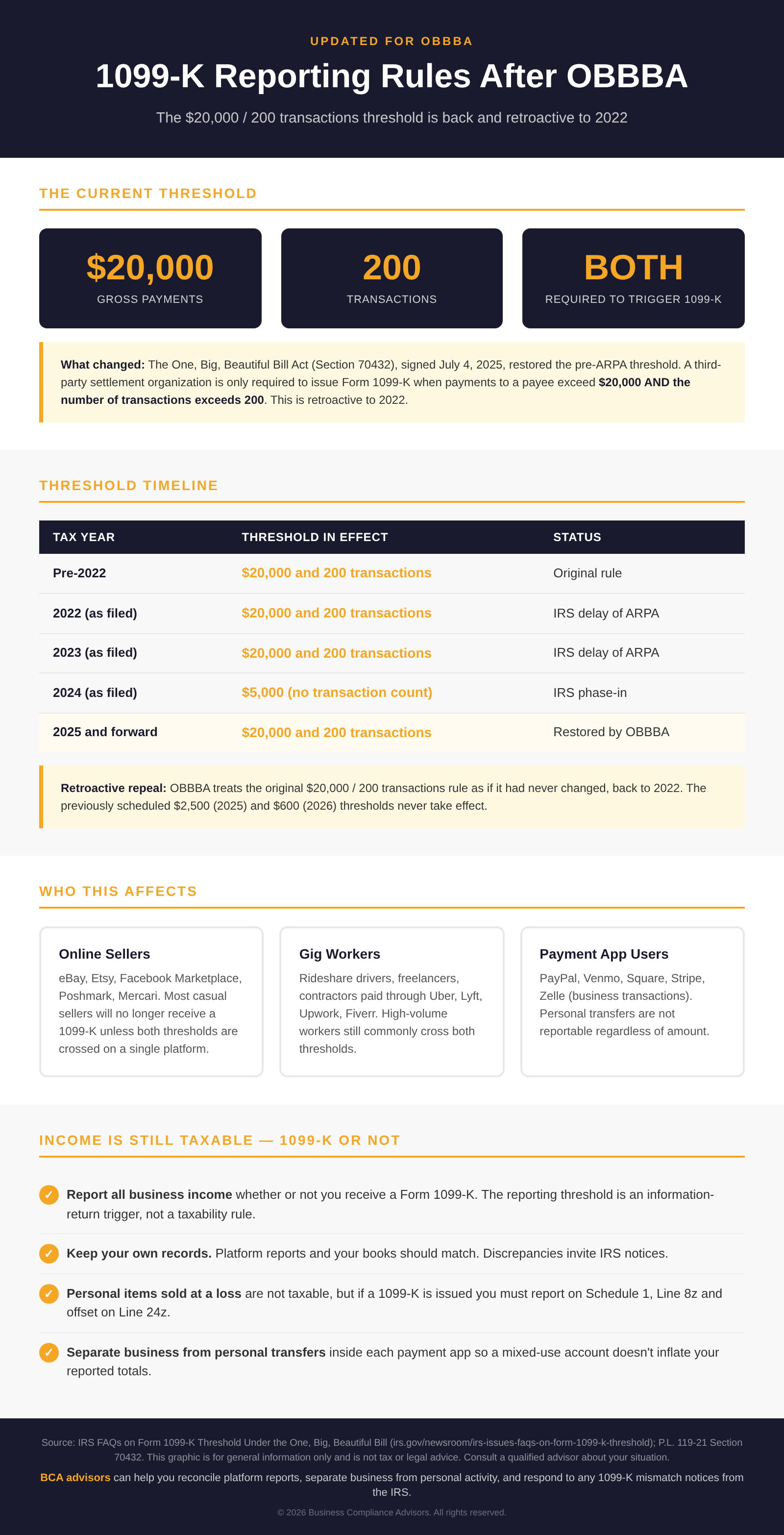
Under Section 70432 of the One, Big, Beautiful Bill Act, a third-party settlement organization (PayPal, Venmo, eBay, Etsy, Uber, and similar platforms) is only required to issue Form 1099-K when gross payments to a payee exceed $20,000 AND the number of transactions exceeds 200 in a calendar year. Both thresholds must be crossed. This is the same rule that was in effect before ARPA, and it is retroactive to 2022.
What Happened to the $600 Threshold
ARPA lowered the threshold to $600 with no transaction minimum starting in 2022. The IRS delayed enforcement for 2022 and 2023, then announced a phased approach with a $5,000 threshold for 2024. OBBBA cut this off entirely in July 2025 and treats the old $20,000 / 200 rule as if it had never changed. The $2,500 threshold that had been scheduled for 2025 and the $600 threshold that had been scheduled for 2026 will not take effect.
Income Is Still Taxable
The reporting threshold is an information-return trigger, not a taxability rule. If you earn business income through a platform, it is taxable whether or not you receive a 1099-K. Keep records of every payment, separate business activity from personal transfers, and reconcile platform reports to your own books before you file.
Selling Personal Items at a Loss
Even under the higher threshold, some casual sellers will still receive a 1099-K if they cross both limits on a single platform. If the 1099-K reflects personal items sold at a loss, you must still report the gross amount and separately claim an offset. Personal losses are not deductible, but you should not pay tax on the full gross either.
Example: You sell a couch you bought four years ago for $3,000, and a buyer pays $500 through a payment app. You have a $2,500 personal loss, which is not deductible. On Form 1040, Schedule 1, Part I, Line 8z (Other Income), enter “Form 1099-K Personal Item Sold at a Loss, $500.” In Part II, Line 24z (Other Adjustments), enter “Form 1099-K Personal Item Sold at a Loss, $500.” Net tax impact is zero, but you have properly reported the 1099-K and offset it.
More information is available on the IRS 1099-K FAQ page: irs.gov/newsroom/form-1099-k-faqs and the IRS OBBB 1099-K FAQs: irs.gov/newsroom/irs-issues-faqs-on-form-1099-k-threshold-under-the-one-big-beautiful-bill-dollar-limit-reverts-to-20000.
Disclaimer: This article is for informational purposes only and is not legal, tax, or financial advice. BCA is not a licensed professional services firm. We help clients assess their situations and work with licensed attorneys, tax advisors, and other qualified professionals on your behalf. Read our full Terms and Conditions. Have questions? Contact BCA and let us put the right team together for you.