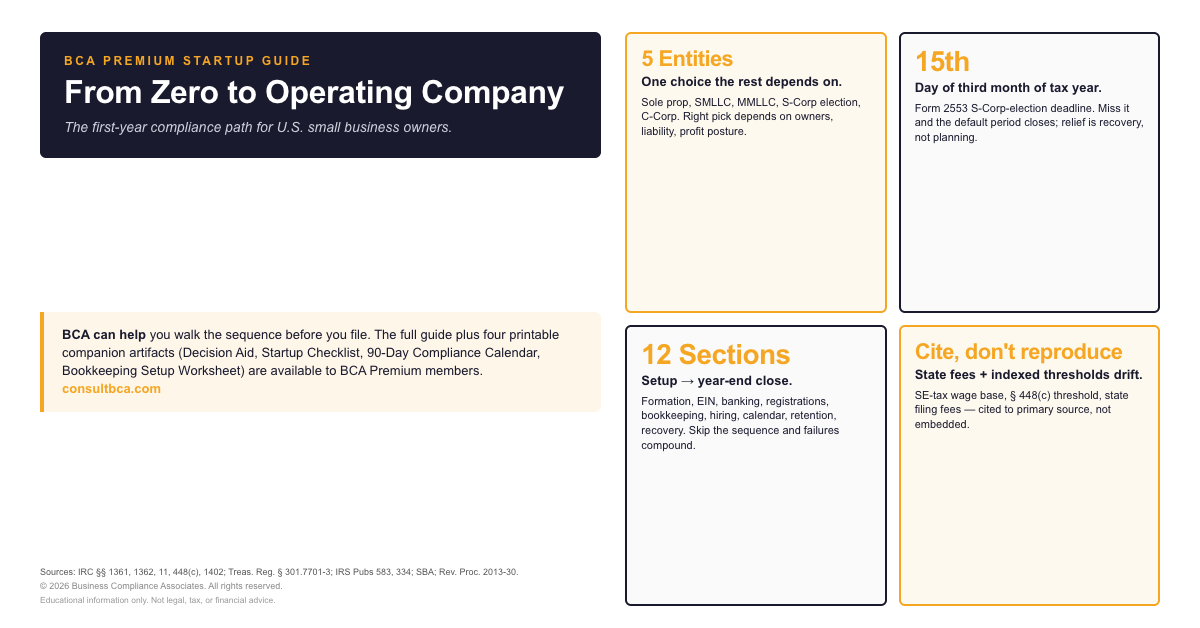
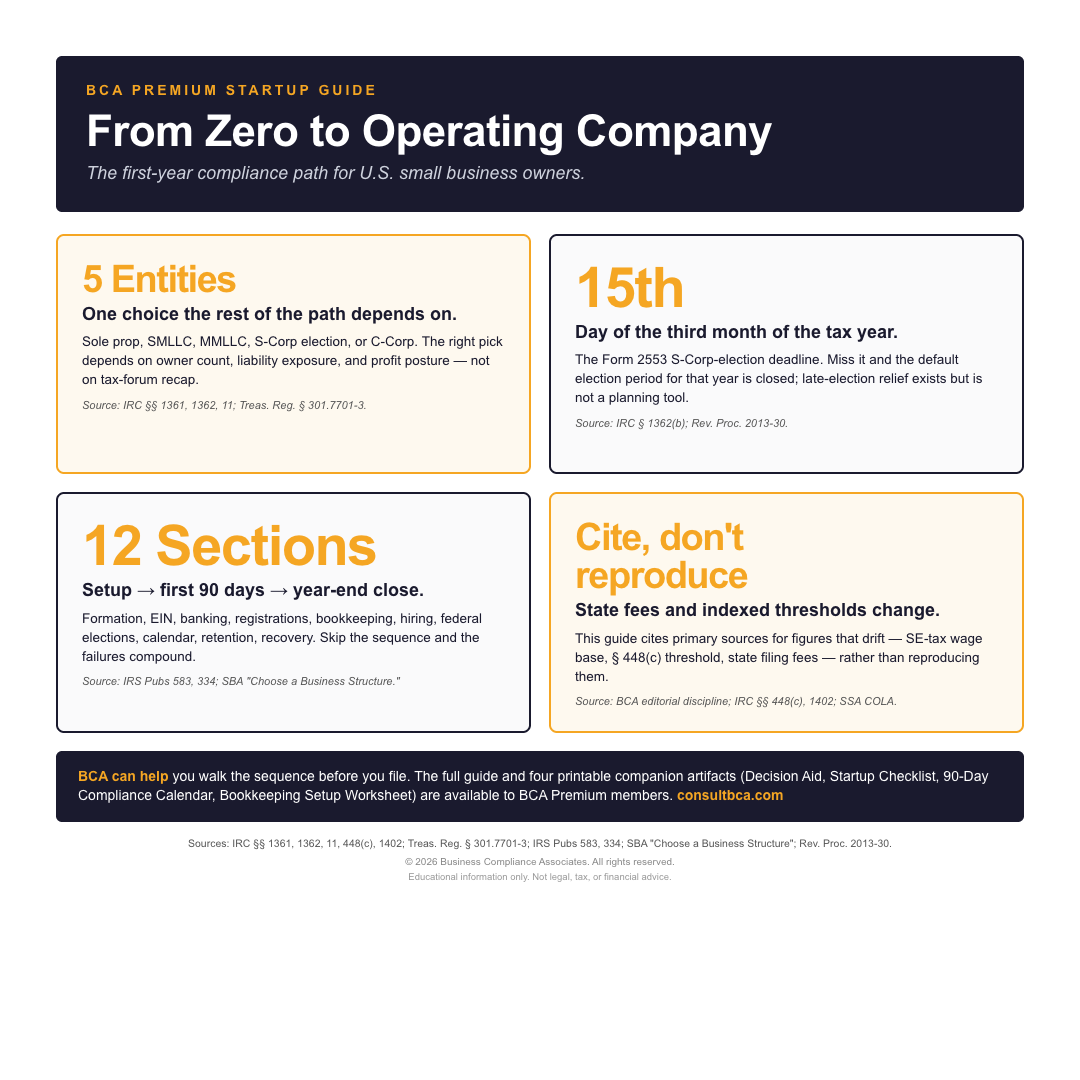
This guide is the operating path for a U.S. small business owner who has decided to start a company and needs to know what to do, in what order, to operate without compliance landmines. It is not a “should I start a business” piece. It is the sequence — entity choice, formation, EIN, banking, registrations, bookkeeping, hiring, federal elections, calendar, retention, and the recovery paths when something goes wrong in year one.
The audience is the ordinary owner-operator: single-owner or 2-3 partner shape, service business or light operating business, U.S.-based, not a venture-track startup and not in a heavily regulated industry. Multi-state operations, foreign-owned entities, industry-specific licensing, cap tables, and trademark/patent topics are out of scope. So is personal financial planning. The value here is in the order of operations founders actually need.
Below: a public overview of the entity-choice framework and the first-90-days operational backbone that every reader can use. The full operational kit — the decision-aid logic, the state and payroll overlays, the recovery paths, and four printable companion artifacts — is gated for BCA Premium and beta members.
1. Choosing How Your Business Will Exist on Paper
Before anything else happens — before the EIN, before the bank account, before the first invoice — you decide what kind of legal and tax entity your business will be. That decision shapes what you pay in taxes, what protects you from a lawsuit, what paperwork you owe each year, and what you can change later without unwinding the rest of the operation.
For most ordinary owner-operators in the U.S., the realistic choice is among five options. They are not all equally common, and they are not all equally portable. The right pick depends on how many owners you have, how much liability exposure your work carries, what you want to do with profits, and whether you intend to pay yourself a salary or take draws.
| Entity | Federal default | Liability shield | SE tax | Where it fits |
|---|---|---|---|---|
| Sole prop | Schedule C; no separate filing | None — owner personally liable | All net earnings | A short-term default for very early one-person operations with low liability exposure; not a long-term home |
| SMLLC | Disregarded; Schedule C | Yes, if formalities are kept | All net earnings (unless an election is made) | The standard starting point for one-owner businesses that want a liability shield without partnership complexity |
| MMLLC | Partnership; Form 1065 + K-1s | Yes, if formalities are kept | Generally all earnings | The standard starting point for two or more owners who want pass-through tax treatment |
| S-Corp election | Pass-through; filed via Form 2553; profit splits between W-2 reasonable comp and distributions | Yes (depends on entity) | SE tax on the W-2 portion only | Profitable owner-operator businesses where the SE-tax savings exceed the additional payroll and compliance cost |
| C-Corp | Separate taxpayer at the 21% federal corporate rate; dividends taxed again at the shareholder level | Yes | None at entity level (FICA on W-2 wages) | Mostly relevant when outside investors require it, or in narrow specialized situations. Not the default for ordinary owner-operators. |
Two points the table cannot show:
The LLC is a state-level liability concept; the S-Corp is a federal tax election. Those are not alternatives to each other. An LLC can elect to be taxed as an S-Corp. A corporation can elect to be taxed as an S-Corp. The “LLC vs S-Corp” framing common in startup forums is a category error. The real question is “what state-law entity, with what federal tax election.”
You can change tax elections more easily than you can change the underlying entity. Switching from disregarded SMLLC to S-Corp tax treatment is an election filing. Switching from an LLC to a corporation, or from one state of formation to another, is a structural conversion with real cost. Pick the entity carefully; the tax election is more recoverable.
The full guide below walks through when each option is the right pick, the four entity-choice mistakes that cost the most to fix later, and the S-Corp election timing trap that catches owner-operators in the first or second year.
10. First-Year Compliance Calendar
The first-90-days operational backbone every new owner-operator should have in view. Entity-specific variants, payroll deposit cadence, state-by-state filing differences, and the recovery paths for missed deadlines are in the full calendar below for BCA Premium and beta members.
Day 1 of this calendar is the date your Secretary of State confirmation comes back. Specific dates (“Mar 15,” “Apr 15”) read as “first applicable” — the first instance of that fixed federal date after you form. A founder forming in July hits Sep 15 first, not Apr 15.
- Day 1-7 — Apply for your EIN at IRS.gov as soon as the SOS confirmation arrives. Save the confirmation immediately; the IRS does not redisplay it.
- Day 8-14 — Open your business bank account in the entity’s exact legal name. Bring the EIN letter, Articles, operating agreement, and owner ID.
- Day 14 — Bookkeeping platform live. Chart of accounts aligned to your federal return form (Schedule C / 1065 / 1120-S / 1120).
- Day 21-30 — Register for sales tax in your home state if you sell taxable goods or services. Before the first taxable sale, never after.
- Before first payday — State employer registrations (UI, withholding where applicable), workers’ comp insurance, Form W-4, Form I-9.
- By first applicable Mar 15 — File Form 2553 if you are electing S-Corp treatment for the current tax year.
- First applicable Apr 15 — First quarterly federal estimated tax payment.
What this misses — entity-specific variants, payroll deposit cadence, state-by-state filing differences, and the recovery paths for missed deadlines — is in the full guide below.
Closing
The startup year is forgiving when the founder catches problems in real time and harsh when problems accumulate. The discipline this guide describes — sequence, monthly close, retention reflex, deadline discipline — is what makes year one recoverable when something goes wrong, and routine when nothing does.
What’s inside the full guide for BCA Premium and beta members:
- The decision-aid logic for choosing among the five entities, including the four entity-choice mistakes that cost the most to fix later (§1).
- Out-of-state formation analysis, including the structural Nevada vs. Wyoming difference and the worked Nevada example (§2).
- Operational formation week, EIN application, banking discipline, and bookkeeping foundation (§3-7).
- First contractor or first hire — the three-regime classification framework (IRS, DOL, state) and the owner-compensation question by entity type (§8).
- Federal tax registrations and elections including the Form 2553 deadline mechanics and Rev. Proc. 2013-30 late-election relief framing (§9).
- The first-year compliance calendar with state, payroll, and sales-tax overlays (§10).
- Recordkeeping retention and the IRC § 274(d) contemporaneous-substantiation rule (§11).
- Five common first-year compliance failures and the recovery paths that actually apply, including the IRC §§ 6654/6655 estimated-tax framework (§12).
Companion artifacts (printable, Premium downloads): the Entity-Choice Decision Aid, the Startup Checklist, the First 90 Days Compliance Calendar with entity-specific variants, and the Bookkeeping Setup Worksheet.
Once the startup year is behind you, BCA’s IRS Enforcement 2026 Field Manual covers ongoing compliance — the monthly close cadence, the AUR notice response playbook, deduction documentation, and worker-classification exposure.
Beta access to BCA Premium is currently open at no cost while we continue to expand the library. Join here →
BCA can advise and assist with the actual sequence before you file. Contact us for info.