

For small and mid-sized business owners thinking about setting up a company in a lower-tax jurisdiction, 2026 is a different game than it was even five years ago.
The traditional pitch was simple. Pick a country with zero or near-zero corporate tax, register a company there, route business through it, pay less. Cayman, the British Virgin Islands, Bermuda, Bahamas. The list hasn’t changed much in twenty years.
What has changed is what those jurisdictions are competing on. The race to the lowest tax rate is mostly over. The competition now is about something more substantive: regulatory credibility, banking access, treaty networks, asset protection, succession planning, and whether your business actually has operations in the place you’re registered. The most attractive low-tax jurisdictions today are the ones that combine a favorable rate with real infrastructure and real legitimacy.
If you’re reading this as the owner of a US small or mid-sized business considering an offshore entity, a foreign subsidiary, or a place to hold profits for future use, the practical question isn’t “where is tax lowest?” It’s “where can I structure something that will hold up, stay compliant, and still deliver real tax efficiency?”
One thing to clear out of the way: the OECD’s new minimum tax
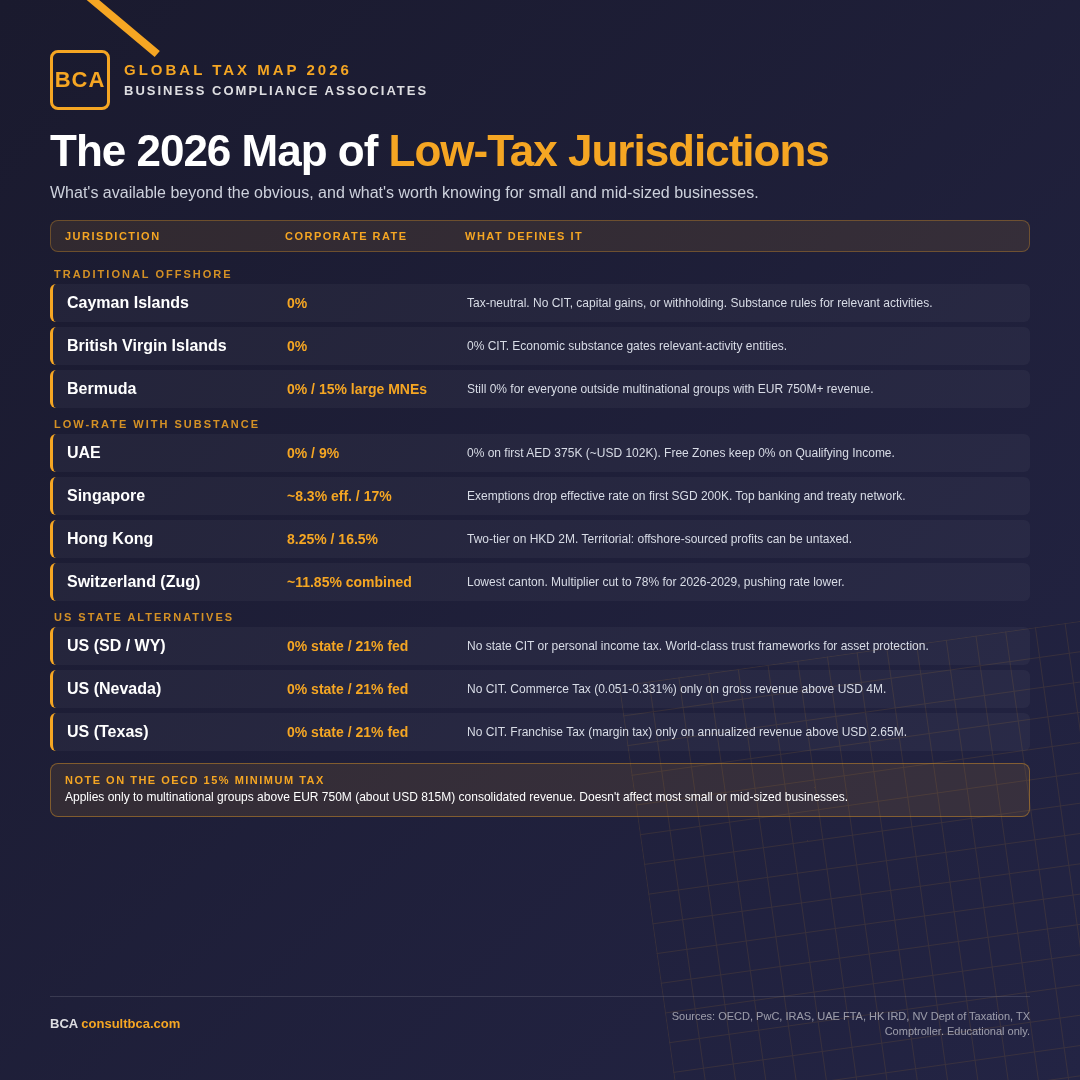
You may have read about a new 15% global minimum tax that the OECD coordinated across more than 140 countries. It’s real. It’s now in force across the EU, UK, Canada, Australia, Japan, and South Korea. Bermuda even introduced its own 15% corporate income tax in January 2025 in response. But it only applies to multinational corporate groups with consolidated annual revenue above 750 million euros (roughly USD 815 million). That threshold rules out essentially every small and mid-sized business reading this. If your company’s worldwide group revenue is below that number, the 15% minimum tax framework does not apply to you, and you can ignore the rest of the headlines about it.
One additional wrinkle worth knowing if you ever scale into the affected range: in January 2026, the OECD framework formally exempted US-headquartered multinational groups from the minimum tax’s main enforcement rules. Translation: a US-based group that does grow past the 750-million-euro revenue mark continues to operate under the existing US corporate tax system rather than the international minimum.
The 2026 menu of low-tax options
Cayman Islands and the British Virgin Islands continue to operate as tax-neutral. No corporate income tax, no capital gains tax, no withholding tax on dividends or interest. Both now require entities engaged in certain activities to demonstrate real economic substance in the jurisdiction (essentially: actual employees, premises, and decisions happening on the ground), but for properly structured holding companies, investment vehicles, and intellectual property entities, the zero-tax posture is intact. Bermuda holds the same posture for anyone outside the large multinational perimeter.
The UAE has moved up the list of options for smaller businesses. Since June 2023, the UAE charges 0% on the first AED 375,000 of taxable profit (about USD 102,000) and 9% above that. Free Zone companies that qualify as a Qualifying Free Zone Person keep 0% on their Qualifying Income under a 2023 Cabinet decision, though the categories of qualifying income are narrower than the headlines suggest and the substance requirements are real. Dubai and Abu Dhabi Free Zones increasingly require audited financials and demonstrated commercial activity to keep that 0% status.
Singapore keeps a 17% corporate tax rate on paper, but exemption schemes drop the actual tax bill on the first SGD 200,000 of profit to about 8.3% for established companies, and to nearly 4% for qualifying startups in their first three years. There’s no capital gains tax. Foreign-sourced income that’s properly structured can be exempt. Singapore’s appeal isn’t its rate; it’s a top-tier regulatory environment, strong banking, and a treaty network that gives you preferential access to Asia.
Hong Kong operates a two-tier corporate tax: 8.25% on the first HKD 2 million of profit, 16.5% above that. The Hong Kong system is territorial, meaning profits actually arising outside Hong Kong can be untaxed even for a Hong-Kong-resident company, as long as you can substantiate the offshore source. Switzerland’s Canton Zug stays at about 11.85% combined, and Zug just cut its cantonal multiplier from 82% to 78% for 2026 through 2029, which will trim the effective rate further once communal numbers settle.
What you might be missing closer to home
Before going offshore, it’s worth knowing what’s available inside the US. Four states stand out for owners who want a domestic structure with minimal state tax burden and strong asset protection.
South Dakota and Wyoming both have zero state corporate income tax and zero state personal income tax. Both have built world-class trust frameworks; South Dakota in particular has become the preferred US jurisdiction for dynasty trusts and asset protection structures because of its perpetual sealing of trust court records and its abolition of the rule against perpetuities. A trust set up in either state can hold assets for unlimited generations without estate tax at each transfer.
Nevada has no traditional corporate income tax and no personal income tax. The Nevada Commerce Tax only applies to business gross revenue above USD 4 million in a fiscal year, with rates ranging from 0.051% to 0.331% depending on industry. For most small and mid-sized businesses, that effectively means zero state-level tax. Nevada also has strong asset protection laws and a long-standing reputation for business-friendly courts.
Texas charges no corporate income tax or personal income tax. The Texas Franchise Tax (technically a margin tax) only kicks in for entities with annualized revenue above USD 2.65 million for 2026 reports, at rates of 0.375% for retail and wholesale or 0.75% for most other businesses. Below that threshold, no franchise tax is owed. The combination of zero personal income tax, generous business exemptions, and a deep service economy makes Texas a meaningful domestic alternative.
Federal corporate income tax of 21% still applies to all four states. The state-level zero is the bonus, and for asset-protection or trust planning, the bonus can be substantial.
What actually matters when you set something up
If you do decide to set up an entity in a lower-tax jurisdiction, the questions that will determine whether the structure works are surprisingly consistent across destinations. Can you demonstrate that real business activity happens there? Can you open and maintain a bank account locally? Does the jurisdiction have a tax treaty with the United States or your other relevant markets? Are you ready for the US reporting obligations that come with foreign entities (FBAR, Form 5471, Form 8865, GILTI, Subpart F)? Is the structure something you can comfortably explain to your US tax preparer and, if necessary, to the IRS?
None of those questions has a generic answer. The right structure depends on your specific business, the kind of income you’re earning, where your customers are, and what you’re trying to accomplish (current tax savings, deferred profits, retirement accumulation, asset protection, succession planning). The wrong structure can generate compliance costs and tax exposure that erase any rate advantage.
That’s the conversation a US-based small or mid-sized business owner should have with qualified international tax counsel before assuming any of the jurisdictions above is the right answer. BCA helps you frame the strategic questions and the trade-offs; the licensed tax and legal professionals we partner with do the actual structuring work.
Sources
OECD Global Anti-Base Erosion Model Rules and 2026 administrative guidance. PwC Worldwide Tax Summaries (Bermuda, Cayman Islands, BVI, Singapore, Hong Kong SAR, Switzerland, UAE). IRAS Singapore corporate tax pages. UAE Federal Tax Authority Cabinet Decision 100 of 2023. Hong Kong Inland Revenue Department two-tier profits tax FAQ. Swiss Federal Tax Administration cantonal data. Nevada Department of Taxation Commerce Tax pages. Texas Comptroller Franchise Tax 2026 guidance.
Educational information only, not licensed legal, tax, or financial advice. We refer to and partner with licensed professionals when personalized advice is needed. Laws change; no warranty of accuracy or timeliness.