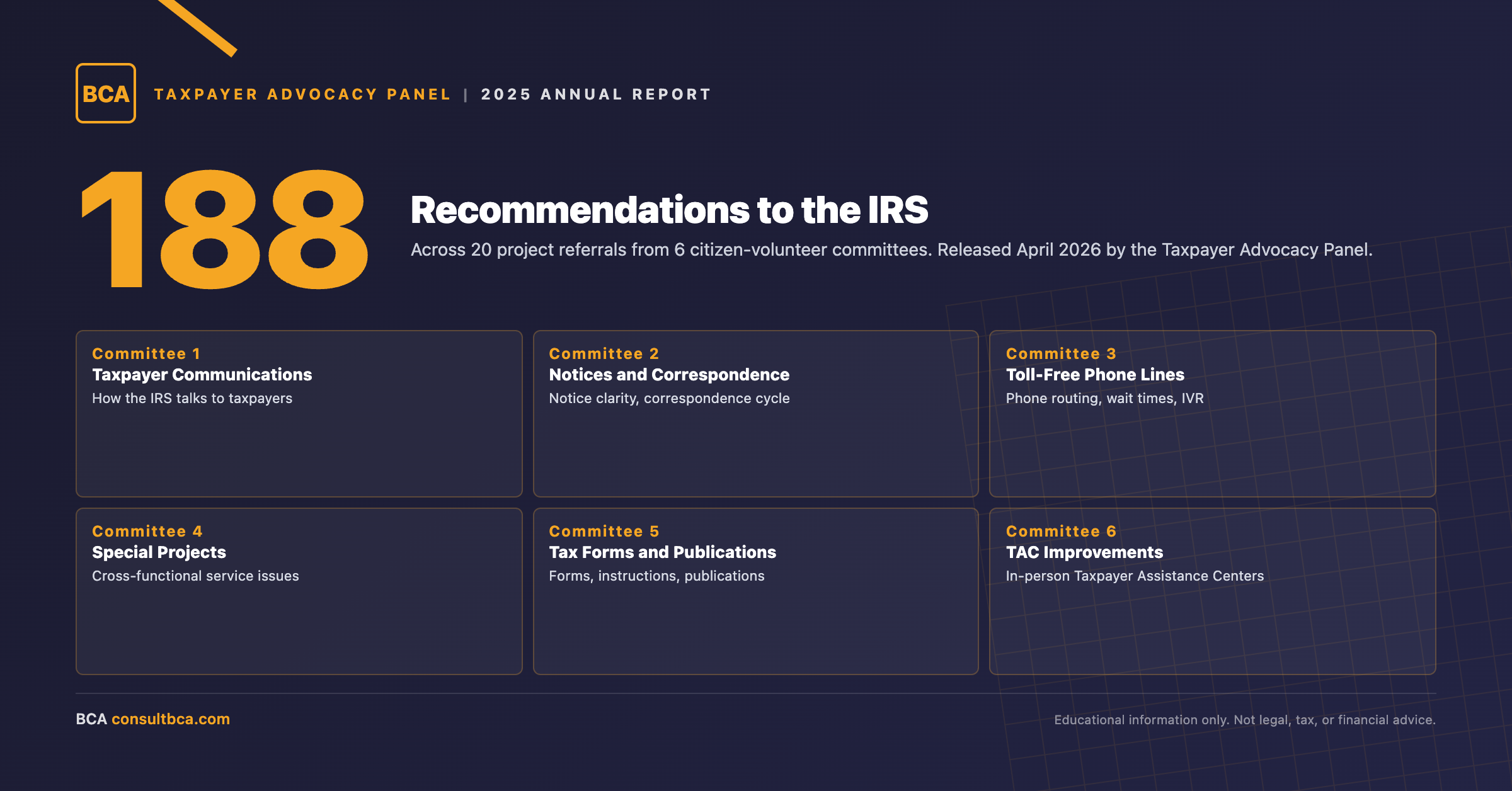
The Taxpayer Advocacy Panel released its 2025 Annual Report in April 2026, with 188 recommendations to the IRS across six committees. The companion news post covered the headline numbers. This post answers the question that actually matters for small business operators: which of those 188 recommendations are worth watching for movement in 2026 or 2027, and how should that change the way you interact with the IRS in the meantime. The IRS does not commit to adopting TAP recommendations; this is a watchlist, not a forecast.
What TAP is, in one paragraph
The Taxpayer Advocacy Panel is a citizen-volunteer federal advisory committee, sponsored by the IRS through the Taxpayer Advocate Service. Volunteers are drawn from across the country. They listen to taxpayers, run committee-level analyses on systemic IRS service issues, and submit recommendations the IRS reviews. TAP is distinct from the National Taxpayer Advocate (NTA), which is an internal independent IRS office. NTA writes its own Annual Report to Congress. TAP is the citizen-volunteer companion process, working from outside-in.
The IRS does not commit to adopting any particular TAP recommendation. Whether and when a recommendation lands depends on the IRS’s own roadmap, its budget, and how the recommendation interacts with other priorities. Historically, a meaningful share of TAP recommendations are adopted in some form within two to three years. The number that get fully adopted is smaller. A reasonable framing: TAP recommendations are leading indicators of where the IRS is paying attention, not commitments.
The six committees and what they own
The 2025 report is structured around six principal project committees:
1. Taxpayer Communications. Cross-cutting committee on how the IRS talks to taxpayers (language, tone, channel design).
2. Notices and Correspondence. Specific committee on notice content, structure, and the correspondence cycle. Notice clarity and notice-driven call volume are perennial focus areas. This committee touches almost every IRS notice a small business owner will encounter.
3. Toll-Free Phone Lines. Committee on the IRS phone-line experience: routing, wait times, agent training, IVR design.
4. Special Projects. Catch-all committee for issues that do not fit the other five (cross-functional service problems, emerging issues, time-bounded initiatives).
5. Tax Forms and Publications. Committee on forms readability, instructions clarity, and publication architecture. This is where the recommendations on cleaner Schedule C, simpler Form 8821, and better-organized Pub 535 type guidance originate.
6. Taxpayer Assistance Center Improvements. Committee on the in-person Taxpayer Assistance Center (TAC) network: locations, hours, services offered, accessibility, and the appointment system. Relevant for small business operators who need in-person help with notice resolution or ITIN matters.
For a small business audience, committees 2 (Notices and Correspondence), 5 (Forms and Publications), and 3 (Toll-Free Phone) are the highest-impact.
A BCA watchlist of five recommendation areas
Reading the 2025 themes against IRS modernization activity that BCA tracks separately, here are five recommendation areas worth watching over the next 18 months. The IRS does not commit to adopting any TAP recommendation, and BCA is not predicting outcomes; this is a watchlist, not a forecast.
1. Notice clarity for high-volume notices. TAP has consistently pushed for plainer language and clearer next-step framing on the most common IRS notices. The IRS has been redesigning notice templates over the past two years. CP14 balance-due, CP504 final notice, CP2000 underreporter, and CP297 levy are the small business notices worth watching for redesigns. If a redesign lands, the notice you receive in 2027 may be more readable than the same notice in 2025.
2. IRS Online Account. TAP recommendations on Online Account have been a multi-year effort. The Business Tax Account expansion to partnerships, S-corps, and tax-exempts in April 2026 is one piece. The 2025 TAP report points at the next layer: tax-transcript download, direct payment, balance-due management, and authorized-representative interactions. Worth watching for incremental Online Account additions through 2026 and 2027.
3. ITIN tooling. TAP has flagged ITIN delays as a service-quality issue affecting non-citizen small business owners and their dependents. Recommendations on ITIN online tooling are in the 2025 report. Whether this produces faster ITIN turnaround depends on what IRS prioritizes; worth watching.
4. Chatbot and live-chat scope. TAP recommendations to expand chatbot and live-chat capabilities feed into the IRS’s broader digital-service investment. Watching for: more issue types covered by chat, longer hours, better escalation paths to human agents. This is the recommendation area where the underlying technology is mature and the cost-to-deploy is relatively low, so visible changes are plausible.
5. Tax forms readability. Slow-moving but on the watchlist. The 1040, 1065, and 1120 are unlikely to change dramatically. Schedule C, Schedule E, Schedule SE, and the most common forms a small business owner touches are the candidates for clarity improvements that small operators would actually notice.
Recommendation areas with structural constraints
Two areas where TAP recommendations are well-meaning but face structural constraints:
- Toll-free phone wait-time targets. TAP consistently pushes for shorter wait times on the IRS toll-free lines. The structural answer (more agents, more training) is a budget question that does not move on the recommendation alone. Expect modest improvements driven by chatbot offload, not dramatic improvements in human-agent wait time.
- In-person assistance expansion. TAP supports continued access to Taxpayer Assistance Centers (TACs) and Saturday hours. Whether year-round expansion happens depends on appropriations.
How to use this signal
For small business operators, three practical applications:
1. Treat unclear notices as transient. If a 2026 IRS notice is hard to interpret, the cleaner version may be one redesign cycle away. That is not a reason to delay responding (the deadline still applies), but it is a reason to be patient with the IRS framework that is being progressively improved.
2. Lean into the Online Account. The IRS Online Account is the channel TAP and the broader IRS modernization effort are investing in. Time spent setting up your Business Tax Account or Individual Online Account in 2026 pays off as more functionality lands in 2026 and 2027.
3. Submit your own issues. TAP accepts suggestions at improveirs.org. The submission form takes a few minutes. If you have a specific issue (a notice that misled, an online tool that lacked a needed feature, a correspondence cycle that took too long), TAP is a legitimate channel to register it. Annual reports synthesize these submissions into recommendations the IRS reviews.
Why this is BCA’s lane
Tracking the IRS’s service-quality trajectory is part of BCA’s compliance-strategy work. Whether a notice is actionable, whether to use the Online Account or paper, whether ITIN processing time will allow a 2026 contractor to be onboarded by Q2, all depend on where IRS service quality is heading. TAP’s report is one of the cleaner public signals on that trajectory.
BCA advisors bring business and compliance experience to:
- Mapping a specific IRS interaction to where the IRS is heading on that service area.
- Advising on whether to wait, escalate, or document an issue for a future TAP submission.
- Coordinating with tax counsel and tax preparers when the issue requires action beyond service-quality patience.
Our role is to advise and assist. The IRS interactions, the notices, and any TAP submissions stay yours.
When to bring BCA in
Three scenarios where the planning conversation matters:
- You received an IRS notice that is unclear and you are not sure whether to respond, escalate to NTA, or wait. BCA can help you map the notice to TAP/IRS modernization activity and advise on the right move.
- You operate a multi-state or multi-entity small business and the IRS Online Account / Business Tax Account does not yet support a feature you need. BCA can advise on workarounds and on the timeline for likely IRS expansion.
- You have a service-quality issue you suspect is systemic (not just bad luck on one case). BCA can help you frame it for a TAP submission so it has the best chance of surfacing in a future report.
Key Takeaways
- TAP’s 2025 Annual Report contains 188 recommendations across six committees: Taxpayer Communications, Notices and Correspondence, Toll-Free Phone Lines, Special Projects, Tax Forms and Publications, and Taxpayer Assistance Center Improvements.
- Five recommendation areas worth watching for small business audiences: notice clarity rewrites, IRS Online Account additions, ITIN tooling, chatbot/live-chat scope, tax forms readability.
- Two areas with structural constraints (budget-bound, slower to move): dramatic toll-free wait-time improvements and broad in-person TAC expansion.
- Small business owners can submit their own service-quality issues at improveirs.org.
- The Online Account is where the IRS is investing; setting it up in 2026 pays off in 2026-2027.
- BCA can help map a specific IRS interaction against where the IRS is heading on that service area and advise on the right next step.
Download the TAP 2025 Watchlist (PDF)
A printable tracking sheet for the TAP recommendations most likely to land in IRS guidance, with priority badges and notes columns to track adoption over the next 12 to 18 months.
Educational information only, not licensed legal, tax, or financial advice. We refer to and partner with licensed professionals when personalized advice is needed. Laws change; no warranty of accuracy or timeliness.
Sources
- U.S. Internal Revenue Service. “Taxpayer Advocacy Panel issues 2025 Annual Report highlighting taxpayer-focused recommendations to improve tax administration.” IRS Newsroom, April 2026. https://www.irs.gov/newsroom/taxpayer-advocacy-panel-issues-2025-annual-report-highlighting-taxpayer-focused-recommendations-to-improve-tax-administration
- Taxpayer Advocacy Panel. “2025 Annual Report.” Pub 4444. April 2026. https://www.improveirs.org/wp-content/uploads/2026/04/TAP25_Pub4444_AnnualReport.pdf
- Taxpayer Advocacy Panel. About TAP and Submit a Suggestion. https://www.improveirs.org/
- National Taxpayer Advocate. “2025 Annual Report to Congress.” Taxpayer Advocate Service. https://www.taxpayeradvocate.irs.gov/reports/2025-annual-report-to-congress/
This information is provided for general educational purposes and reflects opinions based on experience. Individual circumstances may vary. The “watchlist” framing in this post is BCA’s reading of which recommendation areas are worth monitoring, not a forecast of IRS adoption. Whether and when the IRS adopts any specific recommendation depends on the agency’s own roadmap and resource decisions. BCA advisors bring business and compliance experience to help you evaluate IRS interactions against your specific situation and advise on next steps.