The April 30, 2026 Executive Order establishing TrumpIRA.gov is one of those policy actions that sounds bigger than it is and smaller than it could be. The site itself does not exist yet. The Federal Saver’s Match it promotes already does, and most BCA clients qualify or know someone who does. The 0.15% expense ratio gate the site will use to evaluate IRA products is the most useful piece of the order; it gives BCA’s audience a clean lens for evaluating retirement accounts they may already hold.
This post unpacks the Order against current law and shows BCA’s audience what is actually new, what is already available, and what should change about your retirement planning before TrumpIRA.gov ever ships.
What the Executive Order is, in one paragraph
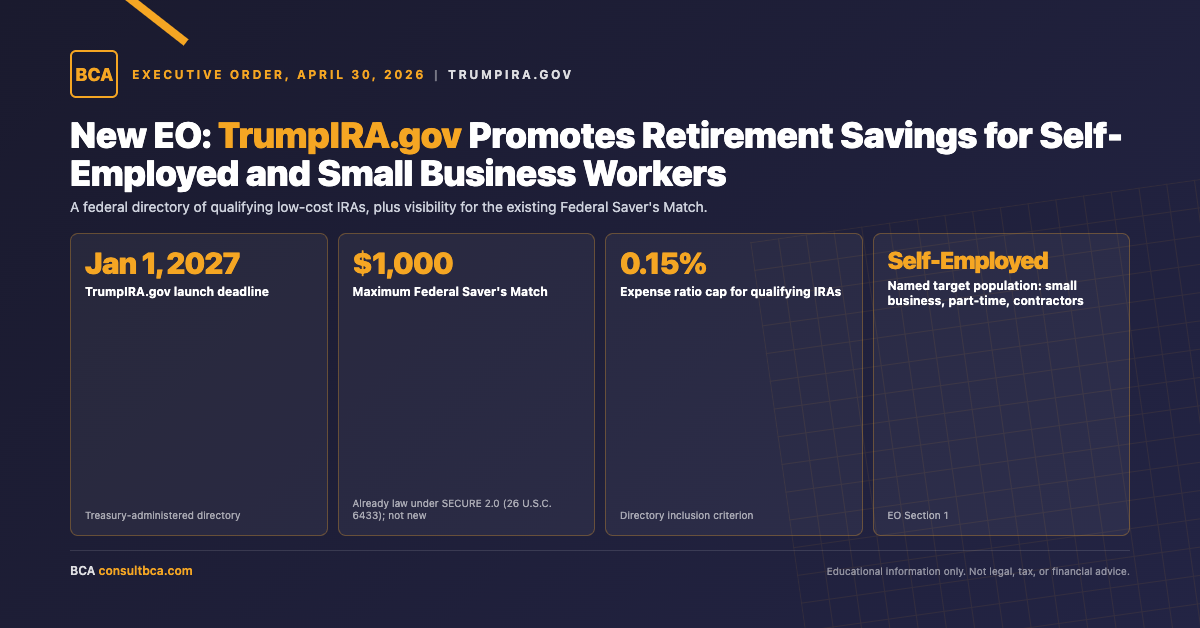
A directive to Treasury to build a federal website by January 1, 2027 that lists qualifying private-sector IRAs, explains the Federal Saver’s Match, and helps eligible savers find low-cost retirement accounts. The Order also directs guidance on tax-exempt organization contributions to worker IRAs, regulations to protect workers from prohibited transactions, and legislative recommendations to codify the policy. It creates no new account type, no new contribution limit, and no new tax shelter.
What is already law that the Order publicizes
The Federal Saver’s Match is the centerpiece. It has been on the books since SECURE 2.0 was enacted in December 2022 and is codified at 26 U.S.C. 6433.
The Match in plain English: the federal government contributes up to $1,000 directly into a qualifying retirement account (an IRA or, in some cases, an employer retirement plan) for each eligible saver each year, beginning with tax years after December 31, 2026. The $1,000 is calculated as 50% of the first $2,000 of qualifying retirement contributions made by the saver. The Match is paid into the account itself, not as a tax credit on the saver’s return.
Income eligibility: the Match phases out at moderate-income thresholds similar to the prior Saver’s Credit framework. The phase-out structure under 26 U.S.C. 6433 follows AGI-based tiers; the precise 2027 thresholds will be set under the implementing regulations. Single filers, head of household, and married filing jointly all have separate threshold tables. Married filing separately has narrower eligibility than the joint thresholds.
Saver’s Match versus prior Saver’s Credit: for tax years beginning before January 1, 2027, the prior Saver’s Credit (a nonrefundable tax credit on Form 8880) remained in place. SECURE 2.0 replaced the credit with the Match for tax years after 2026. The two are mechanically distinct: a credit reduces your federal tax liability; the Match deposits federal money into your retirement account. The Match is more valuable for low-income savers who would not have had enough tax liability to absorb the full credit under the old framework.
This was already true before April 30, 2026. The EO did not move the policy. It directed visibility and operational support.
What the Order actually adds
Five things the Order changes operationally:
1. A directory site. TrumpIRA.gov, run by Treasury, will list qualifying IRA products. This is curation, not regulation. Financial institutions are not required to participate. Eligible savers do not need TrumpIRA.gov to access either the Saver’s Match or the underlying IRAs; the Match is automatic for qualifying contributions to any eligible IRA.
2. The 0.15% expense ratio gate. To appear in the directory, an IRA product’s net expense ratio (operating + management + administrative costs combined) must be at or below 0.15%. This is a Treasury directive specific to directory inclusion. It is a useful lens for evaluating any retail IRA product, regardless of whether you ever use the federal site. The gate is met by total-market index funds at Vanguard (e.g., VTSAX at 0.04%), Fidelity zero-fee index funds (FZROX at 0.00%), and Schwab broad-market index funds (SWTSX at 0.03%). It is generally not met by advisor-sold proprietary fund products or many target-date funds at major brokerages, where expense ratios commonly run 0.50% to 1.20%.
3. Pending guidance on tax-exempt org contributions to worker IRAs (Section 4). This is the most novel piece of the Order for BCA-adjacent nonprofits. Section 4 directs Treasury and IRS to clarify the tax treatment of contributions made by tax-exempt organizations to IRAs maintained by workers in a charitable class, without jeopardizing the organizations’ tax-exempt status. Until the guidance issues, nonprofits considering this kind of program should document the contemplated contribution structure carefully but not implement it without confirming the framework against the eventual guidance.
4. Pending worker-protection regulations (Section 5). Treasury and DOL are directed to issue regulations protecting workers and preventing prohibited transactions under 26 U.S.C. 4975. The prohibited transaction rules already apply to IRAs; the directed regulations are about platform-specific protections.
5. Pending legislative recommendations (Section 6). Treasury is directed to prepare legislative recommendations to codify the policy. Until codification happens, the Order is reversible by future executive action.
The 0.15% expense ratio gate, in operator terms
For a self-employed saver who contributes $2,000 a year over 30 years and earns 6% nominal annualized return, the difference between a 0.15% expense ratio product and a 1.00% expense ratio product is roughly $20,000 to $25,000 of accumulated value at retirement. The gate is not an arbitrary number. It is a threshold below which expense drag is small enough that compounding does the work; above it, fees materially shave the saver’s outcome.
For BCA’s audience, three practical implications:
- Audit your current IRA product against 0.15%. If you hold an IRA at an advisor-sold platform with target-date funds running 0.50% or higher, the product would not qualify for TrumpIRA.gov. That is a signal to evaluate, not a verdict.
- The big-three index providers all have qualifying products today. Vanguard, Fidelity, and Schwab broad-market index funds all run below 0.15%. The constraint is on the wrapping IRA’s administrative cost, which at Vanguard, Fidelity, and Schwab is also at or below 0.15% for self-directed accounts.
- Robo-advisor IRAs vary. Wealthfront, Betterment, and similar platforms layer a management fee (typically 0.25%) on top of the underlying fund expenses. The combined net cost runs above 0.15% for most robo configurations, even with low-fee underlying funds.
The tax-exempt organization angle (Section 4)
This section is the one most reporters will skip. It is the one most worth flagging for BCA’s nonprofit and small-business clients with charitable-class employee benefits.
The question Section 4 raises: can a 501(c)(3), 501(c)(4), or other tax-exempt organization make direct contributions to the IRA of a worker who is a member of a charitable class the organization serves, without jeopardizing the organization’s tax-exempt status? The answer under current law is unclear; the IRS has not issued direct guidance on the specific question of IRA contributions as charitable-class benefits. Some structured benefit programs at faith-based and community organizations have effectively done this through employee compensation pathways, but the direct-IRA-contribution model is novel.
If you operate or advise a nonprofit that has a defined charitable class of beneficiaries who are also employees or service providers, and has been considering retirement-benefit contributions as part of the charitable mission, then Section 4 is worth tracking. Document the contemplated contribution structure now. Do not implement before guidance issues. When guidance does issue (expected sometime in 2026-2027), bring the structure to your tax counsel and BCA for review.
What is NOT in the Order
The Order does not:
- Create a new account type. It uses existing IRAs under 26 U.S.C. 408.
- Change IRA contribution limits ($7,500 for 2026, plus $1,100 catch-up for age 50+, for a total of $8,600 per IRS Notice 2025-67).
- Change the income thresholds for IRA deductibility or Roth contribution eligibility.
- Change the Saver’s Match (already enacted by SECURE 2.0).
- Require financial institutions to participate.
- Grant individuals or businesses any rights enforceable in court (Section 8(c)).
- Allocate any new federal money beyond what was already authorized for the Match.
What to do now
Three concrete actions, regardless of whether TrumpIRA.gov ever materially changes the landscape:
1. If you do not have an IRA, open one. The Saver’s Match becomes available for tax years after 2026. Contributions made in 2026 still earn under the prior Saver’s Credit framework on Form 8880. Contributions made in 2027 onward will earn the Match. Either way, you need an open account to participate. The 0.15% expense ratio gate is a good filter for the IRA you choose. Vanguard, Fidelity, and Schwab self-directed IRAs all meet the gate today.
2. If you already have an IRA, check the expense ratio. Pull the prospectus or statement; look up the underlying funds’ expense ratios. If the all-in cost (fund + admin) exceeds 0.50%, that is a planning conversation worth having. Switching IRA custodians is a transfer, not a withdrawal, and is not a taxable event.
3. If you are self-employed and your AGI is in the moderate-income range, model whether you would qualify for the Match in 2027 based on your projected income. The Match is up to $1,000 federal money into your account each year, separate from your contribution. For a self-employed person making $40,000 to $60,000 AGI (single), the Match is genuinely meaningful federal support that most BCA clients have not yet factored into retirement planning.
When to bring BCA in
Four planning conversations where the EO’s effects matter:
- You are self-employed and have not yet opened an IRA. BCA can advise on which product structure (Traditional, Roth, SEP, SIMPLE, Solo 401(k)) fits your tax situation and how the Saver’s Match interacts with each.
- You operate a small business and want to evaluate whether you should establish a SEP-IRA or SIMPLE plan for employees. The EO’s Section 6 legislative recommendations may eventually create a federally promoted IRA pathway that simplifies your setup; until then, the existing options are unchanged.
- You operate a tax-exempt organization with a defined charitable class. Section 4 guidance is pending; document any contribution structure now and revisit when guidance issues.
- You hold an IRA at an advisor-sold platform with expense ratios above 0.50%. BCA can model the cost difference of a transfer to a self-directed account at a lower-fee custodian.
BCA’s role is to advise and assist with business and compliance experience. The investment selection, the IRA setup, and the federal-tax filings stay yours; we are not a tax preparer or licensed financial advisor.
Key Takeaways
- The April 30, 2026 Executive Order establishes TrumpIRA.gov, a federal directory of qualifying private-sector IRAs, scheduled to launch by January 1, 2027.
- The Federal Saver’s Match (up to $1,000 federal contribution to qualifying retirement accounts) is already law under SECURE 2.0 and codified at 26 U.S.C. 6433. The Match becomes available for tax years after 2026.
- The 0.15% net expense ratio gate is a Treasury directive for directory inclusion. Vanguard, Fidelity, and Schwab self-directed IRA products meet it today; many advisor-sold platforms do not.
- Section 4 of the Order opens a real new compliance question for tax-exempt organizations contributing to worker IRAs as part of their charitable mission. Guidance is pending.
- The Order is reversible by future executive action unless legislatively codified (Section 6).
- BCA’s earlier May 1 news brief covered the EO procedurally; this post is the operator-level analysis.
Download the Self-Employed Retirement Strategy Worksheet (PDF)
A printable one-page sheet that sorts what the TrumpIRA.gov EO actually changes from what was already law, with an action checklist and a fillable IRA-audit table.
Educational information only, not licensed legal, tax, or financial advice. We refer to and partner with licensed professionals when personalized advice is needed. Laws change; no warranty of accuracy or timeliness.
Sources
- The White House. “Promoting Retirement-Savings Access for American Workers by Establishing TrumpIRA.gov.” Executive Order, April 30, 2026.
- SECURE 2.0 Act of 2022, Public Law 117-328, Division T.
- 26 U.S.C. 6433 (Federal Saver’s Match).
- 26 U.S.C. 408 (Individual Retirement Accounts).
- 26 U.S.C. 4975 (Prohibited Transactions).
- IRS Publication 590-A (Contributions to Individual Retirement Arrangements).
- IRS Form 8880 (Credit for Qualified Retirement Savings Contributions, the Saver’s Credit predecessor).
- 29 C.F.R. 2550.404c-5 (Qualified Default Investment Alternatives under ERISA).
- Tax Foundation SECURE 2.0 analysis (independent Tier 2 corroboration of Saver’s Match mechanics).
- Vanguard, Fidelity, and Schwab published expense-ratio data for self-directed IRA products.
- IRS Notice 2025-67, “2026 Retirement Plan Contribution Limits.”
- BCA, “Trump Signs Executive Order Establishing TrumpIRA.gov.” May 1, 2026. https://consultbca.com/regulatory-feed/trump-ira-executive-order-saver-match-news/
This information is provided for general educational purposes and reflects opinions based on experience. Individual circumstances may vary. The Executive Order has been signed but the TrumpIRA.gov website and its implementing regulations have not yet been issued; descriptions here are based on the Order’s text. Federal Saver’s Match eligibility depends on the saver’s AGI, filing status, and contribution amount under 26 U.S.C. 6433; the precise 2027 thresholds will be set under implementing regulations and may differ from the prior Saver’s Credit framework. The 0.15% expense ratio gate is a Treasury directive specific to directory inclusion, not a statutory requirement. Specific brokerage product references in this post are illustrative only and not investment recommendations. BCA advisors bring business and compliance experience to help you evaluate retirement-savings options against your specific situation; we are not a tax preparer or licensed financial advisor, and the IRA structure and investment selection decisions stay yours.
Leave a Reply
You must be logged in to post a comment.